E-Invoicing in Oman:
2027 Mandate, Fawtara & Peppol
Last update: 2026, October 19
Summary
Oman is implementing an e-invoicing mandate in 2027 covering all transactions countrywide. The obligation revolves around the Peppol network and Accredited Service Providers.
B2G & B2B & B2C Transactions
Mandatory phased e-invoicing from 2027
E-invoicing will progressively become mandatory in 2027 following a pilot in 2026, and the model will rely on the Peppol network, following a five-corner model, with invoice data automatically reported to Oman Tax Authority’s platform called Fawtara.
Oman
Table of Contents
What the Law Says
B2G & B2B E-Invoicing
E-invoicing is gradually becoming mandatory in Oman through the Peppol network and accredited service providers.
The mandate in Oman is being led by the Oman Tax Authority (OTA), which is responsible for defining its framework and technical guidelines [↗︎].
The OTA became a Peppol Authority in January 2026 and opted for a 5-corner model based on the Peppol network and the PINT-OM format, while maintaining a degree of centralisation. This includes a single centralised SMP, mandatory local establishment requirements and the accreditation of Peppol service providers.
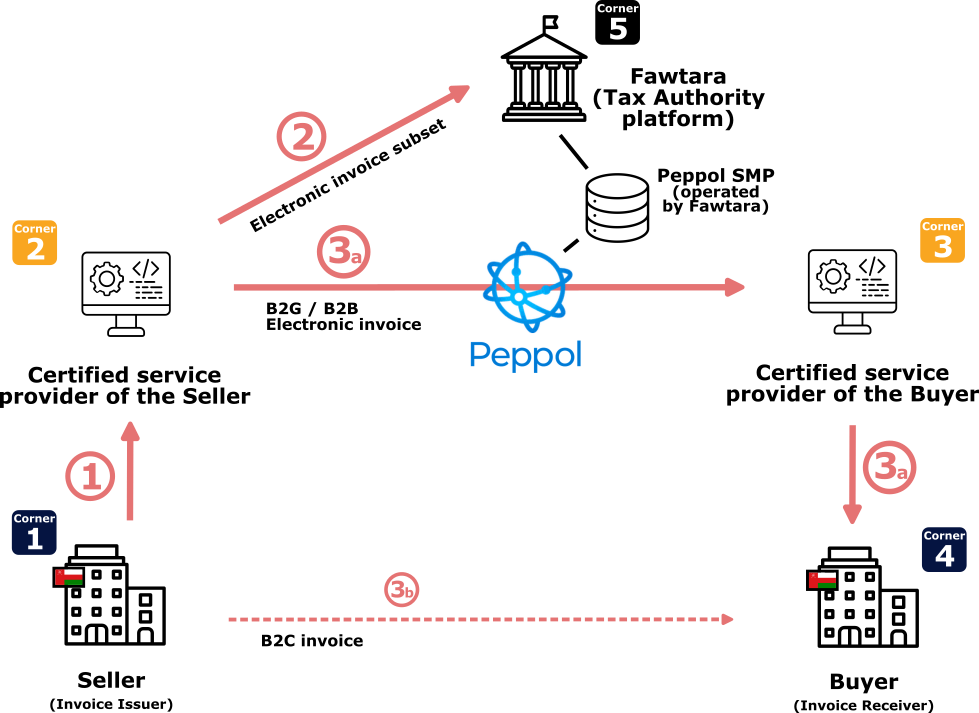
The chosen model also involves a central platform called Fawtara, which will act as the 5th corner of the mandate. Businesses will exchange electronic invoices through their respective accredited service providers, which will also transmit relevant invoice tax data to Fawtara.
Following a pilot phase launched in August 2026 with 100 selected large taxpayers, the mandate is being rolled out for B2G and B2B transactions according to the following timeline:
- April 1, 2027: mandatory e-invoicing for taxpayers with annual taxable supplies in Oman above OMR 5 million (approximately €11.5 million).
- October 1, 2027: mandatory e-invoicing for the remaining VAT-registered taxpayers.
The requirements were introduced under Decision No. 189/2026 [↗︎]. Some technical and operational details may still be clarified as implementation progresses.
The OTA’s initial rollout plan also envisaged a final phase for public entities issuing invoices in G2G and G2B transactions. Its implementation date and its relationship with the revised timeline have not yet been confirmed.
Invoices must generally be archived for ten years.
B2C E-Invoicing
E-invoicing is gradually becoming mandatory in Oman for B2C transactions, with invoice data to be electronically reported by accredited service providers to the Fawtara central platform via the Peppol network.
The Oman Tax Authority (OTA) has confirmed in an official FAQ [↗︎] that the upcoming e-invoicing mandate for B2G & B2B transactions will also include B2C transactions, with the same deadlines:
- April 1, 2027: mandatory e-invoicing for taxpayers with annual taxable supplies in Oman above OMR 5 million (approximately €11.5 million).
- October 1, 2027: mandatory e-invoicing for the remaining VAT-registered taxpayers.
Businesses will have to select an accredited service provider, in order to issue their B2C invoices electronically in PINT-OM format, and to transmit relevant data to the Fawtara central platform for tax reporting purposes.
Invoice delivery to the final customer remains the issuer’s responsibility, who will usually choose a readable invoice format, such as PDF or paper. Those invoices must include a QR code allowing the recipient to verify that the invoice was properly validated by the tax administration.
The B2C obligation however currently lacks important official guidance and specifications, that should be released shortly. Among the open topics, it appears that the obligation will apply to B2C invoices and B2C simplified invoices, but it’s not clear whether it will apply to POS receipts.
Invoices must generally be archived for ten years.
Timeline
E-invoicing mandate - Pilot phase
The e-invoicing mandate begins with 100 selected large VAT-registered companies
E-invoicing mandate Phase 1 - Large Companies
E-invoicing becomes mandatory for large VAT-registered companies
E-invoicing mandate Phase 2 - Remaining Companies
E-invoicing becomes mandatory for all remaining VAT-registered taxpayers
E-invoicing mandate Phase 3 - Public Entities
E-invoicing mandate extends to the public sector, and thus to G2G, G2B and G2C transactions
Latest E-Invoicing News in Oman
E-invoicing Compliance in Oman: The Complete Guide
Technical Details
E-invoicing in Oman will become mandatory countrywide in 2027 for all transactions within scope (B2G, B2B and B2C). The model revolves around accredited service providers that will exchange invoices through the Peppol network and report corresponding tax data to the Fawtara central platform.
Peppol at the core of the mandate
Oman has selected the Peppol network as its national approach for transmitting e-invoices, in a five-corner configuration. The Oman Tax Authority (OTA) acts as the Omani Peppol Authority, overseeing Oman’s implementation of the network and supporting its use across the country.
Under the mandate, businesses in scope must use an accredited service provider in order to exchange documents with each other, as well as with the tax authority’s central platform, “Fawtara”, which acts as the “Corner 5” of the model.
A specific feature of the Peppol implementation in Oman is the establishment of a centralised SMP (Service Metadata Publisher) operated by OTA. As a result, service providers will not be permitted to operate their own SMPs to register the receiving capabilities of Omani taxpayers.
Businesses must also connect with their chosen service provider through the Fawtara portal [↗︎]. They can select an accredited provider and submit a connection request, which the provider can then accept or reject.
Invoice format
The mandate strictly requires suppliers to issue their invoices electronically for all types of transactions: B2G, B2B and B2C.
More specifically, e-invoices must be issued in the PINT-OM format [↗︎], the Omani extension of the Peppol International standard, and comply with the official data dictionary and business rules.
B2G & B2B invoice delivery
For B2G & B2B scenarios, the Seller’s service provider (“Corner 2”) is responsible for delivering the electronic invoice to the final customer, through the Customer’s service provider (“Corner 3”) via the Peppol network.
The Seller’s service provider will also automatically extract and transmit the relevant invoice tax data to Fawtara.
B2C invoice delivery
For B2C transactions, the seller issues an electronic invoice in PINT-OM format and submits it to its accredited service provider. The provider validates the invoice and transmits the relevant tax data to Fawtara. The invoice itself does not need to be delivered to the buyer through a second service provider.
Instead, the seller delivers a readable version directly to the customer, typically on paper or as a PDF. This version must include a QR code generated by the seller.
The QR code is intended to help verify the invoice’s authenticity. The technical rules for generating the QR code are described in the Peppol Oman architecture [↗︎].
However, several aspects of the B2C obligation still need clarification from the OTA, including the applicable reporting deadline, certain QR code requirements, and if invoice tax data must be reported to Fawtara before the invoice is delivered.
Accredited Service Providers
Exchanging e-invoices on the Peppol network usually relies on Access Points: e-invoicing service providers that are members of and are connected to the Peppol network.
However, in Oman, as in multiple other countries, the local Peppol Authority (here: Oman Tax Authority) requires those Peppol Access Points to be officially accredited.
The OTA has set several key requirements [↗︎] to certify service providers, such as the ISO 27001 certification, or the particularly restrictive obligation to be commercially registered in Oman.
An official list of accredited service providers [↗︎] is available. Accreditations are still in progress, and service providers are free to submit their application [↗︎]. Businesses with sufficient IT resources also have the possibility to become their own provider, if they manage to get accredited.
The Invoicing Hub Word
Oman
A major e-invoicing wave is sweeping across the Middle East, and Oman is joining the movement. The country has chosen an approach inspired by the neighbouring UAE: a 5-corner model relying on the Peppol network.
This strategy will give the tax authority access to invoice data while enabling companies to leverage e-invoicing automation for B2B and B2G processes. For B2C transactions, the emphasis appears to be on ensuring a smooth experience for consumers in their everyday activities.
The first phase, a pilot involving 100 selected large taxpayers, should help clarify and refine the requirements, as many aspects of the mandate remain unclear for the time being.
One concern is the OTA’s requirement for service providers to be commercially registered in Oman to obtain accreditation and offer compliant e-invoicing services. This seems at odds with the objective of promoting a global network such as Peppol and could create unnecessary complexity for companies conducting domestic and international trade.
It will be interesting to see whether Oman follows the UAE’s example, which recently lifted similar location-based restrictions.
Get your Project Implemented
Gold Sponsor
Trusted by 5,000+ leading businesses, our platform powers tax compliance, e-invoicing, accounts payable, and real-time reporting across 50+ countries.
By combining intelligent automation, deep regulatory expertise, and enterprise-grade technology, we enable CFO offices to reduce complexity, improve accuracy, and stay ahead of evolving compliance mandates.
From India to global markets, including the EU, GCC, and SEA, ClearTax helps organizations operate with greater efficiency, visibility, and confidence.
Silver Sponsors
Official Resources [↗︎]
Tax authority supervising e-invoicing in Oman
Official e-invoicing mandate homepage, with FAQ
Official specifications of the e-invoicing mandate relying on Peppol architecture
Draft technical specifications of the Oman implementation of the Peppol INTernational (PINT) invoice format
Directory of e-invoicing solutions accredited by the OTA
Central platform operated by OTA
Related Resources
Advertisement
Latest News
New accreditation requirements for e-invoicing solutions in the Philippines
BMF publishes additional guidance on mandatory German e-invoicing
Peppol & GENA e-invoicing conferences in Singapore – 17-19 November 2026
Spain’s B2B e-invoicing mandate will start in October 2027
Greece slightly postpones the next phases of its mandates
📩 Newsletter
Receive the latest e-invoicing news, directly in your mailbox, once a month.