E-Invoicing in Ireland
Last update: 2026, May 26
Summary
B2G
Allowed
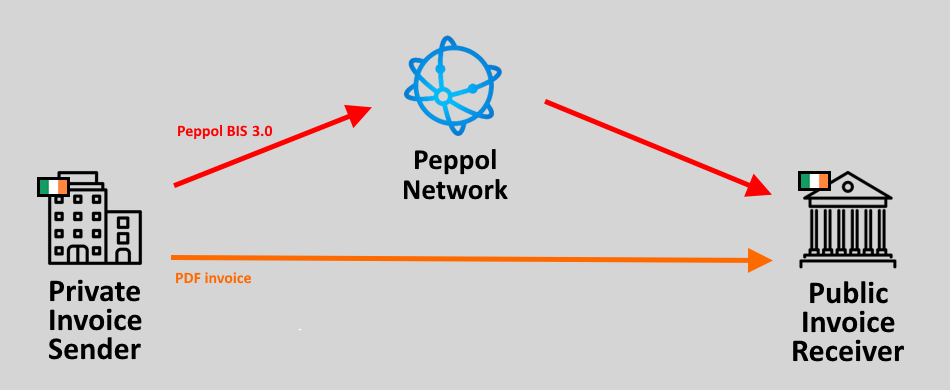
All Irish public administrations are able to receive and process electronic invoices compliant with the EN 16931 from their suppliers. The encouraged method is via the Peppol network in Peppol BIS 3.0 format.
B2B
Not mandatory
E-Invoicing is allowed, and will become mandatory in the coming years (2028-2030) in anticipation of the ViDA directive.
Ireland
Table of Contents
What the Law Says
B2G E-Invoicing
On June 2019, Ireland made it mandatory for all public entities to be able to receive and process electronic invoices through Statutory Instrument 258/2019 [↗︎]. However, the Irish Tax & Customs Authority (Revenue) didn’t make it mandatory for suppliers of those public administrations to issue e-invoices.
From a regulatory perspective, invoices can still be issued using several methods, mainly:
- PDF invoices with e-signature or complete audit trail
- Electronic invoices compliant with the European Norm (EN) 16931, through the Peppol network that Irish authorities have decided to rely on, more specifically in the Peppol BIS 3.0 format
B2B E-Invoicing
From a regulatory perspective, invoices can still be issued using several methods:
- Paper-based invoices
- PDF invoices with e-signature or complete audit trail
- Electronic invoices in any format, as long as there’s a mutual agreement between both parties
Although there is currently no legal obligation to issue e-invoices, Ireland announced in October 2025, after a public consultation [↗︎], its intention to implement an electronic invoicing & reporting obligation in 3 phases, as part of a VAT modernisation action plan [↗︎] and in anticipation of the ViDA directive.
The current timeline, yet to be officially confirmed, is planned as follows:
- November 2028: mandatory B2B e-invoicing reception for all businesses, and mandatory issuance & e-reporting for large companies
- November 2029: mandatory domestic B2B e-invoicing issuance & e-reporting for all businesses involved in EU cross-border B2B trade
- July 2030: full ViDA compliance, with mandatory cross-border e-invoicing & e-reporting for intra-EU transactions
The Irish Tax and Customs Authority (Revenue) indicated that it has started in-depth analysis and technical preparations covering the legislative changes, as well as the strategic, operational, and IT system requirements needed for successful implementation.
Timeline
B2G mandatory in reception
All public administrations in Ireland must be able to receive and process electronic invoices (but there is no issuance obligation for the suppliers)
B2B e-invoicing mandate phase 1
E-invoicing should become mandatory in reception for all companies, and in emission for large companies
B2B e-invoicing mandate phase 2
E-invoicing issuance and reception should become mandatory for all companies involved in EU B2B trade
B2B e-invoicing mandate phase 3
Full ViDA compliance: cross-border e-invoicing & e-reporting within the EU
Technical Details - B2G
In Ireland, all businesses may issue electronic invoices compliant with the EN 16931 standard when invoicing public sector customers.
All Irish public entities are required to be able to receive electronic invoices through the Peppol network, with the Office of Government Procurement (OGP) serving as Ireland’s Peppol Authority.
The standard currently in use is Peppol BIS Billing 3.0, complemented by an Irish Core Invoice Usage Specification (EI-CIUS). The OGP has also published detailed implementation guidelines [↗︎], including a list of mandatory and optional invoice fields.
Technical Details - Upcoming B2B Obligation
E-Invoice Format
The VAT Modernisation action plan [↗︎] published on October 2025 doesn’t specify the e-invoice format that would have to be used. Detailed guidance and technical specifications is expected to be published by Revenue “well in advance of each implementation phase”.
Stakeholders recommended, in the report on the initial Public Consultation process [↗︎] (June 2024), for digital reporting to be aligned with EN 16931. It has also be outlined, as a suggestion, that to ensure a successful e-invoicing implementation, “unnecessary strict definitions or the exclusive adoption of particular standards or technologies, particularly with regards to B2B relationships”, shouldn’t be adopted, but at the same time that “the technical structure of e-invoices required for domestic transactions should be consistent with those required for crossborder transactions under ViDA”.
Ireland may decide to, at least, implement Peppol BIS / PINT-EU format, under its next 4.0 release taking into account the recent EN16931 evolutions. Additional formats may potentially also be allowed if compliant with the European standard and under specific conditions.
As of today, Peppol BIS Billing 3.0 format, while not mandatory for B2G transactions, is already highly encouraged.
E-Invoice Delivery
While further technical guidelines are being analysed by Revenue, the new mandate should mainly be based on the Peppol Network, already used by Irish public entities for B2G e-invoicing since 2019.
In that aspect, Revenue is working closely with OGP, Ireland’s Peppol authority to prepare the implementation of the B2B e-invoicing mandate, domestic and cross-border EU transactions, through an expansion of the Peppol network usage.
The use of an alternative e-invoice delivery method, other than the standard Peppol network, may also be allowed, notably by capitalizing on “various existing technical infrastructures”.
The Invoicing Hub Word
Ireland
Like many Northern European countries, Ireland has implemented Directive 2014/55/EU, which requires EU Member States to support B2G electronic invoicing. More specifically, Ireland adopted the least restrictive approach by requiring public entities to be capable of receiving electronic invoices compliant with EN 16931, without imposing an obligation on suppliers to issue e-invoices.
With the upcoming implementation of the ViDA directive, expected by 2030, Ireland is now actively preparing the introduction of a B2B e-invoicing mandate, following a path similar to that of the UK and the Netherlands.
This future framework is expected to rely heavily on the Peppol network and to be introduced progressively from the end of 2028 onward.
Ireland’s approach appears pragmatic and carefully structured. By leveraging Peppol, the country should be well positioned to ensure compliance with ViDA requirements while also facilitating both domestic and cross-border trade for Irish businesses. This model is expected to deliver benefits for both companies and public authorities alike.
Additional Resources [↗︎]
Homepage of the Irish Tax & Customs Authority
Irish Peppol Authority
Collection of useful information provided by the Office of Government Procurement
Official resources on the upcoming B2B e-invoicing mandate
Entire set of official Peppol BIS 3.0 specifications
Official directory of worldwide Peppol-ready businesses
Get your Project Implemented
Gold Sponsor
Silver Sponsors
Latest News
E-invoicing Compliance in Oman: The Complete Guide
New technical specifications and ViDA impact in Italy
France’s JFE 2026 and the latest official e-invoicing specifications
UAE extends ASP appointment deadline to October 2026
📩 Newsletter
Receive the latest e-invoicing news, directly in your mailbox, once a month.