E-Invoicing in Colombia:
DIAN Clearance, UBL format & CUFE
Last update: 2026, September 18
Summary
Colombia operates a countrywide e-invoicing mandate based on a Clearance model. All invoices must be validated by DIAN (Colombia’s tax authority) before they can be delivered to their recipients.
B2G & B2B & B2C Transactions
Mandatory e-invoicing
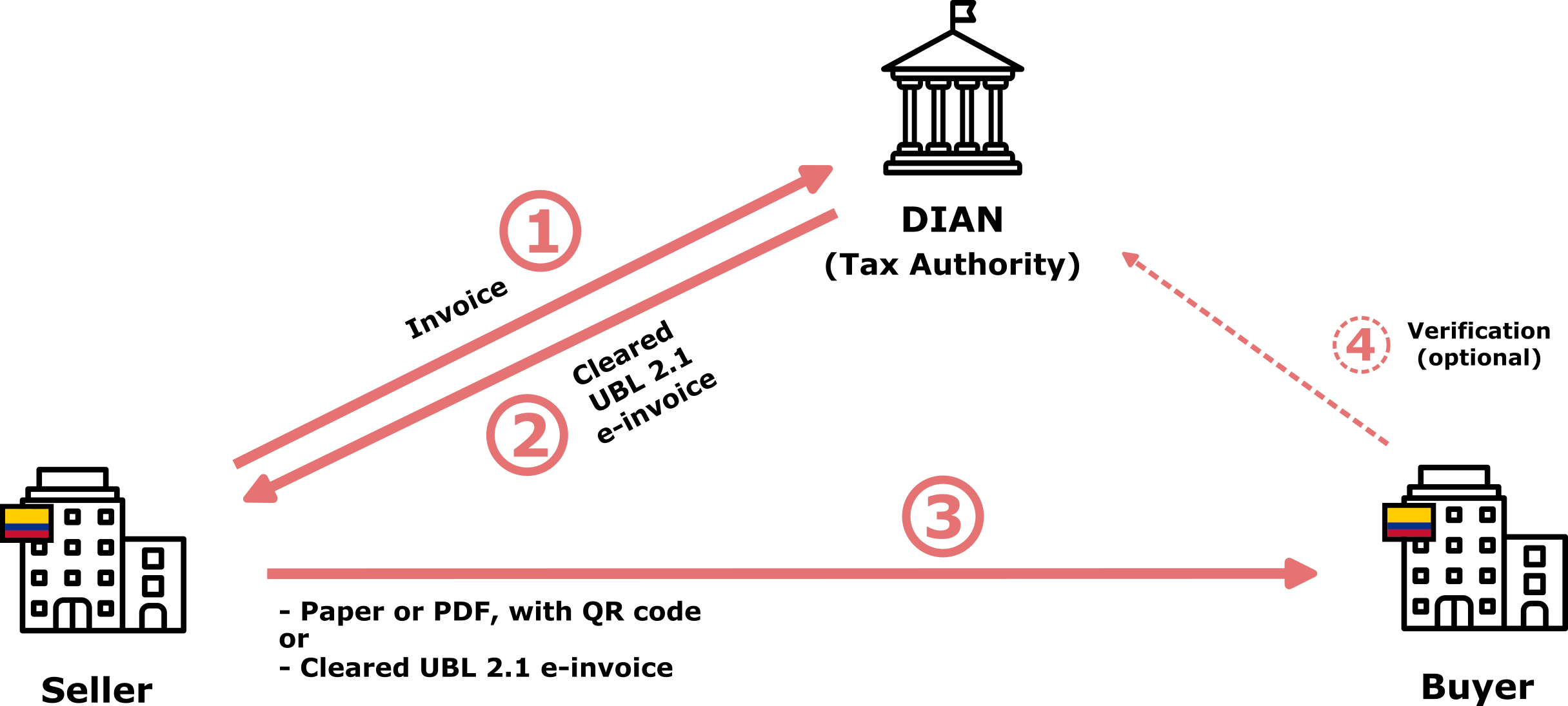
All invoices must be submitted to DIAN for clearance in a proprietary format based on UBL 2.1. Once validated, the supplier must send to the recipient either the electronic UBL invoice, or a readable version (PDF or paper) containing a QR code.
Colombia
Table of Contents
What the Law Says
B2G & B2B & B2C E-Invoicing
The Colombian e-invoicing mandate applies to all transactions countrywide: B2G (business-to-government), B2B (business-to-business) and B2C (business-to-consumer).
It operates through a Clearance model managed by Colombia’s tax authority, DIAN (Dirección de Impuestos y Aduanas Nacionales). Its regulatory framework is set out in the Decree 358 of March 5, 2020 [↗︎] and DIAN Resolution 227 of 2025 [↗︎].
Under this model, invoices must be issued in a local format based on UBL 2.1, digitally signed and submitted to DIAN’s central platform for validation, either through its free online tool or through a certified provider.
DIAN verifies the technical requirements, but the issuer remains responsible for the invoice’s accuracy, legal compliance and delivery to the intended recipient.
Once validated, the issuer may send:
- The electronic UBL invoice, including its CUFE (Unique Code of Electronic Invoice) assigned by DIAN, which uniquely identifies it for verification purposes
- Or a readable version of the invoice in PDF or paper form, which must include a QR code allowing recipients to verify the invoice through the DIAN portal
Invoices must generally be archived for five years.
Timeline
E-invoicing mandatory for large companies
E-invoicing issuance becomes mandatory for large companies
E-invoicing mandatory for public entities
E-invoicing issuance becomes mandatory for public entities
E-invoicing fully mandatory
The Colombian e-invoicing mandate extends to all VAT-registered businesses and for all types of transactions (B2G, B2B, B2C)
Electronic POS receipts
Colombia progressively extended electronic clearance obligation through DIAN's platform to points of sale (POS) receipts
Latest E-Invoicing News in Colombia
Technical Details
Colombia requires electronic invoices to be cleared through DIAN’s central platform. Once validated, the supplier remains responsible for delivering the invoice to the recipient, and the invoice must contain a proof of DIAN’s validation.
DIAN Registration Process
In Colombia, businesses that wish to issue electronic invoices must go through a formal process of registration, testing, and enablement. This process is overseen by Colombia’s tax authority, DIAN (Dirección de Impuestos y Aduanas Nacionales), and is described in its detailed registration and enablement process [↗︎].
This process ensures that the taxpayer is fully compliant with the legal and technical requirements of the country’s electronic invoicing system.
The first step for each company is registering with DIAN through the Unique Tax Registry (RUT) [↗︎]. This registration identifies the taxpayer as a potential electronic invoice issuer. As part of this stage, the taxpayer must:
- Obtain a digital certificate to sign invoices securely
- Select a certified software provider or use DIAN’s free invoicing tool, ensuring the system is capable of generating, transmitting, and receiving electronic documents according to DIAN’s specifications.
The taxpayer must also provide their unique receiving inbox email address, which will be used to receive invoices in their role as an invoice recipient.
After registration, taxpayers enter a testing phase. Upon successful completion, DIAN grants formal enablement, issuing a Notification of Enablement and a Número de Autorización de Numeración (NAN). This authorizes the taxpayer to legally issue electronic invoices and requires ongoing compliance with all related obligations.
Invoice Format, CUFE and Signature
Colombia requires e-invoices to follow an electronic format based on UBL 2.1 [↗︎] with mandatory local extensions. These additions include specific tax and identification fields required by DIAN.
The invoice must include a unique invoice identifier called the CUFE (Código Único de Factura Electrónica), calculated by the invoicing solution from the invoice data and a technical control key provided by DIAN, and populated into the UUID field.
The UBL invoice must then be digitally signed, using the certificate set up during the DIAN registration process, in order to ensure authenticity and data integrity.
Invoice Clearance through DIAN's Platform
Before delivering an invoice to its recipient, the supplier must submit the signed UBL invoice to DIAN for prior validation.
The invoice can be submitted through one of the following methods:
- DIAN’s free invoicing service [↗︎]
- The supplier’s own invoicing software
- An Authorised Technology Provider
DIAN then automatically checks whether the invoice meets the applicable technical and mandatory data requirements.
If the invoice is accepted, DIAN returns a validation response and the invoice becomes valid for delivery to the recipient. If it is rejected, the supplier must correct the identified errors and submit it again.
Invoice Delivery by the Supplier
Under Colombia’s clearance model, the supplier is responsible for delivering the invoice validated by DIAN to its intended recipient.
The supplier may deliver the invoice in one of two ways:
- The validated UBL invoice in its original electronic format, in which case the electronic transmission must also include DIAN’s validation response in an electronic container, as required by DIAN Resolution 165 of 2023 [↗︎].
- A readable version of the invoice (PDF or paper), that must include a QR code allowing the recipient to verify that the invoice was properly cleared.
The second option remains common in Colombia and is particularly practical for recipients that are not equipped to process structured electronic invoices.
Receipt and Acceptance by the Buyer
The recipient must have a receiving inbox email address, which is the default method to receive invoices and can be used to receive electronic or PDF invoices. This address is set up by all Colombian businesses during the initial registration process with DIAN.
After reception, the recipient can verify that an invoice was cleared by DIAN either through the validation response included in the electronic container or through the QR code shown on the readable invoice. The QR code directs the recipient to the DIAN verification service [↗︎].
The recipient may then send a formal acknowledgment of receipt. If no commercial rejection is issued within 3 working days, the invoice is considered tacitly accepted by default, as explained in DIAN’s guidance [↗︎].
Authorised Technology Providers
Many companies will rely on certified providers to manage the entire clearance process, including invoice creation, signature, validation, and delivery.
These authorised technology providers [↗︎] must be certified by DIAN to operate legally in the country. The certification process involves system testing to ensure compliance with DIAN’s technical standards and is open to both local and international companies that meet all necessary requirements.
An official list of certified e-invoicing service providers in Colombia [↗︎] is available and is maintained by DIAN.
It is important to note that using an authorised technology provider does not exempt companies from completing their own registration with DIAN. Businesses must still register to obtain authorization to issue e invoices and receive the digital certificate needed for signing.
The Invoicing Hub Word
Colombia
As in many Latin American countries, e-invoicing is mandatory in Colombia and follows a clearance model.
This system ensures that all invoices are validated by the tax authority before being sent to recipients, guaranteeing their authenticity, integrity, and traceability. It also simplifies verification for recipients (through a unique identifier, an electronic validation proof or a QR code), who can be confident the invoices they receive have already been approved by DIAN.
What sets Colombia apart from countries like Mexico is its openness to international e-invoicing service providers. Foreign providers are allowed to go through DIAN’s certification process, enabling global companies to work with familiar partners and easing their compliance efforts under Colombian regulations.
For smaller local businesses, DIAN offers a free e-invoicing tool. While limited in features, automation, and scalability, it provides a practical solution for most small enterprises and supports widespread compliance across the country.
Get your Project Implemented
Gold Sponsor
Silver Sponsors
Official Resources [↗︎]
Tax authority supervising e-invoicing in Colombia
DIAN’s e-invoicing homepage, resources and FAQs
Guidelines, specifications, schematrons, validation artefacts, and more
Official directory of service providers authorised by DIAN
Official guidance on registration, testing and enablement with DIAN
DIAN’s free online tool to submit e-invoices designed for micro & small companies
Official verification tool allowing to confirm an invoice’s validity through its CUFE or UUID
Related Resources
Latest News
New accreditation requirements for e-invoicing solutions in the Philippines
BMF publishes additional guidance on mandatory German e-invoicing
Peppol & GENA e-invoicing conferences in Singapore – 17-19 November 2026
Spain’s B2B e-invoicing mandate will start in October 2027
Greece slightly postpones the next phases of its mandates
📩 Newsletter
Receive the latest e-invoicing news, directly in your mailbox, once a month.