Skip to content

Advertisement

Become a gold sponsor - stacked
Contact us to learn about our sponsorship plans

E-Invoicing in Denmark:
NemHandel, Peppol & Bookkeeping Act

Last update: 2026, September 22

Summary

Denmark has required structured e-invoicing for B2G transactions since 2005, using the national NemHandel infrastructure. More recently, the Bookkeeping Act requires in-scope businesses to use digital bookkeeping systems that can receive and process structured electronic invoices.

B2G Transactions

Mandatory e-invoicing

Suppliers to Danish public authorities must send structured electronic invoices through the NemHandel infrastructure, using the local OIOUBL 2.1 format or Peppol BIS.

B2B Transactions

Mandatory e-invoicing reception capability

Businesses within the scope of the Bookkeeping Act must use digital bookkeeping systems able to receive and process structured electronic invoices. This does not require every B2B invoice to be issued electronically, but it makes e-invoice reception compulsory in practice for covered businesses.

B2C Transactions

No e-invoicing obligation

No e-invoicing or e-reporting obligation applies to business-to-consumer transactions in Denmark.

Denmark

Table of Contents

What the Law Says

B2G E-Invoicing

Suppliers must send structured electronic invoices when invoicing Danish public administrations since 2005, under the Executive Order on Electronic Settlement with Public Authorities [↗︎].

Denmark has implemented a central platform called “NemHandel” to enable the sending & reception of e-invoices, but it is also possible to use the Peppol network as it is interconnected with the NemHandel platform.

E-invoices must be sent either in Peppol BIS 3.0 format (compliant with the EN 16931) or in the local OIOUBL 2.1 format.

Invoices must generally be archived for five years.

B2B E-Invoicing

Denmark does not impose a general B2B e-invoicing obligation, but mandates in practice e-invoicing reception.

Businesses may agree to exchange invoices in any format accepted by both parties, including:

  • Paper invoices
  • PDF invoices sent by email
  • EDI, including established formats such as EDIFACT
  • Structured electronic invoices sent through the Peppol network or NemHandel

Additionally, the Bookkeeping Act [↗︎], published in May 2022 and overseen by the Danish Business Authority (ERST) [↗︎], requires most Danish businesses to use a digital bookkeeping system.

This obligation was implemented in 4 phases between July 2024 and January 2026. It now applies to:

  • Businesses required to prepare annual accounts
  • Other businesses, including financial and personally owned companies, whose annual net turnover exceeded DKK 300,000 (~ €40K) in each of the two preceding income years

Businesses in scope may use a system registered with ERST or develop their own compliant solution. In either case, the system must support the automatic sending and receiving of structured electronic invoices and credit notes. It can be done through the Danish NemHandel infrastructure, which is interconnected with the Peppol network, in line with the official requirements for digital bookkeeping systems [↗︎].

The Bookkeeping Act therefore creates a practical obligation for covered businesses to be capable of receiving e-invoices, but it does not require every domestic B2B invoice to be issued electronically, and no e-reporting obligation currently applies.

Invoices must generally be archived for five years.

B2C E-Invoicing

Denmark does not have a B2C e-invoicing or e-reporting mandate.

Companies may continue to issue business-to-consumer invoices and receipts through their usual channels, including paper invoices, PDF invoices sent by email and printed receipts.

Timeline

B2G e-invoicing mandatory

B2G e-invoicing becomes mandatory for all companies sending invoices to public administrations, through the NemHandel infrastructure.

EN 16931 mandatory acceptance for B2G

Danish public authorities must be able to receive and process EN 16931-compliant electronic invoices.

Bookkeeping Act - Medium & Large Companies with Certified Software

Medium & large companies, that opt for a certified accounting software, are now in practice able to receive electronic invoices.

Bookkeeping Act - Medium & Large Companies with Own Software

Medium & large companies, that develop their own software, are now in practice able to receive electronic invoices.

Bookkeeping Act - Most Companies

Most companies in Denmark are now in practice able to receive electronic invoices, except those with an annual turnover < 300,000 DKK.

OIOUBL 3.0 cancelled

 ERST cancels the planned OIOUBL 3.0 invoice format rollout and announces work towards a single future standard.

2005
2019
July 1, 2024
January 1, 2025
January 1, 2026
Jan 14, 2026

Latest E-Invoicing News in Denmark

Photo of the European Parliament, gathered within the European Commission in Brussels, capital of Belgium

European Commission calls for public input to shape the future of EU e-invoicing

A “Reality Check” event and a public consultation launched by the European Commission aim to shape EU e-invoicing by gathering feedback.

Photo of the tower of Christiansborg castle in Copenhagen, capital of Denmark

Denmark details plans for a new Nemhandel BIS 4 e-invoicing standard

After announcing the cancellation of OIOUBL 3.0, Denmark presented at the Nemhandel Forum the new standard and e-invoicing roadmap.
Set of flags from around the world waving in the wind

EN 16931 update: the next step in e-invoicing is on its way

With the EU shifting from public e-invoicing mandates to full B2B, the EN 16931-1 update will arrive mid-2026 to raise compliance standards.

Technical Details

Denmark’s e-invoicing framework relies on the NemHandel / Peppol infrastructure for B2G exchanges, while B2B businesses covered by the Bookkeeping Act must use systems capable of sending and receiving structured electronic invoices. However, B2B e-invoicing itself is not mandatory, and companies may still exchange those invoices on paper, by PDF or in a structured electronic format.

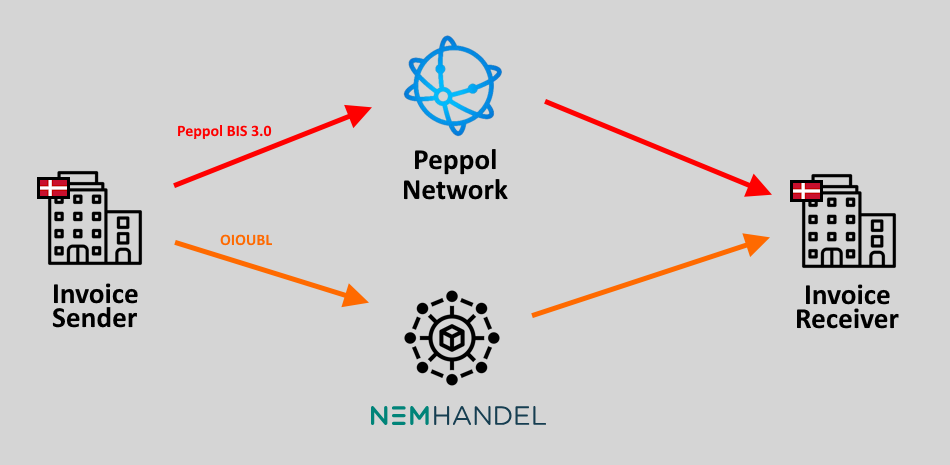
Schema of the Denmark e-invoicing landscape through the NemHandel platform and the Peppol network
Denmark’s e-invoicing infrastructure: NemHandel / Peppol

E-invoice format

For structured electronic exchanges, Denmark currently supports two main invoice formats:

  • OIOUBL 2.1, the Danish national format used for domestic exchanges through NemHandel.
  • Peppol BIS Billing 3.0, which can be used for both domestic and cross-border exchanges through the Peppol network.

Under the Bookkeeping Act, ERST (Danish Business Authority) requires businesses to use systems capable of sending and receiving structured electronic invoices [↗︎].

However, B2B e-invoicing remains voluntary, and trading partners are free to agree on other formats, such as paper or PDF invoices.

Only for B2G transactions must suppliers use structured electronic invoices in OIOUBL 2.1 or Peppol BIS Billing 3.0 format.

E-invoice delivery

Denmark relies on the NemHandel infrastructure [↗︎] to exchange e-invoices and other business documents. It is used for mandatory B2G exchanges and supports the B2B e-invoicing capabilities required from digital bookkeeping systems.

NemHandel uses the European eDelivery AS4 standard and is interconnected with the Peppol network. This enables Danish businesses and public administrations to exchange invoices with domestic and international trading partners through Peppol.

NemHandel is developed and maintained by ERST, the Danish Business Authority, which provides official technical guidance [↗︎].

Company identifiers & invoice addressing

Danish businesses and public administrations available through NemHandel can be identified through the NemHandelsregistret [↗︎]. The Peppol Directory [↗︎] can similarly be used to identify recipients reachable through the Peppol network.

Danish recipients may use a CVR number, P-number, SE number or GLN/EAN number as their electronic endpoint identifier [↗︎].

In addition, B2G invoices must use the identification and routing details provided by the public administration, as set out in the Executive Order on Electronic Settlement with Public Authorities [↗︎]. These may include a mandatory EAN location number, a contact or other reference, and any relevant purchase order number.

Digital bookkeeping systems

Businesses covered by the Bookkeeping Act may use an ERST-registered digital bookkeeping system or develop their own compliant solution. A business using its own system is responsible for ensuring that it meets the applicable legal and technical requirements.

E-invoicing functionality can be provided directly by the bookkeeping system, through an integrated module or by an external service provider. Companies do not need to build their own technical connection to NemHandel, but they or their provider must configure the relevant sending and receiving capabilities.

When a company activates e-invoicing, its receiving details must be registered in the NemHandelsregistret, either manually or through an API, enabling other businesses and public authorities to identify its delivery address.

ERST provides official implementation guidance [↗︎], as well as a list of registered bookkeeping systems [↗︎].

Future developments

In early 2026, Denmark was preparing to introduce OIOUBL 3.0, a new national invoice format that was expected to become mandatory from May 15, 2026. However, the OIOUBL 3.0 project was cancelled before its mandatory implementation. OIOUBL 2.1 therefore remains Denmark’s currently applicable e-invoice format.

ERST is now working on a future Danish specification, currently referred to as NemHandel BIS 4. The objective is to align this future format with the upcoming Peppol standard, Peppol BIS 4, that will incorporate the 2026 update of EN 16931.

Migration to the new format is provisionally planned between 2027 and 2029, and further details should be disclosed in the coming months.

The Invoicing Hub Word

Denmark

Denmark and all the Nordics countries have long been pioneers of electronic invoicing. E-invoicing even became mandatory for all B2G transactions with central public administrations as early as 2005, which puts Denmark at the forefront of e-invoicing in Europe and even in the world!

And now Denmark is going one step forward, or should we say several steps forward at once. Indeed, the new “Bookkeeping Act” will move a lot of business processes onto the digital road, and among them the invoicing.

However, this law is very monolithic and can make things very complicated for companies, service providers and software developers. Indeed, the main principle of this law is to mandate the use of a certified solution, or to let companies build their own solution in compliance with the law.

Digital bookkeeping covers far more than just the invoicing process. Many businesses may therefore be pushed towards comprehensive solutions, even though no single system can handle every function equally well. This is precisely why specialised software exists.

Consequently, this new law may reduce the granularity of the solution landscape that companies have at their disposal, and force them either to move to sub-par do-it-all solutions, or to build their own solution at their own expense & risk.

Similarly, this law has a huge impact on all e-invoicing service providers (including foreign ones) by almost closing the Danish market to many of them that won’t be able to find a partnership with a bookkeeping software editor. It may lead to a lack of competition and possibly later to a drop in quality of all accounting solutions (including the e-invoicing solutions) on the Danish market.

Get your Project Implemented

Gold Sponsor

Become a gold sponsor - stacked
Contact us to learn about our sponsorship plans

Silver Sponsors

Contact us to learn about our sponsorship plans

Official Resources [↗︎]

Danish Business Authority supervising bookkeeping, e-invoicing and NemHandel in Denmark

Requirements for digital standard bookkeeping systems & text of the Bookkeeping Act

Continuously updated list of registered bookkeeping systems

Official directory of entities connected to NemHandel

Official directory of worldwide Peppol-ready businesses

Entire set of official Peppol BIS 3.0 specifications

Official specifications of the Danish electronic invoice OIOUBL 2.1 format

Related Resources

One world. Many mandates. Join Basware's global webinar series for practical guidance on e-invoicing compliance, region by region.
Choose E-Invoicing: The Sales Cycle Download our infographic to discover the e-invoicing sales cycle. The Accountant’s 5-Step Checklist
Implement the E-Invoicing Reform for the Sales Cycle. Download our guide to implementing e-invoicing for your sales processes.

Advertisement

Become a gold sponsor - stacked
Contact us to learn about our sponsorship plans

Latest News

Spanish national flag flying above the Royal Palace of Madrid, Spain.

Spain’s B2B e-invoicing mandate will start in October 2027

Spain’s Ministerial Order is now published, triggering the countdown to mandatory B2B e-Invoicing and providing key technical rules

Greece slightly postpones the next phases of its mandates

Just one day before phase 2 of its e-invoicing mandate, Greece revised the implementation timetable for both e-invoicing and e-transportation.

Slovakia proposes latest adjustments and an extended grace period

A new bill outlines a six-month penalty-free period, removal of buyer-side e-reporting, alongside the release of valuable practical guidance.

VeR expands the conversation around B2B e-invoicing

VeR’s public events widen the discussion about B2B e‑invoicing as a driver for digitalization across the German economy

KSeF penalty grace period to be extended until end 2027

Poland plans to extend the KSeF penalty grace period by an additional year, without changing the mandatory e-invoicing rollout.
Chatbot icon at the colors of The Invoicing Hub

Try me 🙂

I’m an e-invoicing  expert and I might just surprise you!

📩 ‎ Newsletter

Receive the latest e-invoicing news, directly in your mailbox, once a month.