Skip to content

Advertisement

Become a gold sponsor - stacked
Contact us to learn about our sponsorship plans

E-Invoicing in Slovakia

Last update: 2026, July 10

Summary

B2G

Mandatory acceptance

All Slovak public administrations are able to receive electronic invoices since 2019, and since 2023, it was theoretically mandatory for suppliers to submit electronic invoices via the IS EFA central platform, but the platform was never released, so in practice the B2G e-invoicing mandate is currently not enforced.

From January 1, 2027, B2G invoices will have to be sent through the Peppol network in Peppol BIS 3.0 format.

B2B

Will become mandatory soon
Will become mandatory starting January 1, 2027, mainly via the Peppol network in Peppol BIS 3.0 format following a 5-corner model.

Slovakia

Table of Contents

What the Law Says

B2G E-Invoicing

All public administrations  in Slovakia must be able to receive electronic invoices compliant with the EN 16931 since 2019.

In addition, a B2G e-invoicing obligation for all suppliers of public administrations is also theoretically in effect in Slovakia since April 2023 under Act No. 215/2019 Coll [↗︎]

Suppliers of Slovak public entities are supposed to be sending electronic invoices via the official central platform “IS EFA”, either in UBL 2.1 or CII format according to the SK_CIUS specifications (which are EN16931-compliant). 

In practice, it appears however that the IS EFA platform was never fully deployed. As a result, the B2G e-invoicing mandate is effectively not enforced in Slovakia at this time.

On January 1, 2027, following the adoption of Act No. 385/2025 Coll [↗︎], amending the core VAT Act and transitioning the B2G framework, all B2G transactions will be required to follow the new model alongside the B2B mandate, based on the decentralized Peppol network

Invoices must be archived 10 years.

B2B E-Invoicing

Electronic B2B invoicing will be mandatory countrywide starting January 1, 2027, following Act No. 385/2025 Coll [↗︎], approved by the parliament in December 2025, which amended the core Slovak VAT Act No. 222/2004 Coll.

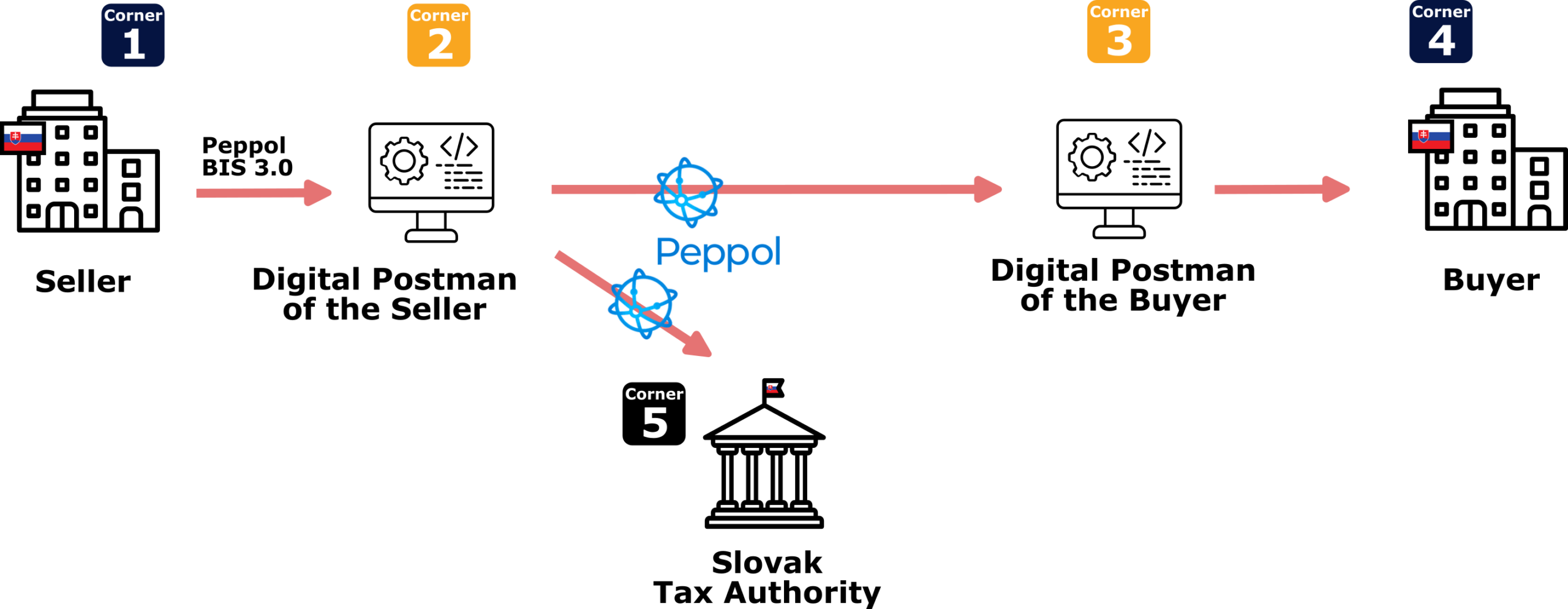
The system will be based on the decentralized Peppol network following a 5-corner model, with the Slovakia tax authority acting as the fifth corner.

Companies will be mandated to select an accredited service provider locally known as “Digital Postman” (Digitálny poštár) and to send EN 16931-compliant invoices in Peppol BIS 3.0 format. Invoice data will be automatically and asynchronously transmitted to the tax authority by the Digital Postman.

However, while the use of a Digital Postman is mandatory, the CII syntax and/or a direct 1-to-1 connection may be used if mutually agreed between the sender and the recipient.

A voluntary testing phase is currently underway since May 2026, allowing companies to prepare. To ease the implementation, a 3-month transitional grace period will also likely be planned until March 31, 2027, during which no penalties will apply for implementation delays while businesses adapt. Discussions are still underway regarding this grace period, and the legislation remains in draft form [↗︎].

Companies realizing VAT-exempt supplies under Sections 28 to 42 of the VAT Act have no obligation to issue an invoice for such supplies. However, they will be allowed to voluntarily send e-invoices through a Digital Postman, with no data transmission to the tax authority.

The adoption of the 5-corner Peppol model is designed to seamlessly prepare for the upcoming ViDA mandate, with the obligation for cross-border intra-EU B2B transactions in electronic format already scheduled to take effect on July 1, 2030.

Timeline

B2G E-Invoicing - Mandatory Acceptance

Public authorities are required to accept electronic invoices, laying the legal foundation for public sector electronic invoicing.

B2G E-Invoicing Mandate (not enforced)

All suppliers of public administrations are theoretically required to issue electronic invoices via the IS EFA central platform but the platform was never deployed.

B2B E-Invoicing - Voluntary Testing Phase

Launch of the voluntary onboarding and testing environment for the new decentralized model.

B2B E-Invoicing Mandate

Electronic B2B invoicing is now mandatory countrywide for domestic transactions, using a decentralized 5-corner Peppol model with automated E-reporting.

B2B E-Invoicing - End of Grace Period

End of the 3-month post-launch transitional period. Administrative penalties apply for compliance failures.

Full ViDA Alignment

Implementation of VIDA E-invoicing & E-reporting cross-border obligations

2019
2023
May 2026
January 1, 2027
March 31, 2027
July 1, 2030

Latest E-Invoicing News in Slovakia

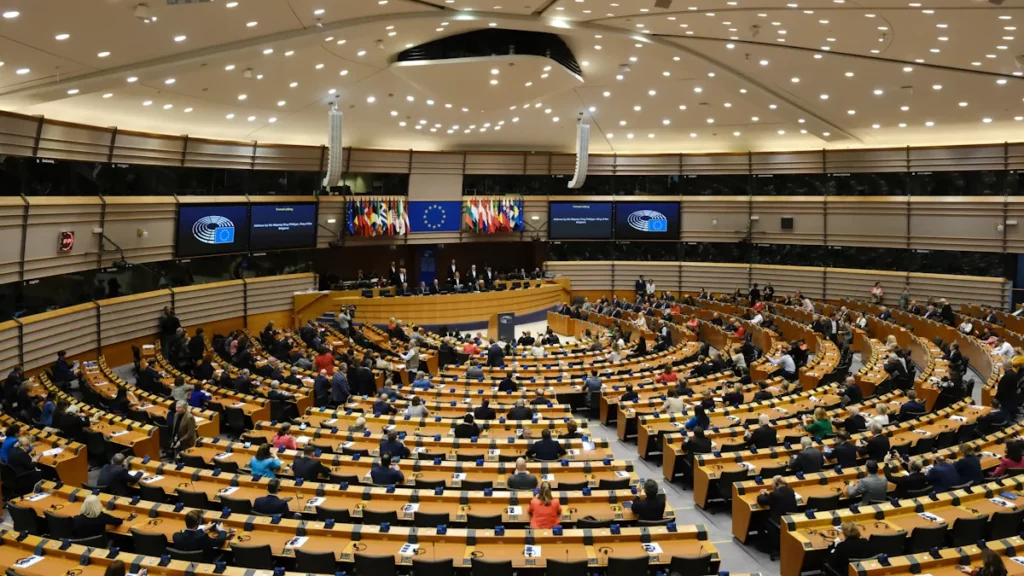
Photo of the European Parliament, gathered within the European Commission in Brussels, capital of Belgium

European Commission calls for public input to shape the future of EU e-invoicing

A “Reality Check” event and a public consultation launched by the European Commission aim to shape EU e-invoicing by gathering feedback.
Set of flags from around the world waving in the wind

EN 16931 update: the next step in e-invoicing is on its way

With the EU shifting from public e-invoicing mandates to full B2B, the EN 16931-1 update will arrive mid-2026 to raise compliance standards.

Technical Details

The information below applies from January 1, 2027. 

Until then, although B2G e-invoicing has theoretically been mandatory countrywide since 2023, the IS EFA central platform has not been fully deployed. Consequently, the B2G e-invoicing obligation is currently not enforced in practice.

Upcoming B2B & B2G mandate overview

From January 1, 2027, B2G & B2B e-invoicing in Slovakia will rely on the Peppol network

"Digital Postmen" - Certified Service Providers

Slovak companies will be required to elect a Certified Delivery Service Provider, known locally as a “Digital Postman” (Digitálny poštár), which will ensure the secure and efficient transmission of invoices between parties, including the Slovak Financial Administration.

The accreditation primarily requires service providers to demonstrate their ability to exchange documents over the Peppol network in compliance with the Slovak PASR [↗︎] (Peppol Authority Special Requirements).

The Financial Administration makes available a list of all certified delivery service providers [↗︎], including those still undergoing accreditation.

E-Invoicing via the Peppol network

The upcoming B2G and B2B e-invoicing obligation in Slovakia will be, by default, based on a decentralized 5-corner Peppol model.

In this framework, the Slovakia Financial Administration will act as the 5th corner, and the Financial Directorate of the Slovak Republik will act as the Peppol Authority.

Effective January 1, 2027, all domestic B2B and B2G invoices in Slovakia must be issued, transmitted, and archived exclusively as structured electronic XML files that comply with the European Standard (EN 16931).

Peppol BIS Billing 3.0, under the UBL 2.1 syntax, will be the e-invoicing format used for all B2G and B2B invoices across the standard national framework. No country-specific extensions or additional requirements (such as an SK_CIUS) will apply, meaning invoices must comply directly with the standard Peppol specification.

The Financial Administration of the Slovak Republik has published a set of information and technical resources [↗︎], providing the necessary guidance for companies regarding the invoice requirements in Slovakia. 

Alternative methods

While the default compliance method requires routing transactions across the Peppol network via a Digital Postman using the UBL 2.1 syntax of Peppol BIS Billing 3.0, the Slovak E-invoicing regulation allows alternative approaches, subject to mutual agreement between parties.

Under this derogation, businesses will still be required to rely on a Digital Postman, but can deviate from the format & transmission requirements:

  • Alternative syntax (CII): parties may choose to issue and transmit UN/CEFACT CII (Cross Industry Invoice) electronic invoices, provided they are fully compliant with the EN 16931 European standard

  • Direct 1-to-1 transmission: instead of using the Peppol network transmission method, Digital Postmen are allowed to establish a direct, 1-to-1 connection to exchange e-invoices. In this case, no data has to be extracted from the invoices and sent to the tax authority until 2030.

The Invoicing Hub Word

Slovakia

After ensuring strict compliance with Directive 2014/55/EU and mandating the acceptance of electronic invoices by public administrations in 2019, Slovakia sought to take the next step in its e-invoicing journey. However, its first attempt proved unsuccessful.

In 2023, the country officially introduced a nationwide B2G e-invoicing mandate, intended to operate through a centralized platform known as IS EFA. In practice, however, the platform was never fully deployed, preventing the mandate from being effectively enforced and contributing to the continued low adoption of electronic invoicing across the country.

Since then, Slovakia has adjusted its approach and is now pursuing a far more ambitious and forward-looking strategy. The country is preparing to implement one of the first genuine decentralized 5-corner e-invoicing models based on the Peppol network. This architecture closely aligns with the vision set out by the EU’s VAT in the Digital Age (ViDA) initiative, which seeks to establish a harmonized framework for electronic invoicing and digital reporting across the European Union.

Scheduled to begin in 2027, this mandate positions Slovakia among the earliest adopters of a decentralized architecture that could eventually become a reference model across the EU. While ambitious, the project is also pragmatic, relying on established standards and infrastructure, most notably the Peppol network and its interoperability framework, rather than requiring the development of a new centralized government platform.

For Slovak businesses, the coming years will mark a significant transition. The success of the initiative will depend on how effectively companies embrace the new framework and how well the authorities support them throughout the implementation process.

Slovakia’s experience will be closely watched across Europe. Many EU countries are ultimately expected to move toward architectures inspired by the same principles promoted under ViDA, making the Slovak project a potentially valuable case study for policymakers, tax authorities, and businesses alike.

Get your Project Implemented

Gold Sponsor

Become a gold sponsor - stacked
Contact us to learn about our sponsorship plans

Silver Sponsors

Contact us to learn about our sponsorship plans

Official Resources [↗︎]

Slovakia Financial Administration, and also the tax authority in the country

Slovak Peppol Authority

Official resources & guidance published by the Financial Administration of Slovakia

Official lists of “Digital Postmen” (already certified and pending)

Entire set of official Peppol BIS 3.0 specifications

Official directory of worldwide Peppol-ready businesses

More Resources

Choose Docoon Invoice in White-Label / Grey-Label Download our guide to learn how to integrate a Certified Platform into your solution
France mandates e-invoicing from Sep 2026. Join our webinar to learn about the French model, e-reporting, and A-Cube's compliance APIs.
France’s most comprehensive Accredited Platforms benchmark: 100 solutions, 60+ criteria, neutral, objective, and free.

Advertisement

Become a gold sponsor - stacked
Contact us to learn about our sponsorship plans

Latest News

Panoramic summer view of the medieval architecture of Sighisoara, a historic town in the Transylvania region of Romania, Europe.

End of Romania’s grace period and B2C transactions legal clarification

End of RO-eFactura grace period for small firms and key invoicing clarifications for B2C transactions.

Peppol model confirmed for 2029 mandatory e-invoicing in UK

The UK Government's Tax Update 2026 has officially named Peppol as the core network for the upcoming 2029 e-invoicing mandate.

New Country Coverage: Luxembourg

The Invoicing Hub now covers a 32nd country: Luxembourg, with regular e-invoicing news & detailed country profile.

Norway’s e-invoicing mandate officially approved

E-invoicing in Norway will progressively become mandatory from January 1st, 2027 (issuance) until January 1st, 2030 (reception).

billentis publishes its 2026 “Riding the Tornado” report on e-invoicing

The report "Riding the Tornado - A Guide to Mastering E-invoicing and Compliance" offers key insights into global e-invoicing and compliance.
Chatbot icon at the colors of The Invoicing Hub

Try me 🙂

I’m an e-invoicing  expert and I might just surprise you!

📩 ‎ Newsletter

Receive the latest e-invoicing news, directly in your mailbox, once a month.