E-Invoicing in Belgium:
2026 B2B Mandate & Peppol
Last update: 2026, September 17
Summary
Belgium has made structured e-invoicing mandatory for domestic B2B transactions between Belgian businesses since January 1, 2026. The Peppol network is the default invoice transmission method, while B2G invoicing remains supported through the Mercurius central platform. The government also plans to introduce e-reporting in 2028.
B2G Transactions
Mandatory e-invoicing
Most suppliers of Belgian public administrations are required to issue electronic invoices, with very few exceptions.
Public e-invoicing infrastructure is based on the “Mercurius” platform and the Peppol network.
B2B Transactions
Mandatory e-invoicing for all domestic transactions, e-reporting to become mandatory in 2028
E-invoicing is mandatory since January 1, 2026, and should occur by default through the Peppol network in Peppol BIS 3.0 format.
E-reporting should become mandatory starting January 1, 2028, with invoice tax data to be seamlessly transmitted to the tax authority via Peppol.
B2C Transactions
No e-invoicing obligation
No e-invoicing or e-reporting obligation applies to business-to-consumer transactions in Belgium.
Belgium
Table of Contents
What the Law Says
B2G E-Invoicing
E-invoicing is mandatory for suppliers in most public procurement contracts with Belgian public administrations.
The obligation began in April 2019, when Belgian public entities became required to receive and process structured electronic invoices under the Act of April 7, 2019 [↗︎].
The mandate was later extended to suppliers through the Royal Decree of March 9, 2022 [↗︎], and amended by the Royal Decree of September 4, 2023 [↗︎]. E-invoicing became mandatory for most public procurement contracts from March 1, 2024.
One major exception applies to non-federal public administrations, where e-invoicing may not be mandatory for contracts worth €3,000 or less excluding VAT. However, the procurement documents may still require structured e-invoicing on a case-by-case basis.
Other exceptions apply to certain contracts awarded by autonomous public companies or entities with special or exclusive rights, such as VRT, SNCB or bpost.
Suppliers are therefore advised to check the requirements set out in the relevant procurement documents.
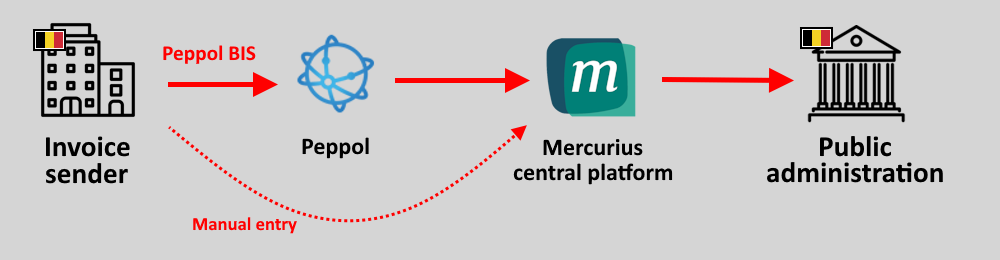
Belgium’s B2G e-invoicing infrastructure relies on the Mercurius public platform [↗︎] and the Peppol network. For Peppol exchanges, invoices use the Peppol BIS Billing 3.0 format. Alternatively, the Mercurius portal allows suppliers to create invoices manually and track submitted invoices.
Invoices must generally be archived for seven years.
B2B E-Invoicing & Planned E-Reporting
E-invoicing is mandatory for domestic B2B transactions since January 1, 2026, as set out in the Royal Decree of July 8, 2025 [↗︎]. A paper invoice or a PDF sent by email is therefore no longer sufficient.
The default solution is to exchange electronic invoices through the Peppol network, using the Peppol BIS Billing 3.0 specification.
Trading partners may nevertheless use other methods and electronic invoice formats compliant with the European Norm 16931, provided that both parties agree to this arrangement.
The mandate applies to most Belgian VAT-registered businesses, including those using the small-business VAT exemption scheme. On the other hand, foreign businesses are generally out of scope, unless they have a permanent establishment in Belgium.
Belgium plans to introduce B2B e-reporting from January 1, 2028. On July 18, 2026, the Council of Ministers approved a preliminary draft law that would require suppliers and their customers to report selected invoice data to the SPF Finances (Belgium’s tax authority) in near real time through the Peppol network. The measure has not yet been enacted into Belgian law, and its technical specifications have not been published.
Invoices must generally be archived for seven years.
B2C E-Invoicing
Belgium does not have a B2C e-invoicing or e-reporting mandate.
Companies may continue to issue business-to-consumer invoices and receipts through their usual channels, including paper invoices, PDF invoices sent by email and printed receipts.
Timeline
B2G E-Invoicing Mandate - Mandatory acceptance
Public authorities are required to accept electronic invoices.
B2G E-Invoicing Mandate - Mandatory issuance
All suppliers of public administrations are required to issue electronic invoices.
B2B E-invoicing Mandate
Electronic B2B invoicing is now mandatory countrywide, primarily through the Peppol network.
B2B E-Reporting Mandate
E-reporting will become mandatory, with the tax authority becoming the 5th corner in the framework implemented in 2026.
Latest E-Invoicing News in Belgium
Belgium’s E-Reporting pre-draft law approved
European Commission calls for public input to shape the future of EU e-invoicing
Technical Details (B2G)
Belgium’s B2G e-invoicing mandate relies on the Mercurius central platform and the Peppol network. Mercurius receives structured electronic invoices intended for Belgian public entities and routes them to the relevant contracting authority.
Invoice Content and Format
Belgian B2G e-invoices must comply with the European Standard (EN) 16931.
For Peppol exchanges, suppliers use the Peppol BIS Billing 3.0 format, which implements this standard. The official Peppol specifications [↗︎] set out the applicable technical and business rules.
Before issuing an invoice, suppliers should check the procurement and ordering documents provided by the contracting public entity. Depending on the recipient, the invoice may need to include a purchase order reference, a contract reference, a recipient identifier or other routing information.
Recipient Identification
Belgian public entities are identified by their ten-digit Enterprise Number, which is recorded in the Crossroads Bank for Enterprises (CBE). This identifier can be found through the CBE Public Search service [↗︎].
For Peppol exchanges, the Belgian Enterprise Number uses the identifier scheme 0208. A Belgian VAT number may also be used, under the identifier scheme 9925.
Suppliers should use the identifier and any routing reference provided by the contracting authority in its procurement or ordering documents.
Sending Invoices via Mercurius and Peppol
The Mercurius platform [↗︎] is Belgium’s central public platform for B2G invoice exchanges, handling structured invoices addressed to public administrations.
It is directly connected to the Peppol network, enabling suppliers to send electronic invoices through their chosen Peppol Access Point.
Indeed, suppliers can submit invoices to the Mercurius platform in two ways:
- Through the Peppol network (preferred)
- Through manual data entry: Belgian suppliers can create and submit invoices or credit notes through the Mercurius web portal. This option is particularly useful for occasional B2G invoices.
Regardless of the submission method, Mercurius receives the invoice and routes it to the intended public recipient. The portal also enables suppliers to track the delivery and processing status of invoices sent to public administrations.
Legal representatives of Belgian companies can access the portal using their electronic identity card (eID) [↗︎]. Alternatively, the company’s main or local access manager can appoint an authorised Invoicing Manager through My eGov Role Management [↗︎].
For public administrations, Mercurius acts as an invoice inbox for incoming electronic invoices and can be integrated with their internal accounting systems.
Technical Details (B2B)
Belgium’s B2B e-invoicing mandate leverages the Peppol standard following a decentralised four-corner model, rather than a central public platform. Other formats and delivery methods remain permitted when both trading partners agree.
Peppol as the Default Method
For domestic B2B transactions, the Peppol network is Belgium’s default method for exchanging structured electronic invoices and is strongly recommended by the Belgian authorities. Businesses normally connect through their accounting, invoicing or ERP software, using a Peppol Access Point.
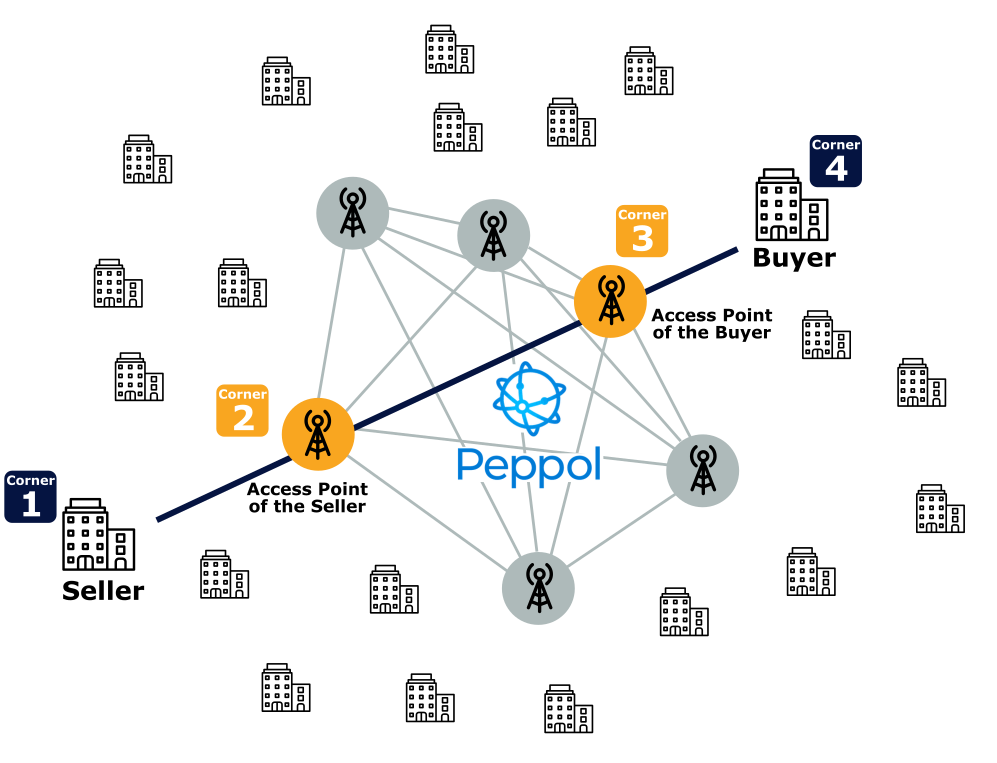
The Peppol framework implemented in Belgium is overseen by BOSA, the Belgian Peppol Authority, and operates through a four-corner model:
- The Supplier (Corner 1) submits an invoice to its own Peppol Access Point (Corner 2) …
- … which sends it to the Recipient’s Access Point (Corner 3) …
- … which delivers it to the internal systems of the Recipient (Corner 4)
Invoices exchanged through Peppol use the Peppol BIS Billing 3.0 format. The official Peppol specifications [↗︎] set out the applicable technical and business rules.
The official list of Belgian e-invoicing solutions [↗︎] currently features 450+ service providers, but is indicative only: it is neither exhaustive nor a government certification or endorsement of listed providers.
Recipient Identification on Peppol
The Peppol Directory [↗︎] is a useful resource to help suppliers identify their Belgian customers on the network and address their invoices correctly.
Belgian businesses are generally identified by their ten-digit Enterprise Number, which is recorded in the Crossroads Bank for Enterprises (CBE). In Peppol, this number uses the identifier scheme 0208. Each company’s Enterprise Number can be found through the CBE Public Search service [↗︎].
Alternatively, a Belgian VAT number may also be used, under the Peppol identifier scheme 9925.
Alternative Formats and Delivery Methods
Peppol is the preferred solution, but not the only one. Trading partners may agree to use another structured electronic invoice format and delivery method, provided that the format complies with EN 16931 and that both parties agree to the arrangement.
The agreement should cover both the invoice format and the delivery channel. The Belgian B2B e-invoicing FAQ [↗︎] confirms that this flexibility remains available.
Before the 2026 Mandate: Hermes
Before structured B2B e-invoicing became mandatory, the Belgian government operated the “Hermes” service. The platform automatically registered all Belgian companies as Peppol receivers, converted incoming Peppol invoices into human-readable PDFs, and delivered them to the recipient by email.
This mechanism allowed any supplier to send e-invoices to any Belgian business through Peppol, while offering a free first step towards e-invoicing for Belgian recipients.
Hermes was discontinued before the mandate took effect. Its closure released these default registrations, allowing businesses to register with their own chosen Peppol service provider. Hermes is therefore no longer an available solution.
Upcoming B2B E-Reporting Mandate (2028)
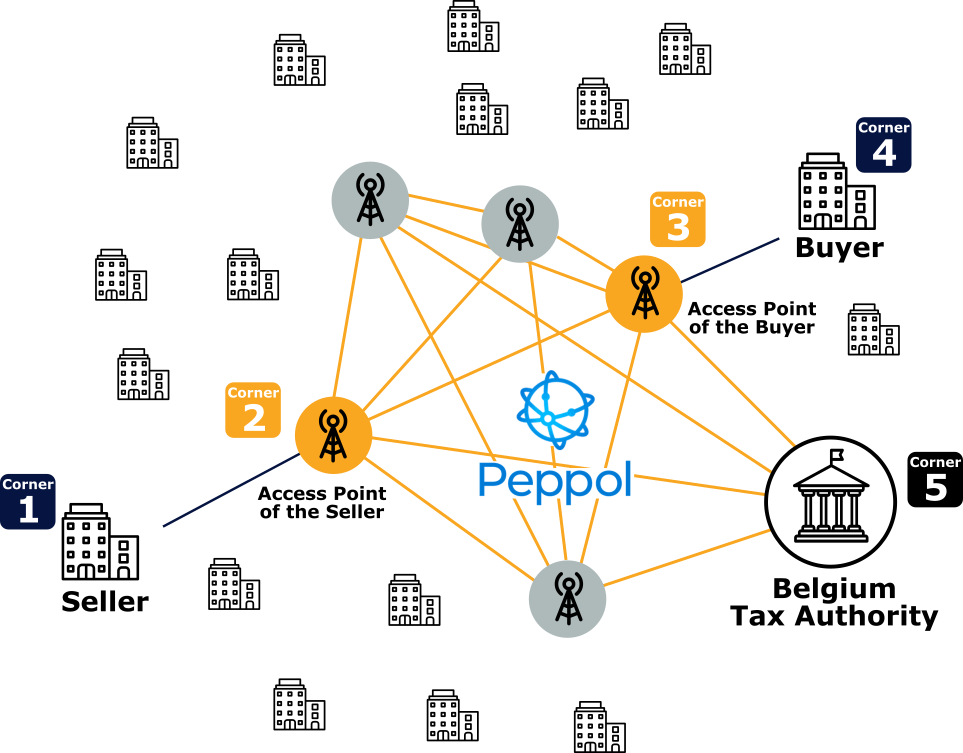
Belgium plans to add B2B e-reporting to its existing Peppol-based e-invoicing mandate from January 1, 2028. The targeted model extends the current four-corner framework by adding the Belgian tax authority as a fifth corner.
Further details are expected to be published in late 2026.
From Four Corners to Five
The e-reporting obligation is designed to build on the infrastructure already implemented through the 2026 B2B e-invoicing mandate.
Participants would retain the same roles: the Supplier (Corner 1) submits an invoice to its Peppol Access Point (Corner 2), which transmits it to the Recipient’s Access Point (Corner 3). The Recipient’s Access Point then delivers the invoice to the Recipient (Corner 4).
The main change is the addition of the Belgian tax authority (Corner 5) to the model. In this e-reporting configuration, the Supplier’s Access Point (Corner 2) would extract and transmit the required invoice tax data to the tax authority.
Unlike in a few other countries, the Recipient’s Access Point (Corner 3) would not transmit corresponding data to the tax authority. The model would therefore not enable cross-verification of invoice tax data.
Legislative Status
On July 18, 2026, the Council of Ministers approved a preliminary draft law introducing electronic reporting and removing the annual customer-listing requirement.
The measure has not yet been enacted into Belgian law. It must then be finalised, approved by the government, adopted by Parliament and published before the obligation can take legal effect.
Further details, expected in late 2026, will also be needed to confirm the reporting data, deadlines and operational requirements.
The Invoicing Hub Word
Belgium
Belgium has built its e-invoicing mandates around international standards.
For B2G, Mercurius serves as a central platform connected to the Peppol network, while the now-discontinued Hermes service gave Belgian businesses an accessible first step into e-invoicing.
For B2B, the same approach applies: Peppol is the default network, with shared standards at the core of the model.
This approach aims to make implementation easier for businesses across the country, while providing a foundation for the planned e-reporting requirement in 2028 and for ViDA requirements across the European Union from 2030.
It should also reduce maintenance and upgrade costs over time, while offering a model that other countries may choose to follow.
The real test is now: Belgium needs to address any issues that arise as businesses, service providers and public authorities use the system at scale.
Get your Project Implemented
Gold Sponsor
A certified Peppol Access Point since 2014, Babelway connects companies to the Peppol network and converts data across any format (UBL, XML, EDIFACT, X12, PDF, JSON, CSV) and protocol (AS2, SFTP, OFTP, VAN). Trusted by 650+ customers across 26 countries, including two national governments, Babelway processes 600M+ messages annually with 99.99% availability.
Drag-and-drop transformations, transparent tiered pricing, automatic upgrades, and SOC 1, SOC 2, ISO 27001 and GDPR compliance make e-invoicing adoption simple.
Silver Sponsors
Official Resources [↗︎]
Tax authority in Belgium
Public entity supervising the e-invoicing mandates in Belgium, and Peppol Authority
E-invoicing homepage & resources on the BOSA website
Official FAQ about e-invoicing in Belgium
Educational website about e-invoicing in Belgium, managed by BOSA
Belgium B2G central platform
Entire set of official Peppol BIS 3.0 specifications
Related Resources about Belgium
Advertisement
Latest News
VeR expands the conversation around B2B e-invoicing
KSeF penalty grace period to be extended until end 2027
XRechnung 4.0 draft published: preparing for EN16931:2026 adoption
The Netherlands shares plans for mandatory B2B e-invoicing and e-reporting
New details on Spain’s upcoming B2B e-invoicing obligation
📩 Newsletter
Receive the latest e-invoicing news, directly in your mailbox, once a month.