E-Invoicing in Oman
Last update: 2026, May 19
Summary
B2G & B2B
Will become mandatory soon
E-invoicing will progressively become mandatory in 2026-2027 through the 5-corner model relying on the Peppol network and Accredited Service Providers.
B2C
Not mandatory yet
B2C transactions are not immediately in the scope of the current e-invoicing mandate in Oman, but should ultimately be included following a Clearance model through Peppol.
Oman
Table of Contents
What the Law Says
B2G & B2B E-Invoicing
The e-invoicing mandate in Oman is being led by the Oman Tax Authority (OTA), which is in charge of defining the framework and technical guidelines [↗︎] for the obligation.
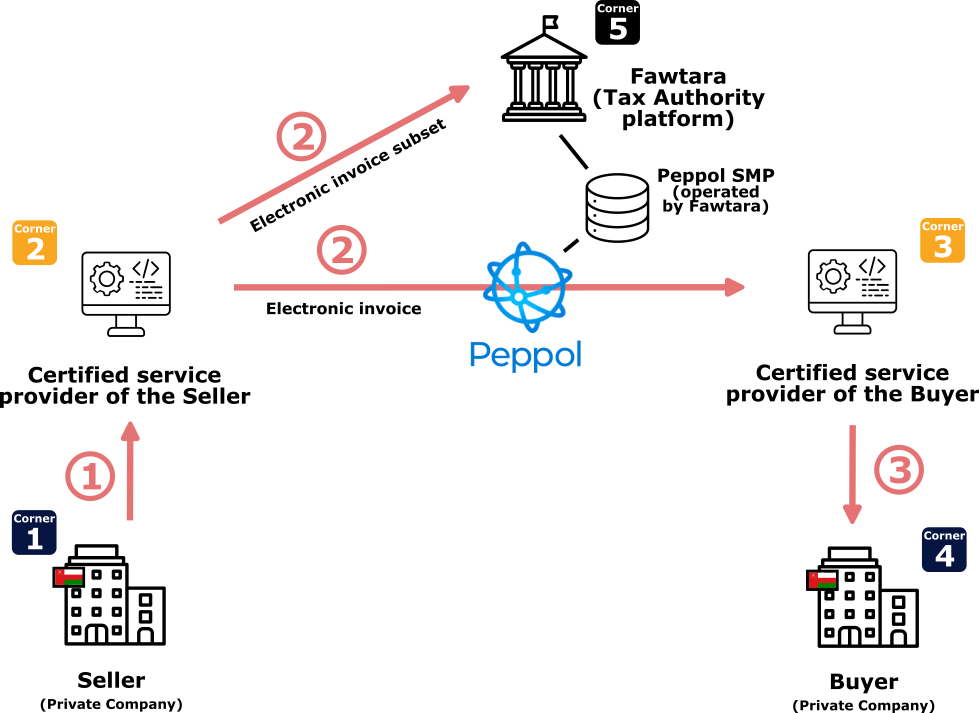
The OTA has opted for a 5-corner model based on the Peppol network, and the PINT-OM format, while maintaining a certain degree of centralization. This includes a single centralized SMP, mandatory local establishment requirements, and certification of Peppol service providers.
OTA became a Peppol Authority in January 2026 and built a platform called Fawtara, that will act as the 5th corner of the mandate. The platform will receive invoice tax data simultaneously with transmission to the intended recipient.
The current rollout timeline is as follows:
- August 2026: pilot phase with 100 selected large VAT-registered companies
- February 2027: mandatory B2B e-invoicing for all large VAT-registered companies
- August 2027: mandatory B2B e-invoicing for all remaining VAT-registered taxpayers
However, several key specifications are still missing despite the first deadline approaching.
A Phase 4 is also planned, although its date has not yet been confirmed. It will extend the mandate to public entities and bring B2G transactions into scope.
Invoices must be archived 10 years.
B2C E-Invoicing
It is highly likely that the Oman Tax Authority (OTA) will eventually extend the scope of the e-invoicing mandate to include B2C transactions. However, as there is currently no official law confirming this, B2C transactions remain out of scope for the time being.
The OTA has indicated that any future B2C e-invoicing requirement would likely continue to rely on the Peppol network and the same e-invoice format, but under a Clearance model.
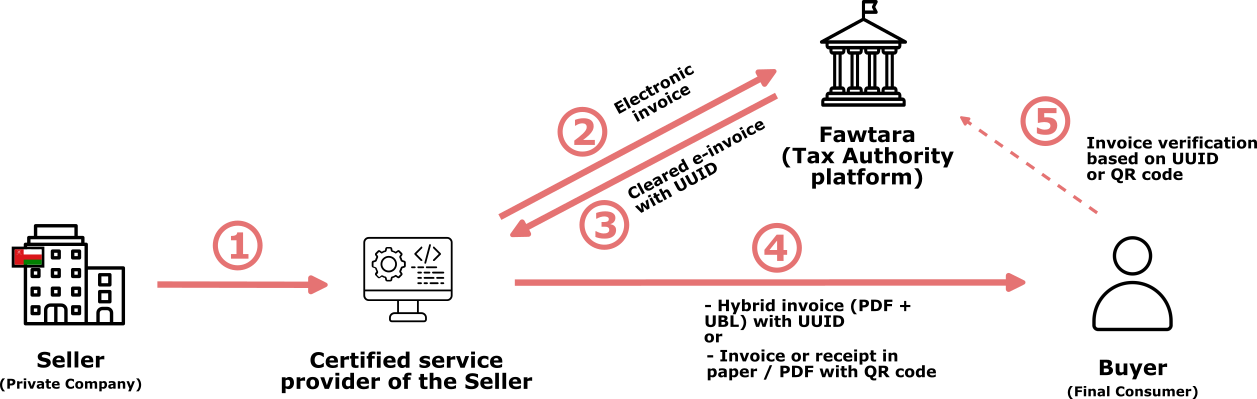
Under this approach, invoice issuers would be required to generate their invoices electronically and submit them to Fawtara. The tax authority platform would then validate (“clear”) each invoice and assign a unique invoice identifier (UUID).
Once validated, the issuer would be free to transmit the invoice to the final recipient in any format. This could be the original electronic invoice containing the UUID, or a readable version (such as paper or PDF), which would include a QR code.
Timeline
E-invoicing mandate Phase 1 - Pilot
The e-invoicing mandate begins with 100 selected large VAT-registered companies
E-invoicing mandate Phase 2 - Large Companies
B2B e-invoicing becomes mandatory for all large VAT-registered companies
E-invoicing mandate Phase 3 - Remaining Taxpayers
B2B e-invoicing becomes mandatory for all remaining VAT-registered taxpayers
E-invoicing mandate Phase 4 - Public Entities
The e-invoicing mandate extends to the public sector, and thus to B2G transactions
B2G E-invoicing mandate
B2C e-invoicing becomes mandatory following a Clearance model
Technical Details
Remaining uncertainties and upcoming official updates
A significant portion of the technical documentation is still missing, and many items listed in the official FAQ items [↗︎] have yet to receive a formal answer. In addition, the currently available technical documentation remains officially in draft status and may still evolve.
For example, regarding B2C transactions, the FAQ states that electronic invoices will be the only legally accepted format, while also indicating that QR codes will be required. However, no additional details have been provided on how these invoices are expected to be delivered to end consumers. Based on this FAQ, it can only be assumed that Oman may allow sellers to provide B2C invoices or receipts in paper, PDF, and/or hybrid PDF formats, which appears somewhat inconsistent with the initial principle that only electronic invoices will be permitted.
As a result, the sections below, which aim to provide further technical insight into the mandate, are based on incomplete information and should therefore be understood as highly probable interpretations rather than formally confirmed rules.
The first phase of the mandate, officially launched as a pilot involving 100 large taxpayers, should help clarify many of these outstanding points.
B2B & B2G e-invoicing mandate
Oman has adopted a “5-corner model” in which both the Seller and the Buyer must use a certified service provider. These providers exchange documents with each other, as well as with the tax authority’s central platform, “Fawtara”, through the Peppol network.
E-invoices must be issued in the PINT-OM format, the Omani extension of the Peppol International standard, and comply with the official data dictionary and business rules (technical specifications [↗︎]).
At the same time as the invoice is transmitted to the recipient, the Seller’s service provider (“corner 2”) extracts the relevant tax data and submits it to Fawtara.
A specific feature of the Peppol implementation in Oman is the establishment of a centralized SMP (Service Metadata Publisher) operated by OTA. As a result, service providers will not be permitted to operate their own SMPs to register the receiving capabilities of Omani taxpayers.
Finally, as part of the prerequisites for complying with the mandate, companies will need to register on the Fawtara portal [↗︎], after which their registration will be validated by their chosen service provider.
B2C e-invoicing mandate
Oman plans to implement a B2C obligation based on a Clearance model, although no specific deadline has been shared yet. The focus is clearly on B2B transactions first, then B2G, then probably B2C.
Under OTA’s B2C future probable obligation, the Seller must use its certified provider (“corner 2”) to submit the invoice in PINT-OM format (technical specifications [↗︎]) to the OTA platform, Fawtara.
Fawtara is then responsible for formally validating (“clearing”) the invoice and returning it to the Seller’s certified provider with a unique identifier (UUID) confirming that the invoice has been successfully approved.
The Seller may then deliver the invoice to the Buyer in the preferred delivery format:
- Electronically, using the cleared Fawtara invoice (including the UUID), exchanged through the parties’ certified service providers via the Peppol network
- In paper or PDF format including a QR code, sent directly between the parties or through one or both certified service providers
The UUID or QR code allows the buyer to verify through the Fawtara portal that the invoice is valid and has been properly cleared by the OTA.
Certified Service Providers
Exchanging e-invoices on the Peppol network usually relies on Access Points: e-invoicing service providers that are members of and are connected to the Peppol network.
However, in Oman, as in multiple other countries, the local Peppol Authority (here: Oman Tax Authority) requires those Peppol Access Points to be officially accredited.
The OTA has set several key requirements [↗︎] to certify service providers, such as the ISO 27001 certification, or the particularly restrictive obligation to be commercially registered in Oman.
Accreditations are currently in progress, and service providers are free to submit their application [↗︎], but no official list of accredited service providers has been shared yet.
The Invoicing Hub Word
Oman
A major e-invoicing wave is sweeping across the Middle East, and Oman is clearly joining the movement.
Oman has chosen an approach inspired by neighboring countries: a 5-corner model similar to the UAE for B2B and B2G transactions, alongside a Clearance model comparable to Saudi Arabia’s framework for B2C transactions.
This strategy will provide the tax authority with access to invoice data while enabling companies to leverage e-invoicing automation for B2B and B2G processes. At the same time, for B2C transactions, the emphasis appears to be on ensuring a smooth and seamless experience for consumers in their everyday activities.
That said, many aspects of the mandate remain unclear and the timeline already appears ambitious. Only a few months before the initial deadline, no list of certified providers has been published, and all technical documentation is still officially marked as draft. The first phase of the obligation, officially presented as a pilot involving 100 selected large taxpayers, will likely be necessary to further clarify and refine the requirements.
Another major concern is the OTA’s requirement that service providers must be commercially registered in Oman to obtain accreditation and offer compliant e-invoicing services in the country. This seems at odds with the objective of promoting a global network such as Peppol, and could create unnecessary complexity to companies for both domestic and international trade.
It will be interesting to see how the Omani framework evolves and whether these obstacles can be addressed, potentially by following the UAE’s example, which recently lifted similar location-based restrictions and postponed the first phase of its mandate to give businesses and service providers more time to prepare.
Additional Resources [↗︎]
Tax authority supervising e-invoicing in Oman
Official e-invoicing mandate homepage, with FAQ
Central platform operated by OTA
Draft technical specifications of the Oman implementation of the Peppol INTernational (PINT) invoice format
Get your Project Implemented
Gold Sponsor
Silver Sponsors
Latest News
France’s JFE 2026 and the latest official e-invoicing specifications
UAE extends ASP appointment deadline to October 2026
UAE opens access to its 4-corner e-invoicing system via accredited providers
Spain provides initial clarifications on its future e-invoicing mandate
📩 Newsletter
Receive the latest e-invoicing news, directly in your mailbox, once a month.