E-Invoicing in The Netherlands:
B2G Rules & 2030-2031 B2B Mandate
Last update: 2026, November 2
Summary
The Netherlands has a partial B2G e-invoicing mandate in place and plans to introduce mandatory B2B e-invoicing in 2030, followed by mandatory e-reporting in 2031. The proposed architecture of those upcoming requirements will likely rely on a four-corner model using Peppol, but official legislation remains to be formally adopted.
B2G Transactions
Mandatory e-invoicing with central public administrations, accepted with others
Suppliers of central public administrations are required to send electronic invoices compliant with the EN 16931, while it remains voluntary with other public administrations.
There are several platforms & formats available, but the preferred method is via the Peppol network in Peppol BIS 3.0 format.
B2B Transactions
Mandatory e-invoicing from 2030, mandatory e-reporting from 2031â
E-invoicing is currently allowed, and will become mandatory in the coming years, alongside e-reporting, through the Peppol network.
B2C Transactions
No e-invoicing obligation
No e-invoicing or e-reporting obligation applies to business-to-consumer transactions in The Netherlands.
The Netherlands
Table of Contents
What the Law Says
B2G E-Invoicing
Suppliers to the Rijksoverheid, the Dutch central government, have been required to send their invoices electronically since 2017. All Dutch public administrations have also been able to receive e-invoices since 2019.
Several platforms and formats can be used to transmit B2G invoices compliant with the European Norm (EN) 16931 to public administrations in the Netherlands. However, the Dutch government and the Netherlands Peppol Authority (NPa) recommend the Peppol network and the Peppol BIS 3.0 format as the preferred method.
Other e-invoicing options include:
- Digipoort, a central platform that accepts UBL-OHNL and SETU (HR-XML) formats;
- the Leveranciersportaal van de Rijksoverheid (Government Supplier Portal), which enables low-volume suppliers to submit invoices manually;
- sending SI-UBL 2.0 invoices through the Peppol network;
- electronic invoices sent as email attachments, where accepted by certain local public administrations.
E-invoicing is not mandatory for B2G transactions with local public administrations. Unless the contract between the public administration and its supplier requires otherwise, suppliers may therefore use more traditional methods, such as paper invoices or PDF invoices supported by an e-signature or a complete audit trail.
Invoices must generally be archived for seven years.
B2B E-Invoicing
B2B e-invoicing is currently voluntary in the Netherlands, but will become mandatory in 2030, followed by e-reporting requirements in 2031.
As there is currently no B2B e-invoicing mandate in the Netherlands, businesses may exchange invoices using:
- Paper-based invoices;
- PDF invoices supported by an e-signature or a complete audit trail;
- Electronic invoices exchanged, for example, via EDI.
On September 11, 2026, the Dutch authorities published a policy outline letter [âïž] setting out the planned implementation of the mandate in two phases:
- July 1, 2030:
- mandatory domestic B2B e-invoicing, with no invoice tax data transmitted to the Dutch tax authority at this stage;
- mandatory intra-EU B2B e-invoicing, together with e-reporting for the corresponding transactions, in line with the ViDA Digital Reporting Requirements.
- July 1, 2031: e-reporting for transactions within the scope of the domestic B2B e-invoicing mandate.
The framework is expected to rely on the decentralised Peppol network, with invoices that will comply with the European Norm (EN) 16931.
Legislation remains in progress and must still be formally adopted. Detailed technical requirements and implementation guidance have yet to be published.
Invoices must generally be archived for seven years.
Timeline
B2G e-invoicing partially mandatory
E-invoicing becomes mandatory for B2G transactions with central public administrations.
B2G e-invoicing acceptance
All public administrations are able to receive and process invoices compliant with the EN 16931
Peppol for B2G
Peppol officially becomes the officially recommended B2G e-invoicing method, and the Dutch government takes ownership of the national Peppol authority
B2B e-invoicing mandatory
E-invoicing will become mandatory for domestic and intra-EU B2B transactions, likely via the Peppol network
B2B e-reporting mandatory
E-reporting will become mandatory for domestic B2B transactions, likely via the Peppol network
Latest E-Invoicing News in The Netherlands
European Commission calls for public input to shape the future of EU e-invoicing
EN 16931 update: the next step in e-invoicing is on its way
Technical Details (B2G)
E-invoicing is mandatory for suppliers of central public administrations and voluntary for transactions with other public administrations. Peppol is the recommended delivery method, although alternative platforms and formats remain available.
E-invoicing via Peppol
The Dutch government has made Peppol its preferred e-invoicing framework. It established the Netherlands Peppol Authority (NPa), which took over the national coordination role previously held by SimplerInvoicing, a foundation bringing together e-invoicing service providers and financial software vendors.
The official recommendation in the Netherlands is therefore to use the Peppol network and exchange invoices in the Peppol BIS 3.0 format, which complies with the European Norm (EN) 16931.
A second invoice format can also be used through Peppol: the local SI-UBL 2.0 format, which is likewise EN 16931-compliant. Older SI-UBL versions, including SI-UBL 1.2, are no longer accepted.
For invoices addressed to the Rijksoverheid (the Dutch government), provinces and municipalities, the recipientâs Organisation Identification Number (OIN) must be used as the Peppol identifier. For other public entities and for B2B transactions, businesses may use their Chamber of Commerce (Kamer van Koophandel, KVK) number, or their Dutch VAT ID.
The NPa also applies additional requirements to Peppol service providers operating in the Netherlands, including requirements relating to information security, End User Identification (EUI), transaction reporting and service availability. These measures aim to ensure that Dutch businesses and public bodies can rely on secure, high-quality Peppol services.
The NPa provides support resources [âïž], technical documentation [âïž] and the NPa Peppol Test Tool [âïž].
E-invoicing via government platforms
The Dutch government operates a central platform called Digipoort. It accepts electronic invoices in two formats:
- SETU (HR-XML), for invoices relating to temporary staffing;
- UBL-OHNL, for other invoice types.
Digipoort is connected to the Peppol network. In practice, when a supplier uses Peppol to send an invoice to a Dutch public administration, the invoice is very often routed through Digipoort, converted into UBL-OHNL or SETU (HR-XML), and then delivered to the intended public recipient. Some public administrations are, however, directly connected to the Peppol network.
Suppliers with a low volume of B2G invoices, typically fewer than ~50 per week, may instead use another central platform: the Leveranciersportaal van de Rijksoverheid (Government Supplier Portal). The portal allows suppliers to manually input invoices without investing in a fully integrated e-invoicing solution, but does not provide automation capabilities.
Other Methods
Finally, some local public administrations may accept invoices as XML attachments of an email.Â
This solution, while very easy to implement, should be considered a last resort as it relies on manual processing and is prone to errors. Most public administrations will not accept it anyway.
Technical Details (B2B)
The Netherlands will introduce mandatory B2B e-invoicing from July 1, 2030. The obligation will require businesses to exchange domestic B2B invoices and intra-EU invoices electronically.
One year later, from July 1, 2031, domestic invoice data reporting to the tax administration will be required.
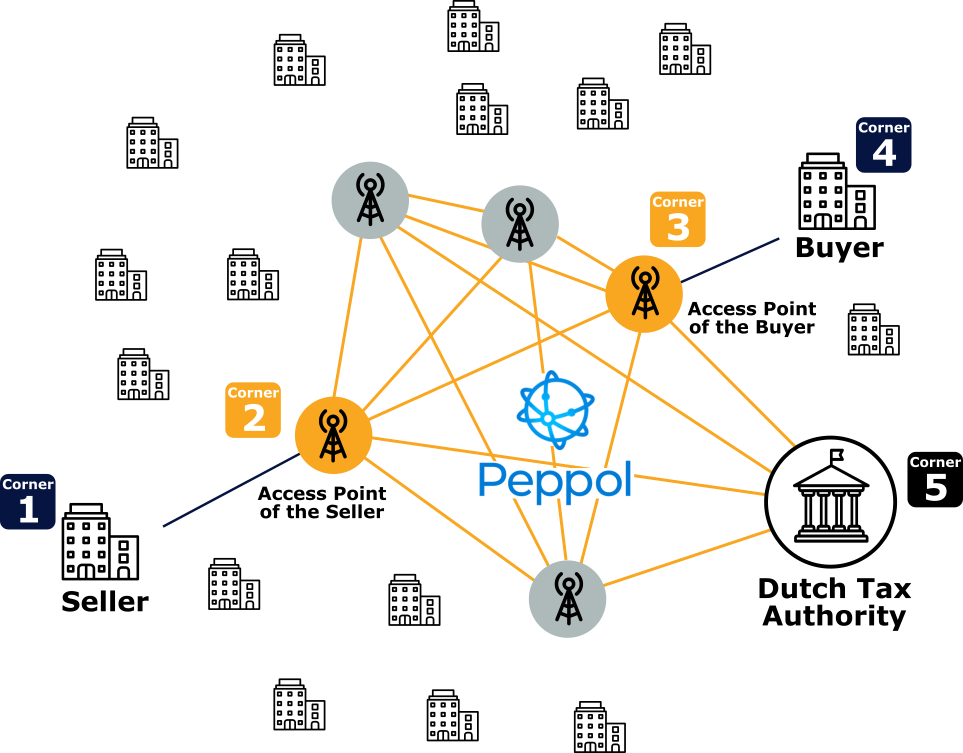
The anticipated architecture of the mandate relies on the Peppol network, with Access Points enabling interoperable invoice exchange between Dutch businesses and international trading partners.
In any case, e-invoices are expected to comply with the EN 16931 and the applicable ViDA requirements.
Further guidance and technical requirements are expected as the legislation and implementation framework are developed.
Beyond E-Invoicing: E-Ordering
Since 2023, the Dutch government has been developing the transmission of electronic orders via the Peppol network for public procurement. An initial pilot [âïž], presented by Logius, the Dutch government agency responsible for shared digital infrastructure, led to a first production implementation between the Dutch Forensic Institute and one of its suppliers.
The initiative has now moved beyond the initial pilot stage, and public entities can use Peppol to send structured electronic purchase orders to suppliers. Suppliers can process the order data in their systems and use it to streamline the creation of the subsequent e-invoice, reducing manual data entry and the risk of processing errors.
In 2025, the Rijksoverheid (Dutch government) issued more than 200,000 e-orders [âïž], approximately one quarter of which were transmitted through Peppol.
E-ordering remains voluntary and is not subject to a national mandate. It forms part of the Dutch governmentâs broader effort to digitise public procurement and expand the use of structured electronic business documents.
The Invoicing Hub Word
The Netherlands
The Netherlands has built a mature B2G e-invoicing ecosystem around the Peppol network, which public authorities recommend as the preferred exchange method.
That recommendation helps bring consistency to a B2G landscape that remains relatively complex. Several platforms, formats and delivery routes continue to coexist, reflecting the countryâs long history of digital public procurement.
For many years, the Dutch government saw little need for a domestic B2B e-invoicing mandate, partly because the country has a comparatively low VAT fraud rate. The ViDA directive has changed this calculation: businesses will be required in any case to digitalise their cross-border B2B invoicing processes.
The planned 2030-2031 reform therefore gives the Netherlands an opportunity to align domestic B2B invoicing with the European framework. If implemented as announced, it will introduce e-invoicing for domestic B2B transactions in 2030, followed by domestic e-reporting in 2031.
The final technical model has not yet been selected, but it will likely be the decentralised Peppol network, as it is already established in Dutch B2B e-invoicing, and will greatly facilitate cross-border transactions.
Get your Project Implemented
Gold Sponsor
As a certified Peppol Access Point since 2012, we handle all infrastructure, compliance, and regulatory updates, allowing our partners to focus on their core products.
With 300+ integrated software partners serving over 300,000 businesses and processing 12+ million transactions monthly, we deliver secure, scalable solutions for B2B, B2C, and B2G invoicing needs.
Silver Sponsors
Official Resources [âïž]
Homepage of the Nederlandse Peppolautoriteit (NPa, ex-SimplerInvoicing)
Resources from the Dutch government agency responsible for shared digital infrastructure
E-invoicing official B2G guidelines & support
Peppol technical requirements maintained by the NPa
Official directory of worldwide Peppol-ready businesses
Specifications of SI-UBL, NL-CIUS, EN16931 invoice formats
Comprehensive Peppol test tool published by the NPa
Discover Additional Resources
Advertisement
Latest News
Egyptâs e-invoicing mandate: understanding the ETA requirements
A first look at Belgium’s 2028 B2B e-reporting mandate
India expands e-invoicing requirements from January 2027
Denmark clarifies and introduces new digital accounting requirements
UK publishes the roadmap to its 2029 e-invoicing mandate
đ© â Newsletter
Receive the latest e-invoicing news, directly in your mailbox, once a month.