E-Invoicing in Egypt:
Tax Invoices & E-Receipts via the ETA Platform
Last update: 2026, November 12
Summary
Egypt operates a countrywide e-invoicing mandate, requiring relevant tax-invoice data to be submitted electronically to the Egyptian Tax Authority (ETA) for validation. In addition, POS receipts must be issued electronically.
Tax Invoices (B2G & B2B & B2C Transactions)
Mandatory e-invoicing
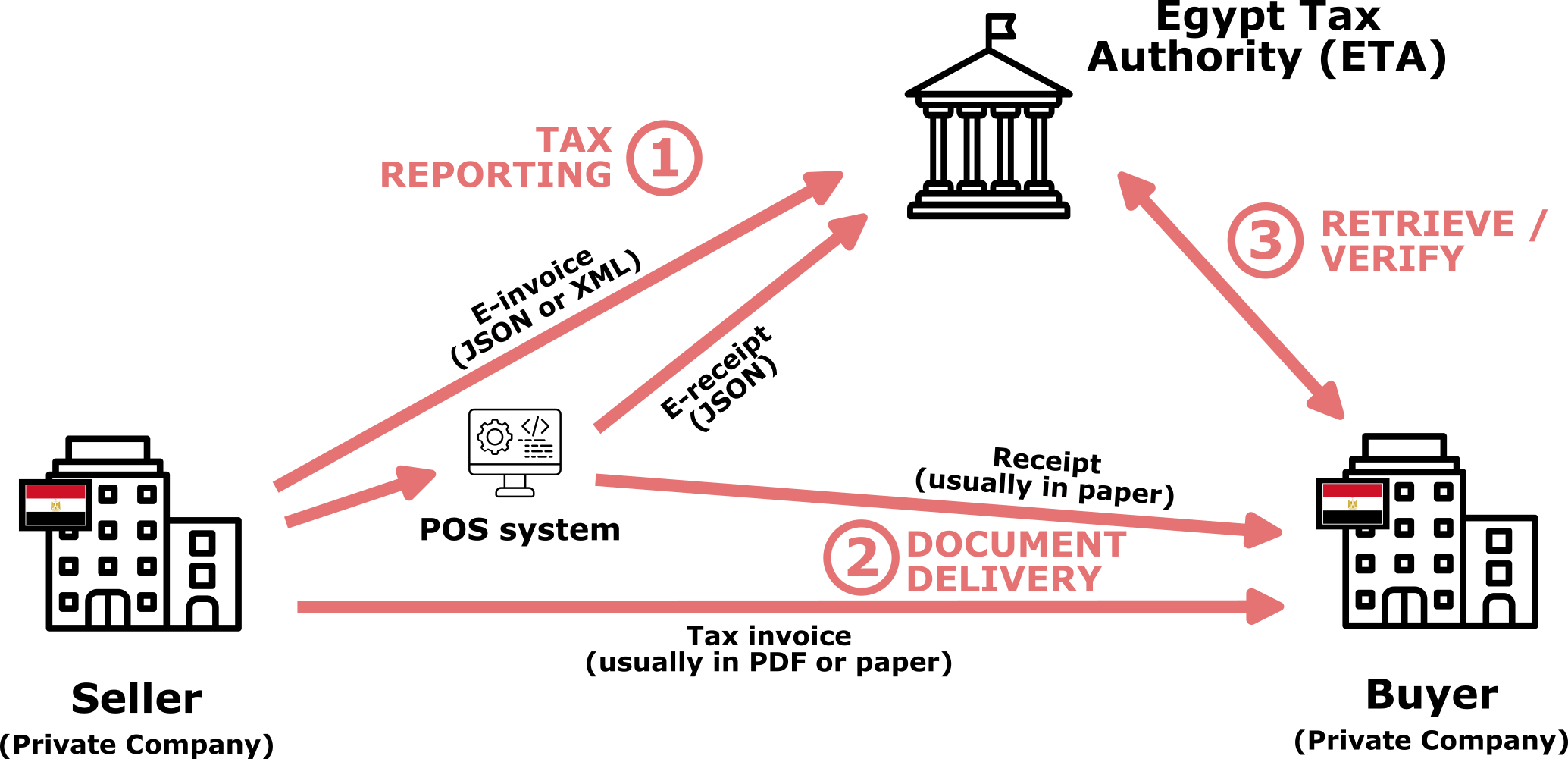
B2G, B2B and B2C invoices must be issued electronically, and reported to ETAâs central platform in a proprietary XML or JSON format, while invoice delivery remains unregulated.
POS Receipts (B2C Transactions)
Partially mandatory e-receipts
Sales receipts issued through Point-of-Sale (POS) systems must be generated electronically, with the relevant data reported to ETAâs central platform for validation.
The obligation is being rolled out in phases, based on named taxpayer lists, business sectors and geographical areas.
Egypt
Table of Contents
What the Law Says
Tax Invoices (B2G & B2B & B2C E-Invoicing)
Egypt requires businesses to issue their tax invoices electronically and report the relevant data to the tax administration.
The e-invoicing mandate is administered by the Egyptian Tax Authority (ETA), and was introduced under Ministerial Decision No. 188 of 2020, with the final nationwide rollout set out in ETA Decision No. 323 of 2022 [âïž].
It applies to tax invoices, including B2G, B2B and, where applicable, B2C transactions, but not to sales receipts issued through Point-of-Sale systems, which fall under the separate e-receipt regime.
Under the e-invoicing obligation, businesses must generate their tax invoices and submit them asynchronously to ETAâs central platform in one of its proprietary XML or JSON formats.
The issuer remains responsible for delivering the invoice to its customer and does not need to wait for the authorityâs validation before doing so.
The rollout of the mandate took place between 2020 and 2023 and now applies to most taxpayers across the country, with very few exemptions, mostly for several sovereign entities.
Invoices must generally be archived for five years.
POS Receipts (B2C E-Receipts)
Point-of-Sale (POS) systems must be registered with the tax administration, and sales receipts must be issued and reported electronically.
The Egyptian Tax Authority (ETA) introduced this e-receipt mandate under Ministerial Decision No. 230 of 2022 [âïž], later amended by Decision No. 38 of 2024.
ETA has since published multiple Mandatory E-Receipt Decisions [âïž], progressively bringing more businesses into scope through named taxpayer lists, sectors and geographical areas. The latest published phase is covered by Decision No. 361 of 2025 [âïž], which took effect on November 15, 2025.
No subsequent phase has been published at the time of writing. The regime now covers numerous businesses across Egypt, but does not yet apply to every B2C seller. Businesses can check whether they are listed through ETAâs e-receipt obligation inquiry service [âïž].
Businesses within scope must first register their POS devices with ETA. Sales receipts must then be generated electronically and reported to ETAâs central platform in its proprietary JSON format.
The seller must provide the customer with the receipt at the point of sale, usually as a printed copy. It includes a unique receipt identifier and a QR code, allowing the receipt to be retrieved and verified through ETAâs system.
Receipts must generally be archived for five years.
Timeline
Start of the e-invoicing mandate
E-invoicing & reporting of B2G, B2B and B2C tax invoices starts with 134 businesses chosen by the authorities
Start of the e-receipt mandate
Selected B2C businesses using POS systems must start issuing and reporting their POS receipts electronically
E-invoicing fully mandatory
Implementation of the last phase of the e-invoicing mandate, bringing most businesses in scope
E-receipting mandate last phase
The latest published phase of the e-receipting mandates kicks in, bringing more businesses in scope
Technical Details
Egypt has implemented requirements for both regular tax invoices, covering B2G, B2B and some B2C transactions, and Point-of-Sale (POS) receipts issued to final consumers. In both cases, documents must be issued electronically and reported to the Egyptian Tax Authority (ETA).
ETA central platform
Egyptâs e-invoicing and e-receipt mandates both rely on a central platform operated by the Egyptian Tax Authority (ETA). Businesses must submit the relevant data extracted from their tax invoices or POS receipts to this platform, which processes the documents, validates them and returns the relevant status information.
For tax invoices, businesses can integrate their accounting or invoicing system with ETA through its API documentation [âïž].
ETA also provides an online portal [âïž] for businesses that need to create invoices manually and submit the corresponding tax data. Official guidance on the portal [âïž] specifies that it is intended for businesses issuing fewer than 200 invoices per month. Businesses exceeding this threshold may use it temporarily, for up to six months, while they acquire an ERP system and complete their direct integration with ETA.
For e-receipts, businesses within scope must first register their POS devices through ETAâs POS registration portal [âïž]. Devices supplied by an ETA-approved vendor can be registered directly while other devices must first undergo a technical inspection before registration.
Once registered, the POS device must be connected to ETA through the dedicated e-receipt API [âïž] to submit receipt data and retrieve validation results.
File content & coding
For both tax invoices & POS receipts, ETA requires that each line item must be identified using one of the two coding schemes:
- GS1: an international coding system, mainly used for standardised goods.
- EGS (Egyptian Goods and Services): a local coding system that allows businesses to register their own goods and service codes with ETA. An EGS code combines the prefix âEGâ, the issuerâs tax registration number and its internal item reference.
Businesses using EGS must submit their codes via API[âïž] to ETA for approval before using them in tax invoices or POS receipts. The codes are also linked to the relevant Global Product Classification (GPC) category, helping ETA identify and classify the goods or services being reported.
Tax invoices: format & e-reporting
Tax invoices must be issued in one of ETAâs proprietary structured formats: JSON or XML. ETA recommends JSON for new integrations and maintains XML primarily for legacy compatibility. The complete invoice structure is set out in ETAâs Invoice v1.0 technical specification [âïž].
Before submitting an invoice to ETA, the issuer must apply a digital signature [âïž] in the CAdES-BES format, using a valid electronic seal or signature certificate.
The invoice is then submitted to ETAâs platform, which performs technical and tax validations [âïž] and returns the processing result asynchronously to the issuer.
POS receipts: format & e-reporting
POS receipts must be generated and reported in ETAâs proprietary JSON format. Each receipt must include the relevant sales and tax data, as well as a unique identifier, known as a UUID, as set out in the Retail Receipt v1.2 specification [âïž].Â
ETA processes submitted receipts, performs the relevant validation checks [âïž], and makes the information available to the seller.Â
Invoices & receipts delivery
ETAâs central platform can make tax invoices available to their intended recipients after processing. Recipients may receive document notifications from ETA [âïž]Â and retrieve received invoices [âïž]Â through their ERP integration. ETAâs PDF printout of a submitted tax invoice also includes a QR code that enables the recipient to verify the document’s validity.
Alternatively, issuers may deliver tax invoices directly to their customers. As ETAâs validation process is asynchronous, they do not need to wait for its outcome before doing so.
The issuer may share the structured JSON or XML tax invoice directly with the recipient. In practice, it will more often provide a readable version, such as a PDF invoice sent by email or a paper invoice.
For POS receipts, the seller must provide a customer-facing receipt at the point of sale, usually as a printed copy. The receipt must include its UUID and a QR code, generated using ETAâs QR-code API [âïž].
The QR code contains a URL leading directly to the receipt details in ETAâs platform, allowing the consumer to retrieve and verify the reported receipt. Consumers may also use ETAâs public receipt-verification portal [âïž] to search for an e-receipt using its UUID or direct URL.
The Invoicing Hub Word
Egypt
Egypt has introduced two mandates that collectively cover B2G, B2B and B2C transactions: one for regular tax invoices, and another for POS receipts. Both rely on the Egyptian Tax Authorityâs central platform, proprietary structured formats and electronic validation.
This is a relatively classic centralised model, in which documents must be issued electronically and submitted to the tax authorityâs central platform for validation. Issuers may then deliver them to customers in their preferred format, although ETAâs platform can itself make tax invoices available to their intended recipients.
This model gives ETA detailed visibility over business transactions, while allowing trading partners flexibility in how they share invoices with one another without interrupting the commercial transaction.
Egypt has published substantial guidance on both obligations, but most of it remains available only in Arabic. This creates a practical challenge for foreign businesses and international service providers seeking to understand the rules and follow new developments.
The framework now appears relatively mature. Tax-invoice e-invoicing has been rolled out nationwide, while e-receipting has progressively expanded through targeted phases. At the time of writing, the authorities have not announced further obligations or scope expansions in the near term.
Get your Project Implemented
Gold Sponsor
Silver Sponsors
Official Resources [âïž]
Tax authority supervising e-invoicing in Egypt
Official e-invoicing resources, for the mandate applying to tax invoices
Indicative list of service providers qualified by ZATCA (not mandatory)
Technical specifications of the JSON or XML e-invoice expected by ETA
Official e-receipt resources, for the mandate applying to POS receipts
Official answers on e-receipts, such as POS registration, printed copies, e-reporting and QR codes
Technical specifications of the JSON e-receipt expected by ETA
Online official tool for consumers to verify the validity of a POS receipt
Discover Additional Resources
Latest News
India expands e-invoicing requirements from January 2027
Denmark clarifies and introduces new digital accounting requirements
UK publishes the roadmap to its 2029 e-invoicing mandate
A busy October ahead of Slovakiaâs 2027 e-invoicing mandate
đ© â Newsletter
Receive the latest e-invoicing news, directly in your mailbox, once a month.