E-Invoicing in Romania:
B2G, B2B & B2C Invoices via RO e-Factura
Last update: 2026, October 21
Summary
Romania has required e-invoicing for B2G transactions since 2022, for B2B transactions since 2024, and for B2C invoices since 2025. The chosen framework is heavily centralised and revolves around a platform operated by the tax authority.
B2G, B2B, and B2C Transactions
Mandatory e-invoicing
All invoices within scope must be submitted electronically to the RO e-Factura central platform in XML format, following the Romanian local RO_CIUS specifications.
Romania
Table of Contents
What the Law Says
E-Invoicing & E-Reporting
Romania requires electronic invoicing for B2G and B2B transactions, as well as electronic reporting of B2C invoices, through the central RO e-Factura platform.
The framework is overseen by the Romanian Ministry of Finance, together with the National Agency for Fiscal Administration (ANAF), Romania’s tax authority, and is based on Emergency Ordinance No. 120/2021 [↗︎]. RO e-Factura was initially available on a voluntary basis from 2021, before becoming mandatory in 2022 for B2G invoices and for certain B2B transactions involving goods considered at high risk of tax evasion.
The obligation was then extended to domestic B2B invoices in 2024 and to B2C invoices in 2025. For B2C transactions, the obligation is more accurately described as an e-reporting mandate: invoices must be submitted to RO e-Factura, but suppliers remain responsible for delivering them to consumers through their usual channels.
Cross-border invoices are generally exchanged directly between trading partners. However, certain transactions involving foreign businesses registered for VAT in Romania must also be reported through RO e-Factura.
Invoices submitted to the platform must be issued in XML format complying with RO_CIUS, the Romanian national specification of the European Norm (EN) 16931. Two syntaxes are allowed: UBL and CII.
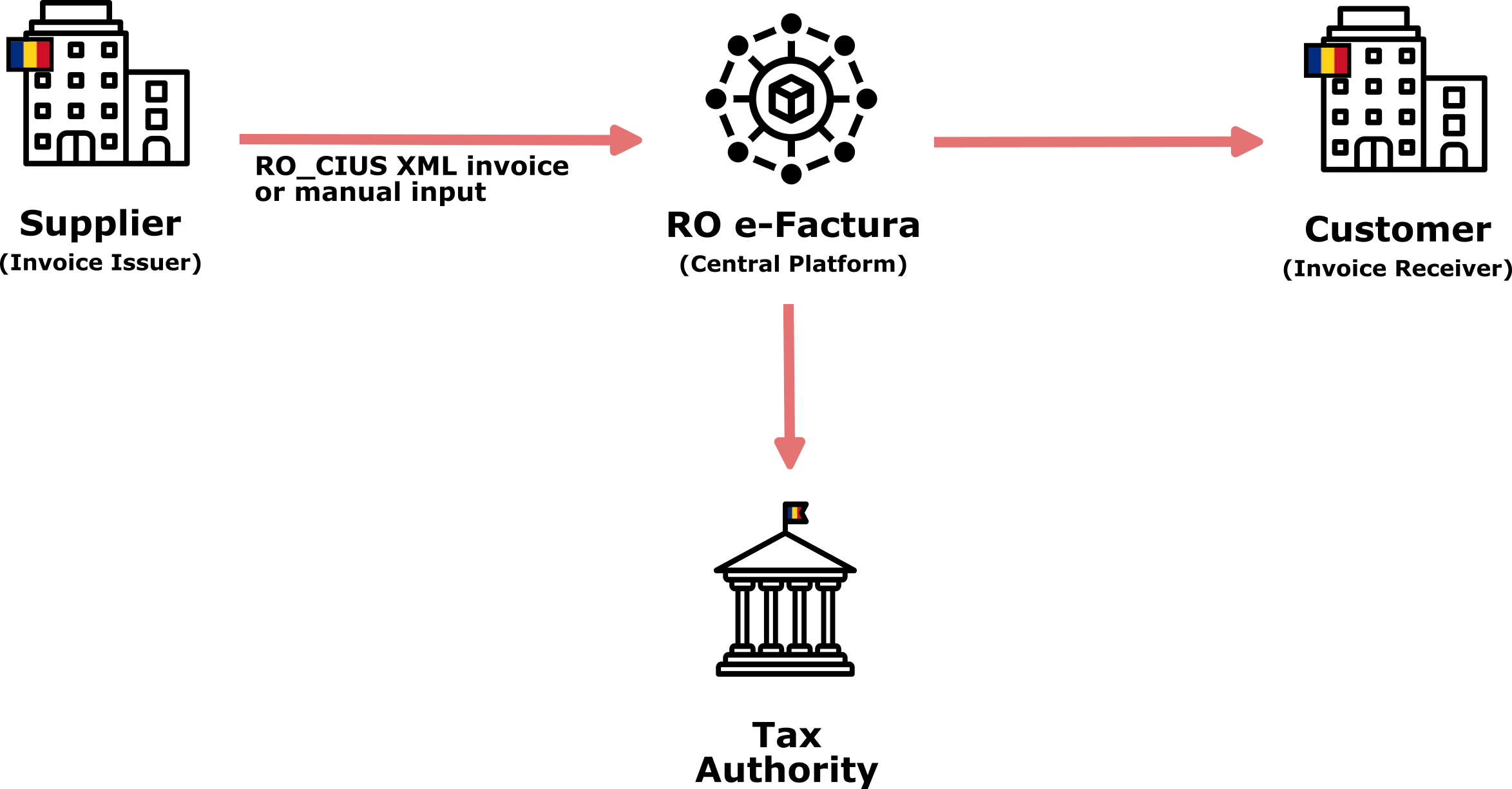
B2G and B2B invoices within scope are exchanged through RO e-Factura under a centralised exchange model: issuers submit their invoices to the platform, and recipients retrieve them from it. The platform also ensures e-reporting by making invoice data available to ANAF.
Several exceptions [↗︎] apply to the use of RO e-Factura, including:
- POS fiscal receipts, which generally do not need to be submitted to the platform.
- Individuals who issue invoices using their personal identification number (CNP), although they may choose to use the platform voluntarily. This exemption does not automatically apply to all self-employed professionals.
- Farmers under the special agricultural VAT regime, who may also choose to use the platform voluntarily.
Invoices must generally be archived for five years.
Timeline
Central platform RO-eFactura available
B2G & B2B e-invoicing becomes possible via the RO-eFactura central platform, and is even mandatory in some specific cases
B2G e-invoicing mandatory, B2B partially
E-invoicing becomes mandatory countrywide for B2G transactions and for B2B transactions involving goods with high tax evasion risks
E-reporting becomes mandatory
E-reporting becomes mandatory through the RO-eFactura platform for B2G & B2B transactions
B2B e-invoicing becomes mandatory
B2B E-invoicing via the RO-eFactura central platform is mandatory for all B2B (& B2G) transactions
B2C e-invoicing becomes mandatory
B2C invoices must be submitted to RO e-Factura (but not POS receipts), but suppliers remain responsible for delivering them to consumers through their usual channels.
End of grace period for SMEs
The deferred penalty grace period ends for SMEs with an annual turnover < 500 K€
Latest E-Invoicing News in Romania
European Commission calls for public input to shape the future of EU e-invoicing
EN 16931 update: the next step in e-invoicing is on its way
Technical Details (B2G, B2B, B2C)
All invoices within the scope of Romania’s e-invoicing mandate must be submitted to the RO e-Factura central platform. They must be issued in RO_CIUS format, Romania’s national specification of the European Norm (EN) 16931.
RO-eFactura central platform
Invoices must be issued electronically for most businesses in order to comply with the Romanian e-invoicing mandate.
More specifically, invoices must be submitted to the RO-eFactura central platform, within 5 working days from the date of issuance (excluding weekends and public holidays). The tax authority provides technical specifications [↗︎] to help companies connect to the RO-eFactura platform using an API.
Alternatively, suppliers that are not equipped with e-invoicing solutions can also manually input their invoices directly on an official web portal [↗︎], that will convert them into the proper invoice format and send them to the RO-eFactura central platform.
The ANAF, Romania’s tax authority, also maintains comprehensive guidelines [↗︎] on its website.
Invoice format & content
Electronic invoices in Romania must be issued in XML format, either UBL 2.1 or CII XML, and respect a set of local specifications called RO_CIUS, compliant with the European Norm (EN) 16931.
The tax authority has published a set of technical resources [↗︎] to help companies regarding the invoice requirements in Romania.
To identify the recipient, the supplier must include its tax identification number in the invoice. This applies to both businesses and public entities. Suppliers should therefore obtain the correct identifier from their customer before issuing an invoice.
Invoice delivery
For B2G and B2B transactions, electronic invoices are delivered directly through the RO e-Factura platform: the supplier submits the invoice to the platform, it gets validated by the tax authority, and routed to the recipient according to its tax identification number. The recipient can retrieve the invoice through its own account or an integrated invoicing solution from its SPV (Private Virtual Space).
For B2C transactions, the supplier remains responsible for delivering the invoice directly to the consumer, for example in paper or PDF format. The invoice is also submitted to RO e-Factura for reporting purposes. POS fiscal receipts that meet the conditions for simplified invoices are generally exempt from submission to the platform, although a separate invoice issued at the customer’s request may need to be submitted.
Virtual Private Space (SPV)
The SPV (Spatiul Privat Virtual) is a comprehensive tax service provided by the ANAF. All businesses must register with the ANAF in order to access their SPV on the ANAF website [↗︎].
In the e-invoicing context, the most important feature of the SPV is an invoice inbox, where e-invoices that went through the RO-eFactura central platform are made available to the invoice recipients. They must retrieve those invoices (manually or via an automated solution) and archive them, although the SPV also stores them and makes them available on demand.
The SPV is also equipped with a messaging feature that allows suppliers & buyers to manage invoicing disputes.
Cross-border invoices
Cross-border invoices are generally exchanged directly between trading partners, but some transactions must also be reported to RO e-Factura.
When a Romanian supplier invoices a foreign customer that is neither established nor registered for VAT in Romania, the invoice is generally sent directly to the customer, in an agreed format such as paper, PDF or an electronic invoice, without being submitted to RO e-Factura.
However, since January 1, 2026, if the foreign customer is registered for VAT in Romania and the place of supply is in Romania, the Romanian supplier must deliver the invoice directly to the customer and also submit it to RO e-Factura for reporting purposes. Some exceptions apply [↗︎], including certain intra-EU supplies of goods.
When a Romanian business receives an invoice from a foreign supplier that is not established in Romania but is registered there for VAT, the foreign supplier must report qualifying B2B invoices through RO e-Factura when the place of supply is in Romania, subject to applicable exceptions.
The supplier may also voluntarily opt into the RO e-Factura register, in which case invoices can be exchanged through the platform. These requirements are set out in Law No. 296/2023 [↗︎].
The Invoicing Hub Word
Romania
Romania implemented its e-reporting and e-invoicing obligations for B2G, B2B and B2C transactions in very quick succession.
This decision came as no surprise, given that Romania has one of the highest VAT gaps in the European Union. The country had also already taken steps towards B2G e-invoicing under EU Directive 2014/55/EU.
However, the Romanian government opted for a very aggressive timeline: the e-reporting obligation entered into force only a few months after its adoption. This left many companies with limited time to implement a solution and become compliant, prompting the government to introduce grace periods.
While Romania’s progress towards e-invoicing is welcome, the implementation calendar created significant pressure for businesses. Combined with a lack of clear documentation, this urgency may have led to rushed implementation projects.
Looking ahead, the ViDA directive will introduce new requirements for cross-border transactions from 2030, with existing domestic reporting systems required to align with the European framework by 2035. This raises questions about how Romania will adapt its current model, which is not yet aligned with ViDA requirements, and what further changes businesses may need to implement.
Get your Project Implemented
Gold Sponsor
Silver Sponsors
Official Resources [↗︎]
Romanian Ministry of Finance, responsible for the RO e-Factura framework and platform
Official web applications for creating and validating e-invoices and converting XML files into PDF.
Legislative texts & technical specifications maintained by the Ministerul Finantelor
Official guidelines about e-invoicing in Romania published by the ANAF
Related Resources
Latest News
New accreditation requirements for e-invoicing solutions in the Philippines
BMF publishes additional guidance on mandatory German e-invoicing
Peppol & GENA e-invoicing conferences in Singapore – 17-19 November 2026
Spain’s B2B e-invoicing mandate will start in October 2027
Greece slightly postpones the next phases of its mandates
📩 Newsletter
Receive the latest e-invoicing news, directly in your mailbox, once a month.