Skip to content

Advertisement

Iopole - Logo transparent
IOPOLE’s API-first Iopole e-Invoicing Hub enables software vendors to deliver compliant e-invoicing and e-reporting across France and internationally, trusted by 150+ integrations and processing 150M+ documents yearly.

E-Invoicing & E-Reporting
in France: 2026-2027 Mandate

Last update: 2026, September 28

Summary

France is introducing in 2026-27 mandatory e-invoicing for B2G & domestic B2B transactions, alongside mandatory e-reporting for B2C & cross-border B2B transactions. The framework combines the Peppol network with direct connections to central government platforms in a 5-corner-like model.

E-Invoicing (B2G, G2G, G2B, domestic B2B)

Mandatory e-invoicing

Electronic invoicing for the public sector (B2G & G2G transactions) has been mandatory through the Chorus Pro central platform since the late 2010s.
The 2026-27 mandate introduces extensive domestic B2B e-invoicing requirements based on Accredited Platforms and Peppol, while the Chorus Pro obligation evolves for B2G & G2G flows and extends to G2B flows.

E-Reporting (B2C, cross-border B2B)

Mandatory e-reporting

Businesses must periodically report their cross-border B2B purchases & sales, as well as their B2C transactions, in an electronic format to the tax authority through their Accredited Platform.

France

Table of Contents

What the Law Says

E-Invoicing (B2G, G2G, G2B, domestic B2B)

B2G and G2G e-invoicing has been mandatory in France since the late 2010s, while the new 2026–2027 mandate introduces mandatory domestic B2B and G2B e-invoicing through Accredited Platforms.

Initially, B2G (Business-to-Government) and G2G (Government-to-Government) e-invoicing obligations were introduced progressively between 2017 and 2020. Since then, all suppliers to public entities have been required to issue invoices electronically through the official and mandatory central platform, Chorus Pro [↗︎].

France’s tax authority, DGFiP, is now rolling out a new e-invoicing mandate. Its final requirements were set out in summer 2026 in Decree No. 2026-677 [↗︎] and the Order of July 27, 2026 [↗︎].

This new mandate applies to domestic B2B transactions, requiring businesses to send and receive electronic invoices, primarily in UBL, CII or Factur-X formats, through certified providers known as Accredited Platforms. Businesses must also exchange invoice lifecycle statuses allowing the supplier, customer and tax authority to follow the invoice throughout its processing.

Public-sector transactions (i.e. B2G, G2G and G2B flows) are also covered by the mandate, with Chorus Pro becoming the Accredited Platform for all public entities. Suppliers to public entities (i.e. B2G and G2G flows) nevertheless retain the choice to submit invoices directly through Chorus Pro, as under the mandate introduced in the late 2010s.

The mandate follows a phased rollout:

  • September 1, 2026:
    • Mandatory e-invoicing (sending and receiving) for large and intermediate-sized companies
    • Mandatory acceptance (receipt only) of electronic invoices for all companies
  • September 1, 2027:
    • Mandatory e-invoicing (sending and receiving) for all companies

A grace period until at least the end of 2026 will apply, during which no penalties will be issued.

Invoices must generally be archived for ten years.

E-Reporting (B2C, cross-border B2B)

The 2026-2027 mandate makes e-reporting mandatory for B2C and most cross-border B2B transactions (purchases and sales). Businesses must aggregate their transaction data and submit periodic electronic reports to the tax authority through an Accredited Platform.

The e-reporting requirements are set out in the same legal instruments as the e-invoicing mandate: Decree No. 2026-677 [↗︎] and the Order of July 27, 2026 [↗︎]. They follow the same timeline:

  • September 1, 2026:
    • Mandatory e-reporting for large & intermediate-sized companies
  • September 1, 2027:
    • Mandatory e-reporting for all companies

The same grace period will also apply until the end of 2026.

E-reporting must be submitted at intervals ranging from 10 days to two months, depending on the business’s VAT regime. The report file must be generated in a proprietary XML format and transmitted to DGFiP, France’s tax authority, through a certified provider known as an Accredited Platform.

Additionally, companies using the VAT-on-payment scheme (“TVA sur les encaissements”) must submit e-reporting files containing payment data.

The transmission of cross-border B2B invoices and B2C invoices and receipts themselves remains unregulated. Businesses are free to exchange these documents on paper, in PDF format or electronically.

Timeline

B2G & G2G E-Invoicing becomes mandatory

E-invoicing is mandatory through the Chorus Pro platform for all suppliers (public & private) sending invoices to public administrations.

E-Invoicing & E-Reporting mandate - Phase 1

E-invoicing & e-reporting becomes mandatory for intermediate & large companies.

E-invoicing acceptance becomes mandatory for all companies.

Phase 1 - End of Grace Period

Companies included in the first phase of the e-invoicing & e-reporting mandate do not face penalties until this date.

E-Invoicing & E-Reporting mandate - Phase 2

E-invoicing & e-reporting becomes mandatory for all companies.

2017-2020
Sept 1, 2026
Dec 31, 2026
Sept 1, 2027

Latest E-Invoicing News in France

Photo of the Eiffel Tower and of a bridge spanning over the Seine river in Paris, capital city of France

France e-invoicing & e-reporting first phase is now live

France’s e-invoicing reform is now live, opening a new phase where operational readiness will be as critical as technical compliance.
Photo of the Arc de Triomphe in Paris, capital of France

New official publications before France’s e-invoicing mandate final stretch

With two months until the e-invoicing mandate, France is sharing final technical documentation, guidelines and pilot phase insights.
Webinar organized by Storecove on the French e-invoicing mandate, to take place on May 28, 2026

France’s e-invoicing mandate: turning compliance into a competitive advantage

France’s e-invoicing mandate is coming. Join Storecove’s webinar to learn how to turn compliance into a simple process. Register now.

Technical Details: E-Invoicing (domestic B2B)

France is implementing an e-invoicing mandate in 2026 and 2027, requiring businesses to exchange invoices electronically through certified providers known as “Plateformes Agréées” (Accredited Platforms). The framework relies on the Peppol network and introduces additional requirements, such as the transmission of invoice lifecycle statuses.

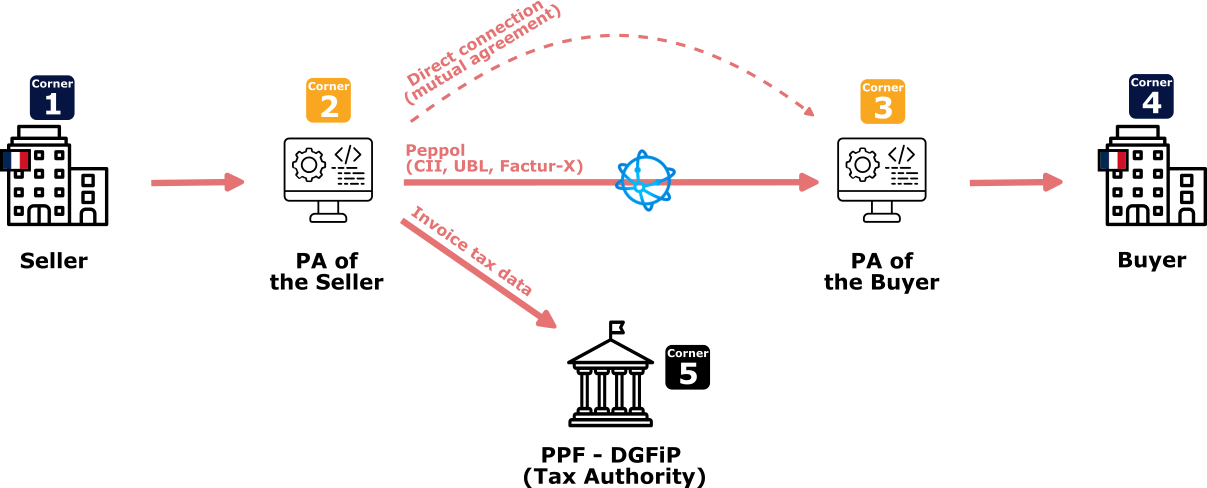
France 2026-2027 e-invoicing schema
France’s e-invoicing model: invoices exchanged electronically through Accredited Platforms (PA) and Peppol, with data automatically reported to the tax authority

E-Invoicing Mandate Overview

The 2026-2027 B2B e-invoicing mandate in France is complex, as it consists of multiple components:

  • Accredited Platforms (“Plateformes Agréées”, formerly known as PDP): all businesses in France must rely on Accredited Platforms, i.e. private service providers officially certified by the DGFiP (French tax authority) based on strict requirements, to exchange all the documents & data included in the mandate
  • E-invoice delivery: All Accredited Platforms must be interoperable with each other. While direct point-to-point connections are allowed upon mutual agreement, the only truly viable solution to meet interconnect all Accredited Platforms is through the Peppol network.
  • Invoice lifecycle: A structured framework for exchanging invoice statuses to ensure that all participants, including the tax authority, have continuous visibility into each invoice’s progress.
  • Annuaire: public directory listing all French entities covered by the mandate, including their electronic invoicing addresses used to properly route invoices.
  • PPF: the central platform managed by the DGFiP, which hosts the central directory (“Annuaire”) and collect all necessary data for tax reporting (“Data Concentrator”).

Official specifications [↗︎] are available on the DGFiP website. The “Spécifications Externes” version (3.2) published by the DGFiP detail interactions with the PPF.

This documentation is complemented by technical standards published by the AFNOR (French standardization body), providing extensive specifications about the Formats & Profiles (XP Z12-012 standard), External API (XP Z12-013) and Use Cases (XP Z12-014).

Additionally, the DGFiP is established as a Peppol authority, in order to clearly define Accredited Platforms interactions and orchestrate the invoice lifecycle within the Peppol network.

5-Corner Model & Accredited Platforms

Initially structured as a “Y-Scheme,” the system featured a central platform (PPF – “Portail Public de Facturation”) and Accredited Platforms (PA – “Plateformes Agréées”), allowing companies the choice of either option for submitting e-invoices and fulfilling e-reporting requirements.

However, in October 2024, it was announced that the PPF would no longer handle invoice processing and delivery, instead focusing solely on maintaining the central directory of companies (called “Annuaire”) and receiving tax data for e-reporting (called “Data concentrator”).

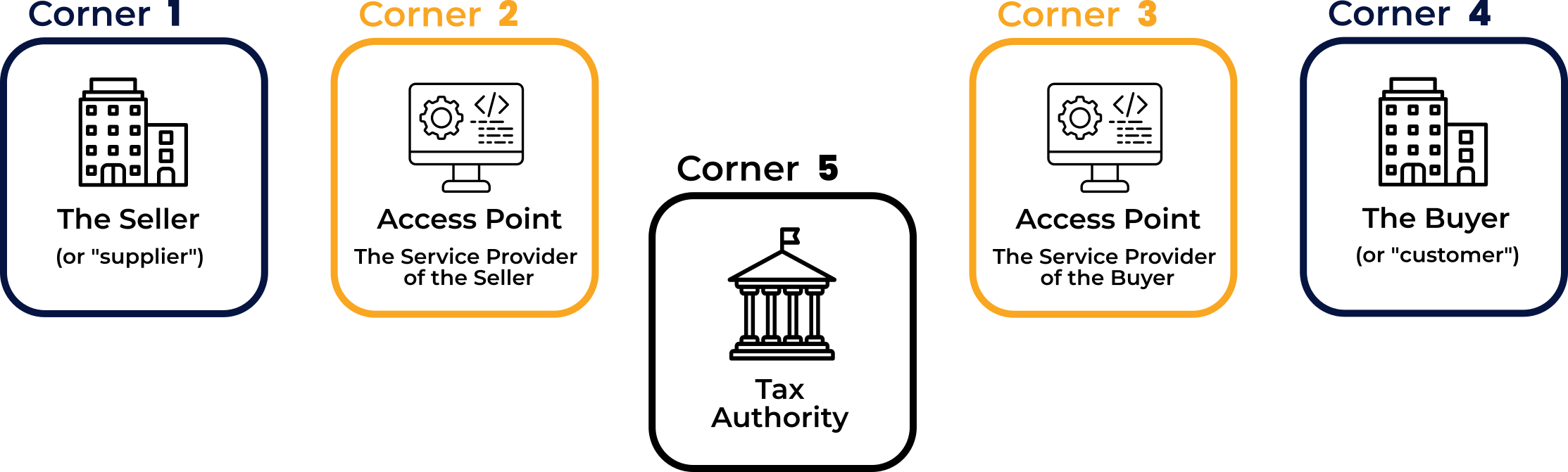
As a result, the B2B mandate follows a standard 5-corner model involving the following participants:

This change means that companies are not allowed to transmit invoices on their own and have to rely on Accredited Platforms.

The up-to-date list of Accredited Platforms [↗︎] is available on the DGFiP website and currently contains around 150 officially certified solutions.

Companies have the flexibility to work with multiple Accredited Platforms. For instance, they may choose different solutions based on factors such as business location, business unit, subsidiary, or invoice type (e.g. direct or indirect purchases).

Additionally, all Accredited Platforms must establish direct connections with the PPF (in AS2 or SFTP) to interact with the Annuaire and the Data Concentrator.

Annuaire & Electronic Invoicing Addresses

Invoice senders and recipients are primarily identified using their SIREN (national company identifier).

But the SIREN alone is insufficient for the accurate routing of e-invoices. To address this, additional routing data must be included in the e-invoice: the electronic invoicing address. This routing information can be structured as either: 

  • a combination of SIREN (mandatory) and a suffix code (free text, optional)
  • or a combination of SIREN (mandatory), SIRET (another national company identifier, optional), and a routing code (free text, optional)

All routing data is accessible to Accredited Platforms (via API) and to businesses (via a web portal), within a central directory known as the “Annuaire” [↗︎], hosted by the DGFiP.

The recipient’s electronic invoicing address is essential: senders must obtain it before issuing the invoice, as it is a mandatory invoice field.

E-Invoice Format

3 formats are mandated by the government, and must be supported by all Accredited Platforms. All 3 are extensions of the European Norm (EN) 16931:

  • UBL 2.1
  • UN/CEFACT CII
  • Factur-X (hybrid format with a readable PDF that includes an attached XML containing the structured data)

Exact syntaxes and invoice data fields are detailed within the AFNOR XP Z12-012 standard, available among the mandate’s official specifications [↗︎].

Alternatively, both parties and their respective Accredited Platforms can also mutually agree on any other electronic format, provided the necessary tax data for e-reporting can be extracted from it. 

This flexibility was introduced to allow companies to continue operating most of their existing EDI connections and to use the EDIFACT format, which remains widely used in various industries.

E-Invoice Delivery

Invoice delivery under France’s e-invoicing mandate is handled entirely by Accredited Platforms. Businesses’ main responsibility is to connect to their chosen platform, which may offer an API, a dedicated software connector, a web portal requiring manual actions, or a combination of these methods.

The Peppol network is the default delivery method between Accredited Platforms. It enables platforms to connect seamlessly, allowing any seller to deliver an electronic invoice to any buyer without each platform having to establish a separate connection with every other platform. The French authorities refer to this exchange as Flow 2 of the mandate.

To support this model, DGFiP, France’s tax authority, acts as the French Peppol Authority and has published Peppol Authority Specific Requirements (PASR) [↗︎] for Accredited Platforms.

Alternatively, two Accredited Platforms may agree to exchange invoices through a direct point-to-point EDI connection. This preserves existing EDI arrangements while Peppol remains the default route for universal interoperability. The French authorities refer to this exchange as Flow 3 of the mandate.

Tax Data Reporting

The e-invoicing mandate also includes the automated reporting of tax data to the tax authority.

When an Accredited Platform transmits an e-invoice, it simultaneously extracts the relevant tax data, compiles it into a structured XML subset and sends it to the tax authority in real time.

In most countries, this type of tax-data transmission is commonly referred to as “e-reporting”. France uses the term differently: under the French mandate, “e-reporting” refers to the periodic reporting of B2C and cross-border B2B transactions.

Instead, the French authorities refer to the real-time transmission of tax data extracted from domestic B2B invoices as Flow 1 of the mandate.

E-Invoice Lifecycle

As part of the upcoming mandate, a complete invoice lifecycle has been defined. All Accredited Platforms must implement it to give invoice issuers, recipients and the PPF visibility over the status of each invoice.

Status updates must be exchanged as CDAR XML messages and may be transmitted through the Peppol network.

The lifecycle includes 14 main statuses, with additional statuses for specific use cases. However, only four statuses must be exchanged between participants:

  • Status 200 – Submitted: the supplier has submitted a new invoice to its sending Accredited Platform. The PPF and the invoice recipient should then receive it.
  • Status 210 – Refused: the recipient has refused the invoice at business level, for example because of an incorrect price or quantity.
  • Status 212 – Payment Received: sent by the invoice issuer to the recipient and the PPF, this status confirms that payment has been received. It is mandatory only where both the transaction and supplier fall under the VAT-on-payment scheme (TVA sur les encaissements).
  • Status 213 – Rejected: the receiving Accredited Platform has automatically rejected the invoice following a technical check, for example because of invalid syntax or an incorrect recipient.

All other statuses are optional. A party may choose whether to send or use these updates, but Accredited Platforms must be able to convey them between participants.

For Accredited Platforms exchanging invoices through Peppol, two further statuses are mandatory: Status 202 – Invoice Received and Status 203 – Made Available.

This creates practical challenges for companies, which must be able to manage the invoice lifecycle whether they receive optional statuses or not.

Even so, the mandatory statuses provide essential information: an invoice’s submission (Status 200), its successful receipt and availability when Peppol is used (Statuses 202 and 203), its early termination because of a business or technical issue (Statuses 210 and 213), and, in some cases, its completion through payment (Status 212).

Standards XP Z12-012 and XP Z12-014, available among the mandate’s official specifications [↗︎], provide the necessary guidance on the invoice lifecycle, its statuses and the CDAR file format. They also define additional statuses for routing errors, cancellations and other specific use cases.

Use Cases

Although the French e-invoicing mandate is complex, it is supported by extensive documentation produced by the DGFiP and the AFNOR commission.

AFNOR standard XP Z12-014, available in the mandate’s official specifications [↗︎], documents the practical invoicing scenarios, called “use cases”, that go beyond a standard supplier-to-buyer invoice. For each scenario, it sets out the parties involved, the information to include, the exchange flow and the relevant invoice lifecycle statuses.

The standard covers, among others:

  • Self-billing
  • Factoring
  • Advance and final invoices
  • Employee expenses
  • Direct-payment subcontracting
  • Invoices paid by a third party
  • Marketplace transactions
  • Retail and point-of-sale invoices

It also provides additional guidance for specific sectors, including media, energy and real estate.

The latest version of XP Z12-014 dates from June 2026 and lists 44 use cases.

Technical Details: E-Reporting (B2C, cross-border B2B)

Alongside its e-invoicing obligations, France will introduce an e-reporting requirement in 2026 and 2027 for B2C and cross-border B2B transactions. Businesses will need to provide the relevant data to their Accredited Platforms, which will transmit aggregated data to the tax authority.

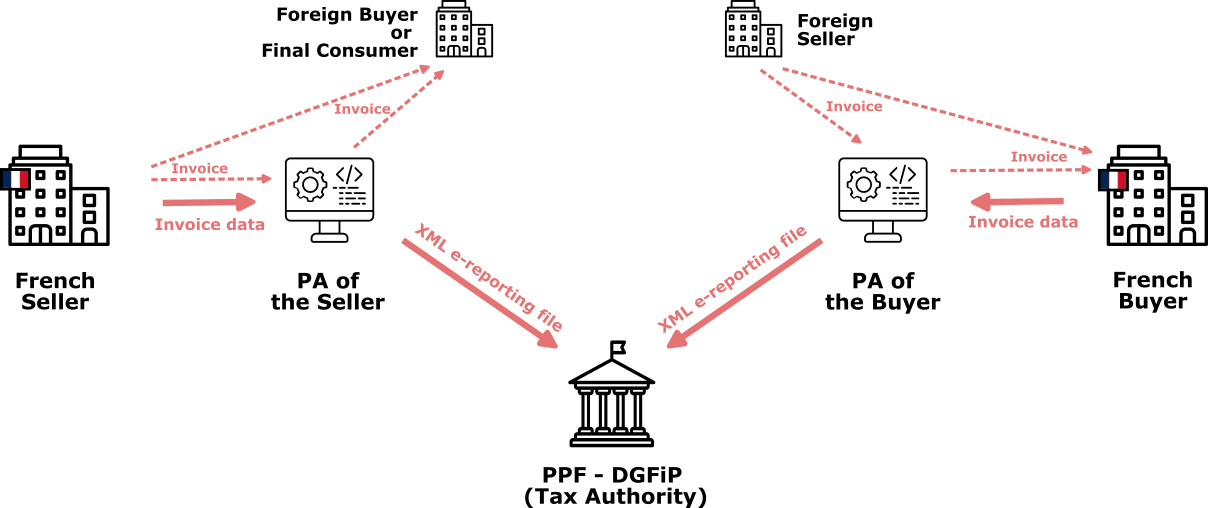
France 2026-2027 e-reporting schema
France's e-reporting model: unregulated invoice exchanges, with periodic reporting via an Accredited Platform to the tax authority.

E-Reporting Mandate Overview

The French e-reporting obligation follows the same timeline as the B2B e-invoicing mandate, and specifically applies to two types of transactions:

  • Cross-border B2B purchases & sales, meaning invoices exchanged by a French business with its foreign trading partners
  • B2C sales, whether an invoice or a receipt was issued

This “French” e-reporting is called the Flow 10 of the mandate, and requires French businesses to extract data from relevant transactions and to send them periodically to the tax authority through their Accredited Platform.

The transmission of the invoice or receipt itself is not regulated, and can take place in whichever format works best, such as paper or PDF.

Domestic B2B invoices are not included in the e-reporting requirement, as they are transmitted electronically via Accredited Platforms under the e-invoicing mandate. These Accredited Platforms then automatically extract the relevant tax data and submit it in real time to the tax authority in what is called the Flow 1 of the mandate.

E-Reporting data & transmission

The e-reporting file format is a proprietary format relying on XML, been designed by the French tax authority, and is not based on any international standard.

It must be submitted to the tax authority via the PPF by the company’s Accredited Platform at a specified frequency, ranging from every 10 days to every 2 months, depending on the company’s VAT regime.

More specifically, companies have to consolidate their transactions data covering those periods: all international B2B transactions must be listed individually, while B2C transactions will be aggregated on a daily basis.

Additionally, companies subject to the cash accounting VAT scheme (“TVA sur les encaissements”) will be required to submit additional e-reporting to detail payments received for international B2B and B2C sales.

Standards XP Z12-012 and XP Z12-014, as well as the “External Specifications” available among the mandate’s official specifications [↗︎], provide the necessary guidance.

Technical Details: Public Sector & Chorus Pro (B2G, G2G, G2B)

Chorus Pro now acts as the Accredited Platform for all public entities, covering both inbound & outbound flows. Private suppliers must submit invoices to French public administrations electronically, either directly through the Chorus Pro central platform (the “old” way) or through an Accredited Platform (the “new” way).

Late 2010s e-invoicing mandate

Mandatory B2G and G2G e-invoicing was progressively introduced in France between 2017 and 2020. The obligation first applied to large companies and public entities in 2017, then extended to intermediate-sized enterprises, SMEs and micro-enterprises until it covered all suppliers in 2020.

All invoices issued to French public administrations must be submitted through the Chorus Pro central platform [↗︎]. While several formats are accepted, the main ones are:

  • UBL 2.1
  • UN/CEFACT CII
  • Hybrid PDF with structured XML, such as Factur-X, or a signed PDF with an embedded XML file

All of these formats are compliant with the European Norm (EN) 16931.

Suppliers to public administrations that are not equipped with an e-invoicing solution can also enter their invoices manually on Chorus Pro.

Comprehensive B2G specifications [↗︎] are available in the documentation section of the Chorus Pro portal.

2026-2027 e-invoicing mandate

The new mandate introduces an additional option for private suppliers of public administrations: they may submit B2G e-invoices to Chorus Pro through their Accredited Platforms, as they do for domestic B2B e-invoicing.

Additionally, Chorus Pro has become the Accredited Platform for all public entities and has therefore evolved to support the 2026–2027 mandate, including some changes to invoice statuses, invoice content and certain specific fields.

The current version 3.2 of the External Specifications [↗︎] provides extensive documentation on Chorus Pro’s role under the 2026–2027 mandate.

The current situation differs from the initial plan, under which Chorus Pro was expected to be fully replaced by the Portail Public de Facturation (PPF). Announcements made by the DGFiP at the end of 2024 confirmed this revised approach.

As a result, Chorus Pro also remains available in its existing form, and direct connections to the platform (i.e. the traditional submission method introduced under the late-2010s mandate), will remain valid for several more years, likely until around 2030.

France Accredited Platforms Benchmark

The most comprehensive comparison of Accredited Platforms in France:

✅ 100 participating Platforms
✅ 60+ analyzed criteria
✅ Objective & neutral benchmark
✅ Free download (in French only)

The Invoicing Hub Word

France

After introducing a central platform for B2G e-invoicing in the late 2010s, France planned in the early 2020s to extend the model to B2B e-invoicing through a central platform called the PPF and certified service providers.

The model was later simplified, and the PPF project was cancelled. Accredited Platforms now handle invoice exchanges and reporting, while the public infrastructure provides the central directory of French invoice recipients, known as the Annuaire, and a data concentrator that receives data extracted from invoices.

This change affected businesses, which must now choose an Accredited Platform and may face additional costs compared with the originally planned free PPF. Accredited Platforms therefore play a central role in the mandate, with providers ranging from international e-invoicing specialists to French accounting software vendors, banks and many others.

The French reform remains technically complex, particularly because of requirements such as invoice lifecycle statuses. The DGFiP and the AFNOR commission continue to develop the specifications, while the State operates the central components and coordinates interoperability.

Among the countries planning e-invoicing mandates based on a five-corner model and the Peppol network in the coming years, France is one of the first major economies to go live. To illustrate this, France has already by far the largest number of recipients on the Peppol network, and the project will definitely provide valuable insights for the countries that follow.

The reform began on September 1, 2026, but many companies are still not ready, and some Accredited Platforms still lack critical features. E-reporting is almost non-existent at the moment and, in anticipation of these challenges, the authorities have adopted a supportive and tolerant approach during the launch phase, with a grace period lasting at least until the end of 2026.

Get your Project Implemented

Gold Sponsor

Iopole - Logo transparent
IOPOLE’s API-first Iopole e-Invoicing Hub enables software vendors to deliver compliant e-invoicing and e-reporting across France and internationally, trusted by 150+ integrations and processing 150M+ documents yearly.

Through the Iopole e-Invoicing Hub, applications connect via API to Peppol-certified networks and French tax authorities, ensuring seamless regulatory compliance across domestic and international flows.
Since 2022, IOPOLE has become the trusted partner for 150+ software integrations, processing 150+ million B2B2B documents annually on a SecNumCloud sovereign infrastructure with 99.9% SLA.

As a pure-player in e-invoicing, IOPOLE focuses exclusively on infrastructure, compliance updates, and scalable technical support, allowing software vendors to expand their services quickly without competing with their core solutions. Optional 10-year legal archiving ensures secure, long-term compliance and audit readiness.

Silver Sponsors

TX2 CONCEPT Logo - Color transparent
TX2 CONCEPT helps businesses comply with e-invoicing regulations, in France and internationally, with secure and automated solutions. As an Approved Platform and Peppol Access Point, we ensure seamless compliance.
Docoon.immo logo
Docoon.immo (ex Neovacom), a French PDP, offers Freedz, a collaborative solution automating electronic invoice processing in real estate and construction, ensuring legal compliance and improving customer-supplier relations.
Cleartax logo
ClearTax is an AI-native technology company helping enterprises automate compliance, invoicing, and finance operations across 50+ countries with intelligent, scalable, enterprise-grade solutions.
Symtrax Logo Dark Blue
Symtrax delivers solutions that streamline AP and AR processing, ensure compliance, and integrate seamlessly with the ERP systems of mid-sized and large companies.
Contact us to learn about our sponsorship plans
Arteva Logo - Color transparent
Artéva, publisher of the Orchestrade® SaaS platform, digitizes your invoice management processes and automates your B2B exchanges with all of your business partners.
Colored logo with transparent background of the service provider "Tenor"
Tenor specializes in publishing Electronic Invoicing and our primary focus is on streamlining exchanges between companies through solutions that interconnect information systems.
EDT (Weexa Group) offers electronic invoicing and B2B flow automation solutions (iPaaS, API, web portals, PDP) in France and internationally.
Itesoft Logo
ITESOFT, the French leader in digitisation and automation software, processes more than a billion documents every year. Its solutions, based on artificial intelligence, optimise processes for more than 650 customers.
Yooz logo
Yooz is the smartest, most powerful, and easiest-to-use cloud solution for automating the e-invoicing and Purchase-to-Pay processes.
Docoon Logo - Color transparent
Docoon is a highly secure solution provider offering electronic signature, electronic invoicing, and a white-label Approved Platform (PA). Additionally, it provides archiving services and a multichannel platform to enhance business processes.
SEEBURGER, 40 years with Seeburger logo
SEEBURGER provides compliant, automated e-invoicing across France, Spain and 33 other countries, with native SAP and broad ERP support, benefiting IT and Finance and built on 40 years of experience.
ICD International logo
ICD International is a French independent software vendor specializing in e-invoicing, EDI, and document digitalization, providing compliant, automated solutions to optimize Purchase-to-Pay and Order-to-Cash processes.
Arratech delivers Access Points & SMP as-a-Service, giving businesses and service providers a modern, compliant platform to connect seamlessly to the Peppol Network and scale e-invoicing with ease.
Comarch Logo
Comarch provides a certified, cloud-based e-invoicing platform designed for global enterprise operations. Trusted in over 60 countries, their scalable solution automates invoice exchange, ensures seamless ERP integration, and guarantees continuous legal compliance.
Septeo logo with transparent background
Septeo is a leading European software group, providing AI-driven e-invoicing and financial management solutions to help businesses go beyond compliance and optimize financial performance.
Esalink logo
EsaLink offers Hubtimize e-Invoicing, an Approved Platform specializing in EDI, already adopted by more than 48,000 active customers. This ERP-agnostic solution provides, among other benefits, multi-format management.
IDC – Indicom eDocument Care Spa Logo
IDC designs and develops innovative solutions and outsourced services to optimize information management. The goal is to be protagonists of the digital transformation of companies' internal processes.
Ecosio logo
ecosio provides futureproof e-invoicing compliance services via a single connection to the cloud. Once connected, businesses can achieve full compliance with e-invoicing mandates all over the world with ease.
Basware Logo - Color transparent
Basware is how the best finance teams gain complete control of every invoice, every time. Our Intelligent Invoice Lifecycle Management Platform ensures efficiency, compliance and control for all invoice transactions.
Esker Logo
Esker is a global cloud platform built to unlock strategic value for Finance, Procurement and Customer Service professionals, and strengthen collaboration between companies by automating the cash conversion cycle.


Official Resources [↗︎]

Public entity supervising the e-invoicing mandates in France

Public entity in charge of technically enabling the e-invoicing mandates in France

Official list of resources about the upcoming B2B e-invoicing & e-reporting mandate

Detailed documentation on how to implement the upcoming French B2B e-invoicing & e-reporting mandates

Official list of Accredited Platforms

Public directory listing all VAT-registered companies in France and their e-invoicing address

France B2G central platform

Detailed documentation on how to implement the French B2G e-invoicing mandate

Related Resources about France

Discover Yooz, the cloud solution for electronic invoicing and process automation, officially registered as a PA.
Choose Docoon Invoice in White-Label / Grey-Label Download our guide to learn how to integrate a Certified Platform into your solution
An Iopole workshop on e-reporting for POS software, featuring a customer case study from Chift on cash register interoperability.

Advertisement

Iopole - Logo transparent
IOPOLE’s API-first Iopole e-Invoicing Hub enables software vendors to deliver compliant e-invoicing and e-reporting across France and internationally, trusted by 150+ integrations and processing 150M+ documents yearly.

Latest News

Photo of the Merlion, a lion head fountain, in Marina Bay in front of the Singapore skyline

Peppol & GENA e-invoicing conferences in Singapore – 17-19 November 2026

Peppol Conference APAC 2026 takes place on 17-18 November, followed by the GENA IDT Summit on 19 November, both at the same venue in Singapore.

Spain’s B2B e-invoicing mandate will start in October 2027

Spain’s Ministerial Order is now published, triggering the countdown to mandatory B2B e-Invoicing and providing key technical rules

Greece slightly postpones the next phases of its mandates

Just one day before phase 2 of its e-invoicing mandate, Greece revised the implementation timetable for both e-invoicing and e-transportation.

Slovakia proposes latest adjustments and an extended grace period

A new bill outlines a six-month penalty-free period, removal of buyer-side e-reporting, alongside the release of valuable practical guidance.

VeR expands the conversation around B2B e-invoicing

VeR’s public events widen the discussion about B2B e‑invoicing as a driver for digitalization across the German economy
Chatbot icon at the colors of The Invoicing Hub

Try me 🙂

I’m an e-invoicing  expert and I might just surprise you!

📩 ‎ Newsletter

Receive the latest e-invoicing news, directly in your mailbox, once a month.