Skip to content

Advertisement

Become a gold sponsor - stacked
Contact us to learn about our sponsorship plans

E-Invoicing in Croatia:
2026 Requirements &
Fiscalization 2.0

Last update: 2026, September 22

Summary

Croatia applies mandatory e-invoicing and “fiscalization” requirements across B2G, B2B and B2C transactions since January 1, 2026. Additionally, transaction data must be extracted and transmitted to the tax authority through the ePorezna central platform.

B2G & B2B Transactions

Mandatory e-invoicing

Electronic invoices must be sent in HR-CIUS UBL format, preferably through the local eDelivery network, with real-time reporting through the ePorezna central platform and additional obligations, in a process locally referred to as “Fiscalization”.

B2C Transactions

Mandatory e-reporting

B2C invoices and POS receipts must be pre-validated through the ePorezna central platform following a Clearance model and locally referred to as “Fiscalization”, before being delivered by the issuer with a unique identifier / QR code.

Croatia

Table of Contents

What the Law Says

B2G & B2B E-Invoicing

On January 1, 2026, Croatia introduced a new e-invoicing mandate, and aiming for all companies countrywide, both private and public, to issue and exchange domestic electronic invoices, and report tax data to the tax authority in a process referred to as “Fiscalization”.

Under this obligation, B2G & B2B invoices must be transmitted electronically using the HR-CIUS UBL format, compliant with the European Norm (EN) 16931, through a local decentralized network (similar to the Peppol network) being highly recommended by Porezna uprava, Croatia’s tax authority.

Invoice data must also be reported in real-time to Porezna uprava via a central platform called ePorezna [↗︎] (“eTax”).

This “Fiscalization” process is governed by the Fiscalization Act 2.0 [↗︎] and introduces multiple additional requirements, most notably:

  • Registration of the e-invoice reception address in the central public directory called AMS (Adresar Metapodatkovnih Servisa)
  • Transmission of invoice data to the tax authority by both the invoice issuer and the receiver for cross-validation
  • Classification of items using KPD categories
  • Notification of invoice rejection by the recipient

The rollout occurs in two stages:

  • January 1, 2026: VAT-registered businesses must issue and receive e-invoices, while non-VAT entities are only required to be able to receive them
  • January 1, 2027: All obligations apply to both VAT and non-VAT registered businesses

The mandate applies only to domestic transactions with registered e-invoice recipients: cross-border transactions, imports and exports remain outside its scope.

Prior to this mandate, B2G e-invoicing was already mandatory [↗︎] since 2019, through a central platform operated by the Financial Agency (FINA). Public entities (and their suppliers) will still be able to use FINA to exchange B2G electronic invoices from 2026 onwards, either through a direct connection or through the local decentralized network.

Invoices must generally be archived for six years.

B2C E-Reporting

Croatia does not impose a structured B2C e-invoicing mandate, but instead requires systematic e-reporting following a Clearance model, in a process referred to as “Fiscalization” and applied to all invoices and receipts issued to final consumers.

B2C obligations already existed in Croatia to some extent, and the new regulation, also part of the Fiscalization Act 2.0 [↗︎], broadened the scope to most B2C transactions (invoices, receipts, …) and forms of payment (cash, card, …).

This B2C obligation requires the supplier to submit tax-related invoice data of B2C transactions to the tax authority via ePorezna [↗︎] (eTax), the tax authority portal, in a proprietary XML format for validation.

Upon success, the administration sends back to the invoice issuer a unique identifier called JIR (Jedinstveni Identifikator Racuna) confirming that the invoice has been successfully validated.

The issuer is then responsible for including this identifier in the final invoice / receipt (typically as a QR code) before delivering it to the customer, most often as a printed or PDF document, as final consumers are typically not equipped to receive electronic documents.

This requirement applies to any type of software that generates B2C invoices, including both traditional invoicing solutions and cash register systems.

Unlike the B2G and B2B mandate, which will be implemented in two phases, the B2C obligation is in full effect since January 1, 2026.

Certain B2C activities are exempt for the mandate, under Article 4 of the Fiscalization Act 2.0, such as passenger transport ticket sales, postal and financial services, or insurance.

Invoices and POS receipts must generally be archived for six years.

Timeline

B2C Fiscalization begins

Croatia requires e-reporting of consumer invoices and receipts to the tax authority through a Clearance model.

B2G e-invoicing reception

Public authorities become required to receive structured electronic invoices for public-procurement transactions.

B2G e-invoicing fully mandatory

Suppliers are required to issue structured electronic invoices to Croatian public authorities through a solution offerred by FINA

Fiscalization Act 2.0 - Phase 1

B2G + B2B e-invoice sending & e-reporting become mandatory for all VAT-registered businesses, while B2C e-invoicing clearance & B2G + B2B e-invoice reception becomes mandatory for all businesses

Fiscalization Act 2.0 - Phase 2

All obligations (B2G + B2B e-invoicing & e-reporting, B2C e-invoicing clearance) become mandatory for all businesses countrywide

2013
December 1, 2018
July 1, 2019
January 1, 2026
January 1, 2027

Latest E-Invoicing News in Croatia

Photo of the European Parliament, gathered within the European Commission in Brussels, capital of Belgium

European Commission calls for public input to shape the future of EU e-invoicing

A “Reality Check” event and a public consultation launched by the European Commission aim to shape EU e-invoicing by gathering feedback.
Set of flags from around the world waving in the wind

EN 16931 update: the next step in e-invoicing is on its way

With the EU shifting from public e-invoicing mandates to full B2B, the EN 16931-1 update will arrive mid-2026 to raise compliance standards.
Croatian flag waving on top of the Central Bank building in Zagreb, capital of Croatia

A tense launch for Croatia’s e-invoicing mandate

Croatia made e-invoicing mandatory for B2G, B2B and B2C transactions just six months after the law passed, which is proving ambitious.

Technical Details (B2G & B2B)

The Croatian B2G & B2B mandate requires all businesses to exchange invoices electronically through a decentralized network, with real-time reporting of invoice data to the tax authority, and is called the “Fiscalization of e-invoices“.

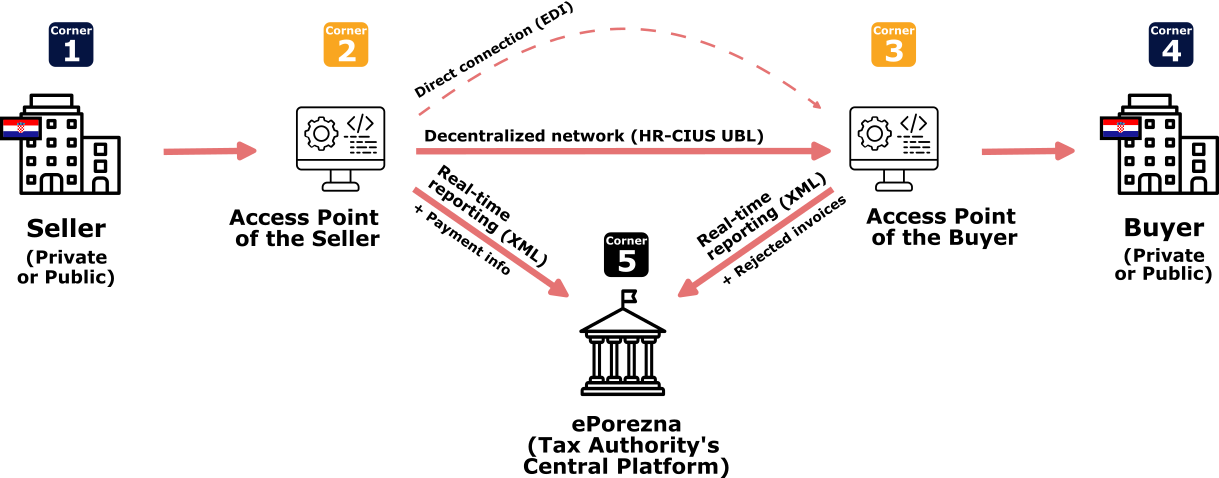
Schema describing the Croatia B2G & B2B e-invoicing model
Croatia’s B2G & B2B e-invoicing and fiscalization model: both parties exchange electronic invoices and report invoice data to the tax authority.

E-invoice format

Invoice transmission for all public and private businesses must be done electronically, in an unified manner. It includes all the following types of transactions:

  • B2G: Business-to-Government
  • B2B: Business-to-Business
  • G2B: Government-to-Business
  • G2G: Government-to-Government

Invoices must be issued following the HR-CIUS XML format, which is compliant with the European Norm (EN) 16931. 

Extensive e-invoice documentation [↗︎] is available, including e-invoices examples, schemas (XSD), schematrons and codelists. So far, only UBL documentation seems to have been published.

E-invoice delivery

Under the mandate, electronic invoices must be delivered through a decentralized network built locally and based on the EU’s eDelivery [↗︎] framework. 

In practice, this functions as a Croatian equivalent of the Peppol network, following the same core concepts such as Access Points, a business directory, and AS4 communication. This network must be adopted as the default solution by all companies.

Businesses can either establish and operate their own Access Point or use a certified service provider (details provided below).

Alternatively, electronic invoices can be exchanged through other methods, such as direct EDI connections between trading partners.

To ensure correct routing and delivery, each company must register their invoice reception address in the Croatian central business directory, called AMS. This registration must be completed on ePorezna [↗︎] (eTax), the official portal of the tax authority, or can be performed by the selected certified provider [↗︎].

"Fiscalization" - Real-time reporting

In parallel to the electronic invoice delivery, a subset of the invoice’s tax data must also be extracted, digitally signed, and submitted to the tax authority portal, ePorezna. This process is known as the “Fiscalization” of an invoice.

It is important to note that Fiscalization must be carried out by both the sender and the receiver of the invoice to enable the government to cross-check the accuracy of the reported data.

The Fiscalization message to be sent to the tax authority must be formatted in a proprietary XML format, and here again, comprehensive technical documentation [↗︎] is available, including examples, schemas, and technical specifications.

Among the information required in the Fiscalization message is the KPD code [↗︎] for each sold item. The KPD code comes from Croatia’s national classification system, which categorizes all goods and services by activity or product-service type.

Its purpose is to help the government monitor economic activity more effectively. Properly assigning KPD codes represents a significant task for companies, as they must ensure that each product or service is correctly classified according to this system.

"E-reporting" - Additional requirements

In addition, Croatian companies must comply with three further obligations, collectively referred to as “e-reporting”. These tasks are separate from the Fiscalization process, which is why they are distinguished under this term.

The three obligations involve sending e-reporting XML messages to the ePorezna central platform in the following cases:

  • The invoice issuer must send tax data even for invoices that could not be delivered electronically, for example if the recipient has not registered an electronic address in the AMS central directory.
  • The invoice issuer must report payment information for each invoice to the tax authority.
  • The invoice receiver must notify the tax authority if they choose to reject an electronic invoice (no later than the 20th day of the month following the transaction).

Certified providers

Multiple e-invoicing solutions covering all aspects of the mandate are available on the market and have been officially certified by Porezna uprava, Croatia’s tax authority, which maintains a list of certified Information Intermediaries [↗︎].

Their use is not mandatory, as companies can choose to develop their own Access Point, connect directly to the ePorezna platform, or rely on the online tools provided by the Tax Administration.

However, if companies prefer to rely on an e-invoicing solution rather than manage their own Access Point and handle all fiscalization and e-reporting obligations, they must select one of the officially certified providers.

Notably, FINA, the state entity that facilitated B2G e-invoicing in the country from 2019 to 2025, is one of the officially certified providers. Public-sector invoice flows can therefore continue through FINA, either by using a direct connection (like businesses have been doing since 2019) or through the Croatian decentralised network.

Online tools

The FiskApplication (FiskAplikacija) can be used by any company to access a wide range of information, including an overview of their Fiscalization messages and their statuses, such as errors and rejected e-invoices. It also allows companies to perform key tasks, such as declaring their e-invoice reception address (and if applicable, their certified provider). Alternatively, private businesses that are not VAT-registered can use the MIKROeRACUN application to fulfill all their obligations, including declaring their reception address in the AMS and Fiscalizing e-invoices. They can use it through manual data entry to comply with the two phases of the mandate, i.e. receive e-invoices and perform the corresponding Fiscalization from January 1, 2026, and to send e-invoices from January 1, 2027. Both applications can be accessed directly on the ePorezna portal [↗︎].

Technical Details (B2C)

The Croatian B2C mandate requires businesses to report transaction data to the tax authority before issuing invoices and receipts to final consumers, following a Clearance model, and is called the “Fiscalization of final consumption accounts”.

It has applied since 2013 and requirements were extended on January 1, 2026 through the Fiscalization Act 2.0.

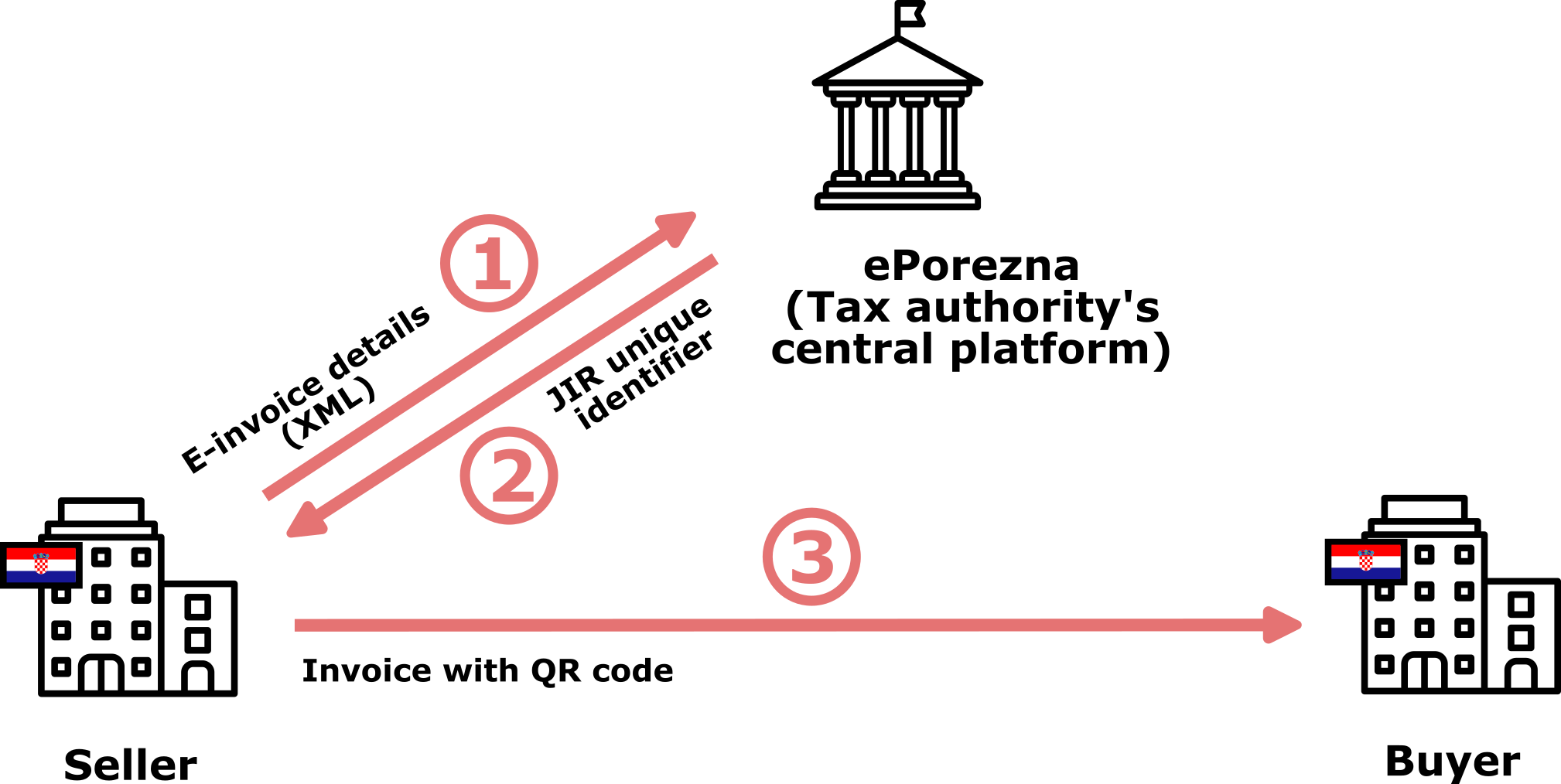
Schema describing the Croatia B2C e-invoicing model
Croatia’s B2C Clearance model: the Tax Administration validates transaction data before the invoice or receipt is delivered to the final recipient.

Invoice issuance & clearance

The Croatian B2C obligation, whose process is known as “Fiscalization”, essentially functions as a Clearance mandate.

This means that when issuing an invoice, companies must first send a subset of the invoice data in a proprietary XML format to the tax authority platform, ePorezna [↗︎], which validates, or “clears,” the invoice.

Once validated, the platform generates a unique identifier called JIR (Jedinstveni Identifikator Racuna) and returns it to the issuer, who must include it on the invoice or receipt. This is typically done by embedding a QR code on the document.

To meet this Clearance requirement, referred to as “Fiscalization” in Croatia, all companies must use B2C invoicing software capable of fully handling the Fiscalization process. This applies to all types of transactions and payments, including card and cash payments in stores, so even cash registers software is in scope.

Comprehensive technical B2C documentation [↗︎] is available to describe this Fiscalization process.

Invoice format & delivery

The Croatian mandate does not impose any specific electronic format or transmission method for B2C invoices or cash register receipts. Businesses may continue issuing them as usual, most often as PDF or printed invoices / receipts. Once received, customers can use the JIR identifier or QR code shown on the invoice or receipt to verify that it was properly fiscalized and recorded by the Tax Administration [↗︎].

Additional requirements

In addition to using software and equipment capable of Fiscalization, companies must also comply with several procedural requirements [↗︎]:

  • Determine and adopt an “internal act” defining the company’s key B2C invoicing processes, including invoice numbering methods, a list of business premises, and of labels assigned to each premise and payment terminal
  • Register their business premises on the ePorezna [↗︎] tax administration portal
  • Display a notice of information regarding Fiscalization within their premises
  • Maintain a book of imported invoices to ensure invoice issuance can continue in case of payment terminal failure, or alternatively implement backup solutions that prevent interruption of service

The Invoicing Hub Word

Croatia

Croatia has introduced extensive invoicing obligations that covers all types of transactions: B2G, B2B, and B2C. The framework combines:

  • Combined e-invoicing and e-reporting for B2G and B2B transactions, aligned with market standards and the principles of the ViDA directive, including a decentralized five-corner network and an EN16931-compliant invoice format.
  • A clearance e-reporting model for B2C transactions, ensuring the tax authority receives comprehensive transaction data, while preserving the usual sales process.

However, the impact on businesses is significant. The Croatian tax authority has defined a wide range of requirements, including mandatory registration of business premises and classification of all products using the KPD taxonomy, while also choosing not to rely on the Peppol network. As a result, companies must invest additional effort to connect to the local infrastructure and comply with the mandate.

The implementation timeline was also very tight: the Fiscalization Act 2.0 was published on June 13, 2025, and the first phase of the obligations began on January 1, 2026.

The mandates now appear to be operating at scale, although their implementation has required technical and organisational adjustments by businesses, service providers and the tax administration.

Get your Project Implemented

Gold Sponsor

Become a gold sponsor - stacked
Contact us to learn about our sponsorship plans

Silver Sponsors

Contact us to learn about our sponsorship plans

Official Resources [↗︎]

Croatia’s tax authority, responsible for supervising e-invoicing in the country

Official government e-invoicing homepage, resources and guidance

Official explanations & technical resources about B2G & B2B requirements

Official explanations & technical resources about B2C requirements

List of certified providers for B2G, B2B and B2C requirements in Croatia

List of questions & answers about the B2G, B2B and B2C obligations in Croatia

Official comparison of B2G & B2B obligations vs. B2C obligations

Related Resources

A case study on how Agfa-Gevaert Group streamlined global e-invoicing operations and cross-border compliance by partnering with Comarch.
A DGFiP-sourced guide to becoming an Accredited Platform (PA) in France: requirements, process, costs, and deployment models for ISVs.
Discover Yooz, the cloud solution for electronic invoicing and process automation, officially registered as a PA.

Advertisement

Become a gold sponsor - stacked
Contact us to learn about our sponsorship plans

Latest News

British Union Jack flying outside a classic London building beside a street lantern.

UK publishes the roadmap to its 2029 e-invoicing mandate

The UK details its e-invoicing roadmap, clarifying the mandate’s scope and timeline, while key technical requirements remain pending.

A busy October ahead of Slovakia’s 2027 e-invoicing mandate

October brings new eFaktúra guidance, Peppol updates and further progress on August’s legislative simplification proposals

UAE authorities release minor electronic invoicing amendments

The UAE amends and clarifies some e-invoicing requirements, easing compliance & implementation for businesses ahead of the 2027 rollout.

New accreditation requirements for e-invoicing solutions in the Philippines

The Philippines introduces new service provider accreditation rules, effective immediately, with a first application window in October 2026.

BMF publishes additional guidance on mandatory German e-invoicing

The BMF clarifies key technical requirements, invoicing scenarios and transitional tolerances ahead of Germany’s next e-invoicing mandate phase
Chatbot icon at the colors of The Invoicing Hub

Try me 🙂

I’m an e-invoicing  expert and I might just surprise you!

📩 ‎ Newsletter

Receive the latest e-invoicing news, directly in your mailbox, once a month.