Skip to content

Advertisement

Babelway logo
Babelway is a self-service Peppol and EDI platform that helps SMBs achieve e-invoicing compliance worldwide. A certified Peppol Access Point since 2014, trusted by 650+ customers across 26 countries.

E-Invoicing in Luxembourg:
B2G Rules & 2028-2029 B2B Mandate

Last update: 2026, October 14

Summary

Luxembourg requires suppliers to send invoices to public administrations electronically and plans to introduce mandatory B2B e-invoicing in 2028-2029. The proposed B2B e-invoicing architecture will rely on a four-corner model using Peppol, with no domestic e-reporting to the tax authority at this stage.

B2G Transactions

Mandatory

E-invoicing is mandatory for B2G transactions via the Peppol network in Peppol BIS 3.0 format, or manually through the MyGuichet.lu public platform.

B2B Transactions

Mandatory phased e-invoicing from 2028

E-invoicing is currently allowed, and will become mandatory through the Peppol network in the coming years (2028-2029) in anticipation of the ViDA directive.

B2C Transactions

No e-invoicing obligation

No e-invoicing or e-reporting obligation applies to business-to-consumer transactions in Luxembourg.

Luxembourg

Table of Contents

What the Law Says

B2G E-Invoicing

B2G e-invoicing is mandatory for suppliers of Luxembourgish public administrations in the context of public procurement and concession contracts.

The mandate was introduced by the Law of 16 May 2019 on electronic invoicing in public procurement and concession contracts [↗︎] and was rolled out in three phases between May 2022 and March 2023, based on supplier size. It now applies to all economic operators within scope.

Suppliers may transmit compliant invoices through the Peppol network, using the Peppol BIS Billing 3.0 format, which is the main transmission method.

Alternatively, companies without a Peppol solution can submit invoices manually through the public MyGuichet.lu portal [↗︎]. They can either upload invoices in Peppol BIS Billing 3.0 or XRechnung 3.0.1 format, or manually enter the invoice data to generate the invoice directly within the system.

A limited number of exceptions apply [↗︎], notably to certain contracts involving development cooperation, diplomatic missions and official activities abroad.

Invoices must generally be archived for ten years.

B2B E-Invoicing

Luxembourg plans to introduce mandatory B2B e-invoicing for domestic commercial transactions between companies established in the country.

On July 17, 2026, the Luxembourg government approved the draft bill. The Minister of Finance then submitted it to Parliament on July 30, 2026 as Draft Law No. 8815 [↗︎]. As the legislative process is still ongoing, the proposed requirements and dates have not yet become legally binding.

The proposed timeline consists of three phases:

  • January 1, 2028: all Luxembourgish companies would be required to receive and process electronic invoices.
  • July 1, 2028: large and medium-sized companies would be required to issue and transmit electronic invoices.
  • January 1, 2029: the obligation to issue and transmit electronic invoices would extend to all companies.

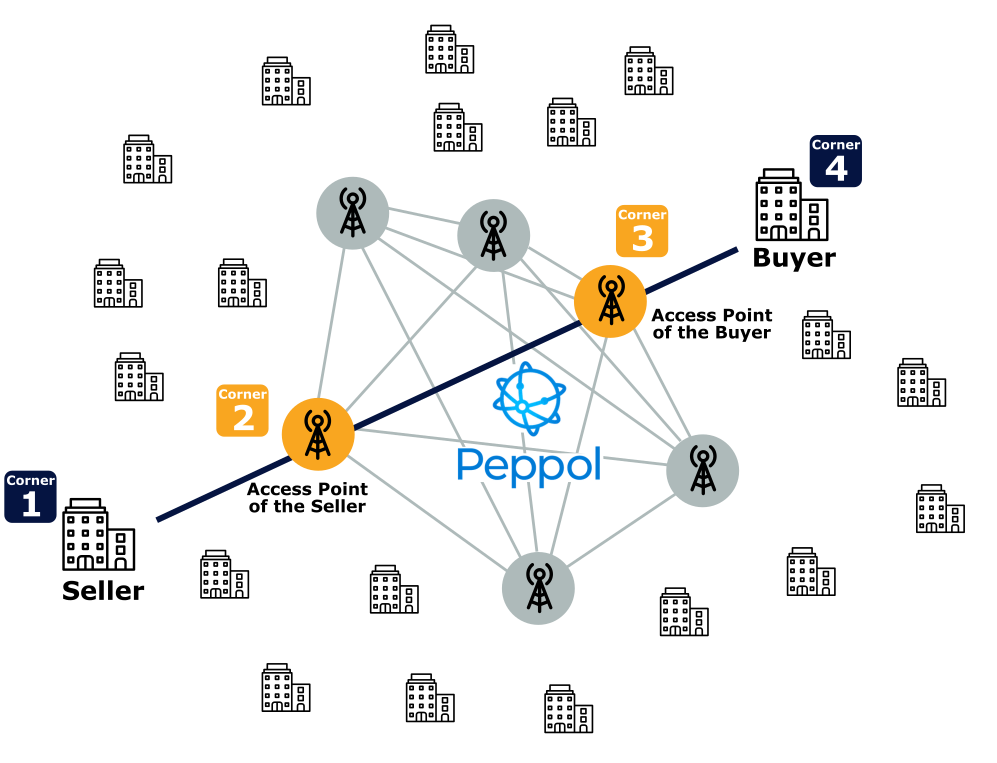
The proposed architecture would rely on the Peppol network in a four-corner model and would not involve domestic e-reporting to the tax authority. The draft law also provides for alternative technical solutions under certain conditions.

Further details must still be reviewed and finalised before the obligation enters into force.

In the meantime, businesses can still transmit B2B invoices in the following ways:

  • Paper-based invoices
  • PDF invoices with an e-signature or a complete audit trail
  • Electronic invoices exchanged for example via EDI or Peppol

Invoices must generally be archived for ten years.

B2C E-Invoicing

Luxembourg does not have a B2C e-invoicing or e-reporting mandate.

Companies may continue to issue business-to-consumer invoices and receipts through their usual channels, including paper invoices, PDF invoices sent by email and printed receipts.

Timeline

B2G E-Invoicing Mandate - Large companies

B2G e-invoicing is mandatory for large companies for all transactions with public administrations.

B2G E-Invoicing Mandate - Medium companies

B2G e-invoicing is mandatory for medium-sized companies for all transactions with public administrations.

B2G E-Invoicing Mandate - All companies

B2G e-invoicing is mandatory for all transactions with public administrations, no matter the company size

B2B E-Invoicing - Mandatory reception

All Luxembourg businesses must be able to receive B2B electronic invoices.

B2B E-Invoicing - Mandatory emission (Phase 1)

Large and medium-sized Luxembourg companies must send electronic B2B invoices

B2B E-Invoicing - Mandatory emission (Phase 2)

All Luxembourg companies must send electronic B2B invoices

May 18, 2022
October 18, 2022
March 18, 2023
January 1, 2028
July 1, 2028
January 1, 2029

Latest E-Invoicing News in Luxembourg

Panoramic view of Luxembourg City's Old Town and the Grund district, featuring historic buildings, stone bridges, and the Alzette River.

Luxembourg will introduce mandatory electronic invoicing from 2028

Luxembourg just approved a draft law to implement an e-invoicing reception obligation by 2028, closely followed by an issuance obligation.

Aerial view of Luxembourg City, showing its historic center

New Country Coverage: Luxembourg

The Invoicing Hub now covers a 32nd country: Luxembourg, with regular e-invoicing news & detailed country profile.
Photo of the European Parliament, gathered within the European Commission in Brussels, capital of Belgium

European Commission calls for public input to shape the future of EU e-invoicing

A “Reality Check” event and a public consultation launched by the European Commission aim to shape EU e-invoicing by gathering feedback.

Technical Details (B2G)

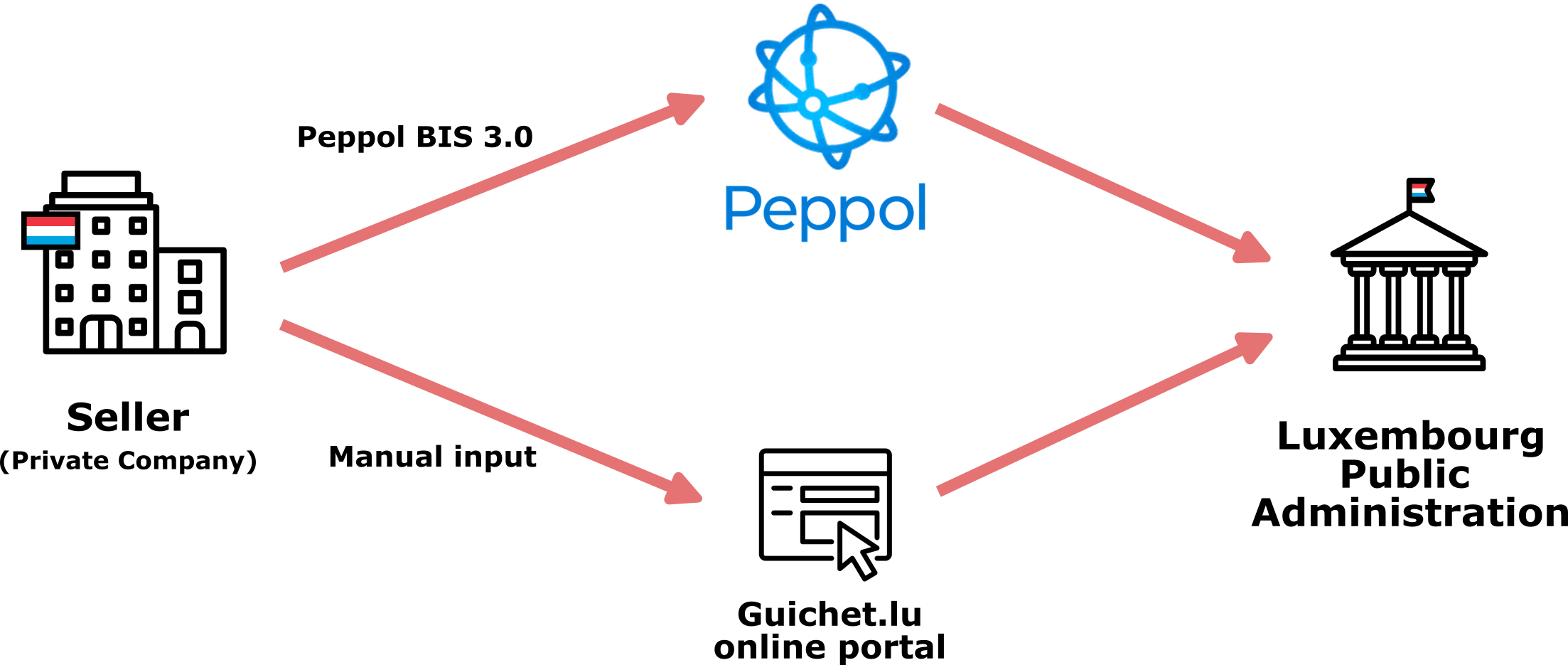
B2G e-invoicing is mandatory countrywide since 2023. Suppliers must send their invoices to their public customers through the Peppol network, or manually via the MyGuichet.lu public platform.

Overview schema of B2G e-invoicing in Luxembourg, either through Peppol or through Guichet.lu
Luxembourg’s B2G e-invoicing model: via Peppol or manually via the MyGuichet.lu government portal

Electronic invoicing through the Peppol Network

The official electronic invoicing method in Luxembourg revolves around the Peppol network and the Peppol BIS Billing 3.0 format, which is compliant with the European Norm (EN) 16931.

It is also possible to exchange XRechnung 3.0.1 invoices via Peppol, but they must be manually adjusted to include the Peppol identifiers of both the sender and the recipient in order to enable transmission through the network, as specified in the official FAQ [↗︎].

The list of public administrations [↗︎] capable of receiving invoices through Peppol, together with their identifiers, is regularly updated and currently includes around 800 entities.

Technical guidance and specifications on B2G e-invoicing in Luxembourg are available on the government’s official e-invoicing website [↗︎].

Manual submission through MyGuichet.lu

For companies not equipped with a Peppol solution, manual submission remains an authorised alternative through the public online portal available at MyGuichet.lu [↗︎].

This portal allows companies to submit invoices in two ways:

  • Manual input of invoice data into a form, from which the portal generates the electronic invoice
  • Manual upload of a compliant electronic invoice in Peppol BIS Billing 3.0 or XRechnung 3.0.1 format

Technical Details (B2B)

Luxembourg plans to introduce mandatory B2B e-invoicing from 2028. If adopted, the obligation would require businesses within scope to exchange domestic B2B invoices electronically, primarily through the Peppol network.

The proposed architecture of the mandate relies on a four-corner model, with Peppol Access Points enabling interoperable invoice exchange between Luxembourgish businesses and, potentially, international trading partners.

Unlike a five-corner model, the proposed architecture would not involve the tax authority in invoice exchange. No domestic invoice data reporting to the tax administration is therefore planned at this stage.

The application of the ViDA Directive from 2030 may nevertheless lead to further changes, particularly for cross-border transactions & e-reporting.

Other technical solutions may also be permitted under certain conditions. As the legislative process is still ongoing, further details remain to be confirmed.

Schema illustrating the Peppol Network 4-corner model where invoices are sent by the Invoice Sender to the Invoice Receiver through the Peppol Access Points of both companies
Luxembourg's targeted B2B e-invoicing mandate, relying on the Peppol network in a 4-corner model

The Invoicing Hub Word

Luxembourg

Luxembourg has generally taken a cautious approach to e-invoicing mandates. While many European countries introduced B2G e-invoicing requirements earlier, Luxembourg only completed the rollout of its B2G mandate in 2022–2023 through a phased implementation.

As anticipated, the forthcoming application of the ViDA directive in 2030 (introducing mandatory cross-border e-invoicing across the European Union) creates a natural opportunity for Luxembourg to extend e-invoicing requirements to domestic B2B transactions. 

It is therefore no surprise that Luxembourg will likely introduce mandatory B2B e-invoicing in 2028-2029, following a pragmatic and business-friendly approach, avoiding aggressive timelines and prioritizing ease of adoption. This is reflected in its plan to base its national e-invoicing framework on the widely adopted Peppol network and the EN 16931 standard. 

This decision is in line with several European countries that have already announced or even implemented such plans as part of their broader digitalization strategies, such as Luxembourg’s close neighbours and economic partners, Belgium & the Netherlands.

Get your Project Implemented

Gold Sponsor

Babelway logo
Babelway is a self-service B2B integration platform that makes Peppol and e-invoicing compliance accessible to SMBs without requiring external IT resources.

A certified Peppol Access Point since 2014, Babelway connects companies to the Peppol network and converts data across any format (UBL, XML, EDIFACT, X12, PDF, JSON, CSV) and protocol (AS2, SFTP, OFTP, VAN). Trusted by 650+ customers across 26 countries, including two national governments, Babelway processes 600M+ messages annually with 99.99% availability.

Drag-and-drop transformations, transparent tiered pricing, automatic upgrades, and SOC 1, SOC 2, ISO 27001 and GDPR compliance make e-invoicing adoption simple.

Silver Sponsors

Contact us to learn about our sponsorship plans

Official Resources [↗︎]

Luxembourg’s Peppol Authority, currently responsible for the B2G e-invoicing framework

B2G e-invoicing guidelines, FAQs and technical specifications

Online portal used for manual submission of B2G invoices

Official directory of worldwide Peppol-ready businesses

Entire set of official Peppol BIS 3.0 specifications

Related Resources

Use cases play a key central role in the implementation of the French electronic invoicing reform framework.
One world. Many mandates. Join Basware's global webinar series for practical guidance on e-invoicing compliance, region by region.
E-invoicing covers only part of the P2P process. To maximize your ROI, automate the entire cycle from purchase order to payment

Advertisement

Babelway logo
Babelway is a self-service Peppol and EDI platform that helps SMBs achieve e-invoicing compliance worldwide. A certified Peppol Access Point since 2014, trusted by 650+ customers across 26 countries.

Latest News

José Rizal Monument with the Philippine flag at Rizal Park in Manila, Philippines.

New accreditation requirements for e-invoicing solutions in the Philippines

The Philippines introduces new service provider accreditation rules, effective immediately, with a first application window in October 2026.

BMF publishes additional guidance on mandatory German e-invoicing

The BMF clarifies key technical requirements, invoicing scenarios and transitional tolerances ahead of Germany’s next e-invoicing mandate phase

Peppol & GENA e-invoicing conferences in Singapore – 17-19 November 2026

Peppol Conference APAC 2026 takes place on 17-18 November, followed by the GENA IDT Summit on 19 November, both at the same venue in Singapore.

Spain’s B2B e-invoicing mandate will start in October 2027

Spain’s Ministerial Order is now published, triggering the countdown to mandatory B2B e-Invoicing and providing key technical rules

Greece slightly postpones the next phases of its mandates

Just one day before phase 2 of its e-invoicing mandate, Greece revised the implementation timetable for both e-invoicing and e-transportation.
Chatbot icon at the colors of The Invoicing Hub

Try me 🙂

I’m an e-invoicing  expert and I might just surprise you!

📩 ‎ Newsletter

Receive the latest e-invoicing news, directly in your mailbox, once a month.