Skip to content

Advertisement

Daribatech logo - Color transparent
DaribaTech is a GCC-first tax technology company delivering e-invoicing and compliance solutions built for the Gulf—combining global best-of-class platforms with deep regional regulatory expertise.

E-Invoicing in the United Arab Emirates (UAE):
2027 Mandate, Peppol & ASPs

Last update: 2026, November 3

Summary

The UAE is implementing an e-invoicing mandate in 2027 for B2G & B2B transactions. The obligation revolves around the Peppol network and Accredited Service Providers.

B2G & B2B Transactions

Mandatory phased e-invoicing from 2027

E-invoicing will progressively become mandatory in 2027, with Accredited Service Providers exchanging invoices through the Peppol network in a five-corner model, and reporting invoice data to UAE Federal Tax Authority.

B2C Transactions

No e-invoicing obligation

No e-invoicing or e-reporting obligation applies to business-to-consumer transactions in the United Arab Emirates.

UAE

Table of Contents

What the Law Says

B2G & B2B E-Invoicing

The UAE will require invoices to be exchanged electronically through Accredited Service Providers from 2027.

The UAE e-invoicing legal framework is primarily set out in Ministerial Decision No. 243 of 2025 [↗], which defines the scope, obligations, exclusions and key operational requirements, and Ministerial Decision No. 244 of 2025 [↗], which sets out the mandate’s timeline, from the pilot project to its phased implementation.

The mandate is led by the UAE Ministry of Finance (MoF) and applies to most private entities conducting business in the UAE and to all public administrations.

Two major steps are required for full compliance with the mandate:

  • Appointment of an Accredited Service Provider (ASP) and the ability to receive e-invoices:
    • Large businesses with revenue above AED 50 million (approximately €11.5 million): October 30, 2026, previously July 31, 2026.
    • Smaller businesses and government entities: March 31, 2027.

  • Mandatory e-invoicing via the Peppol network in the PINT-AE format:
    • Large businesses with revenue above AED 50 million (approximately €11.5 million): January 1, 2027.
    • Smaller businesses: July 1, 2027.
    • Government entities: October 1, 2027.

Failure to comply within the required timeframe may expose businesses to the penalties set out in Cabinet Decision No. 173 of 2026 [↗].

Invoices must generally be archived for five years and may be stored outside the UAE.

B2C E-Invoicing

The UAE does not have a B2C e-invoicing or e-reporting mandate.

Companies may continue to issue business-to-consumer invoices and receipts through their usual channels, including paper invoices, PDF invoices sent by email and printed receipts.

Timeline

E-invoicing mandate pilot phase

Pilot program starts with selected taxpayers, and voluntary implementation becomes possible

Large businesses - Accredited Service Provider appointment

Large businesses (annual revenue > 50M AED / ~11,5 M€) had to appoint an Accredited Service Provider and be able to start receiving e-invoices by this date

Large businesses - Mandatory e-invoicing

Sending e-invoices becomes mandatory for large businesses

Smaller businesses & Government entities - Accredited Service Provider appointment

Smaller businesses & public administrations must have appointed an Accredited Service Provider and be able to receive e-invoices by this date

Smaller businesses - Mandatory e-invoicing

Sending e-invoices becomes mandatory for other businesses

Government entities - Mandatory e-invoicing

Sending e-invoices becomes mandatory for public administrations countrywide

Jul 1, 2026
Oct 30, 2026
Jan 1, 2027
Mar 31, 2027
Jul 1, 2027
Oct 1, 2027

Latest E-Invoicing News in the UAE

Sheikh Zayed Road, in the center of Dubai, in the United Arab Emirates

UAE authorities release minor electronic invoicing amendments

The UAE amends and clarifies some e-invoicing requirements, easing compliance & implementation for businesses ahead of the 2027 rollout.

Multiple UAE flags flying on tall poles under a clear blue sky in Abu Dhabi.

UAE advances towards mandatory e-invoicing with pilot phase launch

The UAE e-invoicing pilot phase started on July 1, kicking off voluntary adoption ahead of the phased 2027 mandatory B2B & B2G rollout.
Aerial view of Burj Al Arab Jumeirah Island with downtown skyline in Dubai, United Arab Emirates

UAE extends ASP appointment deadline to October 2026

The UAE has postponed the first phase of its e-invoicing mandate to October 30, 2026, after businesses requested wider technical options.

Technical Details (B2G & B2B)

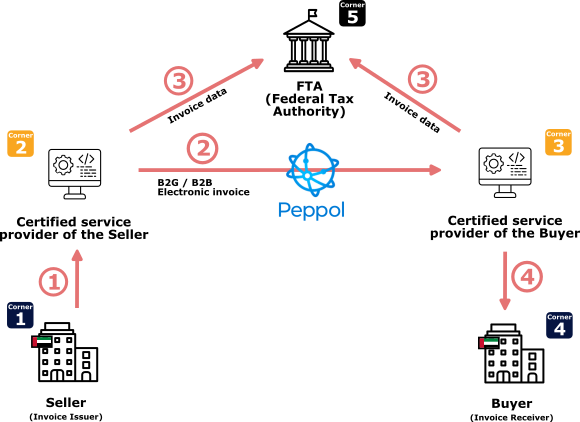
E-invoicing in the UAE will become mandatory countrywide in 2027 for all B2G & B2B transactions within scope. The model revolves around Accredited Service Providers (ASP) that will exchange invoices through the Peppol network and report corresponding tax data to the tax authority.

Overview of the 5-corner e-invoicing model (DCTCE) implemented in the UAE and relying on the Peppol network
UAE B2G & B2B e-invoicing flows: a five-corner Peppol model, with Accredited Service Providers exchanging invoices and reporting tax data to the Federal Tax Authority.

Model and transmission method

UAE is implementing an e-invoicing Decentralized Continuous Transaction Control and Exchange (DCTCE) model, widely known as the “5-corner model”.

The model relies on the Peppol network, with the Federal Tax Administration (FTA) acting as the 5th corner of the model.

Under this framework, suppliers and buyers exchange electronic invoices via Accredited Service Providers (ASP), which both extract tax-relevant data and transmit it to the FTA in real-time, allowing it to gain a nationwide, consolidated view of transactions.

Invoice format & Company identifiers

E-invoices must be issued in the PINT-AE format (technical specifications [↗]), the UAE-specific implementation of the Peppol INTernational (PINT) standard.

The Ministry of Finance has also published detailed guidelines [↗] and invoice schemes [↗] corresponding to the UAE standard tax invoice, as well as 8 specific invoicing scenarios, such as exports or free-zone transactions.

The national identifier used for e-invoicing in the UAE is the Tax Identification Number (TIN), which corresponds to the first ten digits of the business’s Corporate Tax Registration Number (TRN). Businesses within scope with no Corporate TRN must register with the FTA to obtain a TIN.

The TIN is used as the recipient’s Peppol participant identifier under the UAE’s 0235 identifier scheme.

Formal acknowledgements

To ensure successful e-invoice transmission and cross-validation of the data submitted by each ASP to the tax authority, multiple acknowledgements (positive or negative) must be sent between participants, using the Peppol MLS (Message Level Status) standard:

  • The receiving ASP (corner 3) must send a MLS to the sending ASP (corner 2) upon validation of the invoice
  • The tax authority (corner 5) will send a MLS to each ASP following the submission of the reported tax data

Accredited Service Providers

Exchanging e-invoices on the Peppol network usually relies on Access Points: e-invoicing service providers that are members of and are connected to the Peppol network.

However, in UAE, as in multiple other countries, the local Peppol Authority (here: the UAE Ministry of Finance) requires those Peppol Access Points to be officially accredited.

The UAE Ministry of Finance has set several key requirements to certify service providers, such as the ISO 22301 and 27001 certifications, the use of Multi-Factor Authentication (MFA), data encryption and a minimum 2-year operational track record.

The UAE makes available the full set of requirements to become accredited [↗], as well as the full list of Accredited Service Providers [↗] (regularly updated).

UAE Buyer Guide to E-Invoicing & Tax Compliance

Select your UAE Accredited Service Provider with confidence:

✅ 60+ solutions evaluated
✅ In-depth comparative analysis
✅ Neutral & practical
✅ Free download

The Invoicing Hub Word

United Arab Emirates (UAE)

The UAE, much like its iconic cities such as Dubai and Abu Dhabi, is positioning itself as a leading e-invoicing market in the Middle East

Adopting a pragmatic approach, the UAE has chosen to rely heavily on the Peppol standard, implementing a DCTCE e-invoicing mandate, also known as the 5-corner model.

However, the UAE has gone beyond merely adopting the standard. First, it requires mandatory accreditation for local Peppol Access Points, which are referred to locally as Accredited Service Providers (ASPs).

In addition, the UAE tax authority performs dual validation of tax-related data extracted from invoices. Both the sending ASP (corner 2) and the receiving ASP (corner 3) must independently extract the required data from the e-invoice and report it to the tax authority, which then cross-validates the information.

Finally, the system will also rely on the Peppol Message Level Status (MLS) standard to broadcast acknowledgements of successful or failed transactions, ensuring accurate information sharing among all participants.

Overall, the UAE’s choice to use the Peppol network and the PINT invoice format will significantly simplify implementation for companies operating internationally, by leveraging a widely proven and established standard.

Get your Project Implemented

Gold Sponsor

Daribatech logo - Color transparent
DaribaTech is a specialized tax technology company created to bridge the gap between complex GCC tax regulations and enterprise digital transformation.

Powered by RTC Suite's platform, our cloud-based e‑invoicing solution integrates seamlessly with any ERP system, enabling both local and global organizations to automate, validate, and submit fully compliant e‑invoices and tax documents across the UAE and the wider region.

Combining deep regulatory expertise with enterprise‑grade technology, we deliver secure and scalable solutions that ensure 100% compliance with locally hosted data in the UAE.

Silver Sponsors

Cleartax logo
ClearTax is an AI-native technology company helping enterprises automate compliance, invoicing, and finance operations across 50+ countries with intelligent, scalable, enterprise-grade solutions.
Contact us to learn about our sponsorship plans

Official Resources [↗]

Federal ministry leading the e-invoicing programme and accrediting service providers

UAE tax authority, receiving reported invoice tax data as the fifth corner of the e-invoicing model

Official e-invoicing mandate homepage and resources

Official guidelines on the upcoming mandate

List of mandatory fields to be populated in a UAE-compliant invoice

Official list of UAE Accredited Service Providers

Technical specifications of the UAE implementation of the Peppol INTernational (PINT) invoice format

Related Resources about UAE

The billentis 2026 report "Riding the Tornado" features key insights into global e-invoicing and compliance from leading experts.

Advertisement

Daribatech logo - Color transparent
DaribaTech is a GCC-first tax technology company delivering e-invoicing and compliance solutions built for the Gulf—combining global best-of-class platforms with deep regional regulatory expertise.

Latest News

Vidhana Soudha government building in Bengaluru, Karnataka, India.

India expands e-invoicing requirements from January 2027

India expands its e-invoicing mandate to cover additional transaction types from January 2027, without changing its scope criteria.

Denmark clarifies and introduces new digital accounting requirements

Denmark keeps encouraging e-invoicing adoption through NemHandel while clarifying the requirements for registered digital accounting systems

UK publishes the roadmap to its 2029 e-invoicing mandate

The UK details its e-invoicing roadmap, clarifying the mandate’s scope and timeline, while key technical requirements remain pending.

A busy October ahead of Slovakia’s 2027 e-invoicing mandate

October brings new eFaktĂșra guidance, Peppol updates and further progress on August’s legislative simplification proposals

UAE authorities release minor electronic invoicing amendments

The UAE amends and clarifies some e-invoicing requirements, easing compliance & implementation for businesses ahead of the 2027 rollout.

Chatbot icon at the colors of The Invoicing Hub

Try me 🙂

I’m an e-invoicing  expert and I might just surprise you!

đŸ“© ‎ Newsletter

Receive the latest e-invoicing news, directly in your mailbox, once a month.