E-Invoicing in Italy:
B2G, B2B & B2C Invoices via SDI
Last update: 2026, October 12
Summary
Italy has required e-invoicing for B2G transactions since 2015, and for B2B & B2C transactions since 2019. The chosen framework is heavily centralized, and revolves around a platform operated by the tax authority.
B2G, B2B, and B2C Transactions
Mandatory e-invoicing
All invoices within scope must be exchanged electronically through the central platform Sistema di Interscambio (SdI), generally in Italy’s FatturaPA XML format.
Italy
Table of Contents
What the Law Says
E-Invoicing & E-Reporting
E-invoicing is mandatory in Italy for B2G, B2B and B2C invoices through the central Sistema di Interscambio (SdI) platform.
The obligation first applied to all public administrations under Decree No. 55 of April 3, 2013 [↗︎]. It was then extended to B2B and B2C invoices in 2019 under Law No. 205 of December 27, 2017 [↗︎].
For B2C transactions specifically, the requirement applies only when an invoice is issued, but not to POS receipts, which are subject to separate electronic reporting requirements (corrispettivi telematici).
Invoices are generally issued in FatturaPA, a proprietary XML format developed by the Agenzia delle Entrate, Italy’s tax authority, that does not comply with the European Norm (EN) 16931. Another format, known as FatturaEU or CIUS-IT was developed later and complies with EN 16931, but has seen little adoption so far.
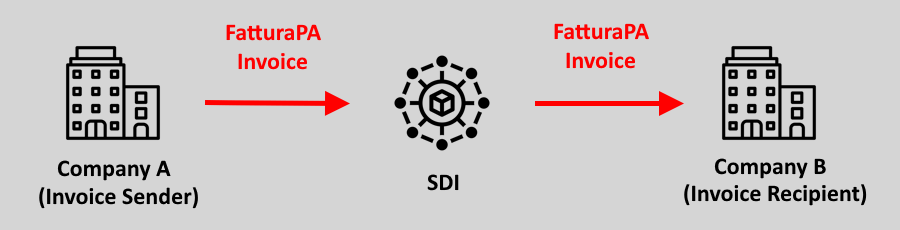
All invoices within scope must pass through the SdI, under a centralised exchange model.
There were initially several exemptions, notably for very small businesses, but these exemptions were progressively removed [↗︎] by the end of 2023. Limited exceptions remain, for example in the healthcare and agricultural sectors. Cross-border transactions are subject to separate rules: they are not exchanged through SdI in the same way as domestic invoices, but their data must generally be reported to SdI.
Invoices must generally be archived for ten years. Electronic archiving for tax purposes, commonly referred to as “fiscal archiving” and conservazione sostitutiva, is governed by the Ministerial Decree of June 17, 2014 [↗︎].
Timeline
B2G e-invoicing mandatory
B2G e-invoicing becomes mandatory for all suppliers of public entities, following a phased roll-out.
E-invoicing & e-reporting mandatory
B2B and B2C invoices must be transmitted electronically through the SdI.
Cross-border e-reporting mandatory
Invoice data for cross-border transactions must be transmitted through SdI, replacing the previous "Esterometro" reporting method.
End of the small business exemption
The remaining small business exemption to the mandate ends, extending the obligation to VAT-registered businesses regardless of their size.
Latest E-Invoicing News in Italy
European Commission calls for public input to shape the future of EU e-invoicing
EN 16931 update: the next step in e-invoicing is on its way
Technical Details (B2G & B2B & B2C)
All invoices within the scope of Italy’s e-invoicing mandate must pass through the Sistema di Interscambio (SdI) central platform. They are generally exchanged in FatturaPA, Italy’s proprietary XML invoice format.
SdI central platform
The Sistema di Interscambio (SdI) [↗︎] is the central platform operated by the Agenzia delle Entrate, Italy’s tax authority. It checks the file format and key invoice data before delivering the invoice through the recipient’s designated electronic channel.
Invoices that fail the SdI’s checks are rejected and must be corrected and resubmitted. If delivery cannot be completed, the SdI makes the invoice available to the recipient through the Fatture e Corrispettivi portal [↗︎] and notifies the issuer. The issuer receives electronic receipts confirming whether the invoice was rejected, delivered or could not be delivered.
Companies with sufficient in-house IT resources, or those using an e-invoicing service provider, can connect directly to the platform through Web Services or FTP, according to the official technical specifications [↗︎].
Alternatively, companies can submit invoices manually through the Fatture e Corrispettivi portal [↗︎], or send the invoice file to the SdI by PEC. PEC is Italy’s regulated certified email service and provides legally recognised evidence of sending and delivery, broadly comparable to registered mail with proof of receipt.
Invoice content
The invoice must include the recipient’s identifier and the delivery details required for the SdI to route the document correctly.
For B2G invoices, the recipient identifier is the Codice Univoco d’Ufficio, which identifies the relevant public authority office. For B2B invoices, it is generally the Codice Destinatario, which identifies the recipient’s delivery channel or that of its service provider.
Recipients can alternatively receive invoices through a PEC address. In that case, the supplier must enter 0000000 in the Codice Destinatario field and include the recipient’s PEC address in the corresponding field.
For B2C transactions, the supplier must provide a readable copy of the invoice, either on paper or in electronic form. Invoices may also need to include additional references, such as CIG and CUP codes, which are sometimes required in the B2G context.
Invoice format
Invoices must be submitted to the SdI in the structured FatturaPA XML format, Italy’s national e-invoicing format. The Italian authorities publish and maintain the official FatturaPA technical specifications [↗︎].
However, FatturaPA was developed before the European Norm (EN) 16931 and does not comply with that standard.
Consequently, Italian authorities have developed FatturaEU, the Italian CIUS-IT invoice syntax, which complies with EN 16931 while incorporating additional Italian requirements. Companies can submit invoices to the SdI in this format, subject to the technical rules for European invoicing [↗︎], although it remains rarely used in practice.
Cross-Border Invoices
Cross-border invoicing requires the Italian party to report relevant transaction data to the SdI. The invoice itself may however be exchanged with the foreign trading partner through any mutually agreed method.
End of the "Esterometro" regime
Until June 30, 2022, Italian VAT taxpayers reported cross-border transaction data through a separate Esterometro filing, submitted monthly and, from 2020, quarterly.
This standalone reporting regime ended on July 1, 2022. Since then, relevant cross-border transaction data must be transmitted to SdI in the FatturaPA XML format, under Article 12 of Decree-Law No. 73/2022 [↗︎].
This is a reporting requirement only: the commercial invoice itself does not need to pass through SdI and may be exchanged with the foreign trading partner through any mutually agreed method.
Sending cross-border invoices
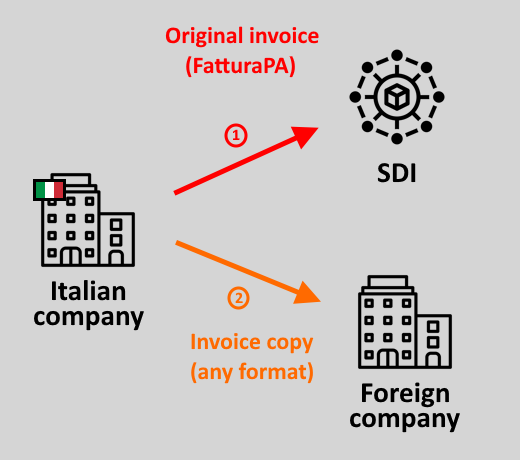
When invoicing a foreign customer, Italian companies must complete two separate actions:
- Deliver the commercial invoice to the customer through a mutually agreed method, such as EDI, PDF or paper.
- Submit the relevant invoice data to SdI in the FatturaPA format for tax reporting purposes.
Receiving cross-border invoices
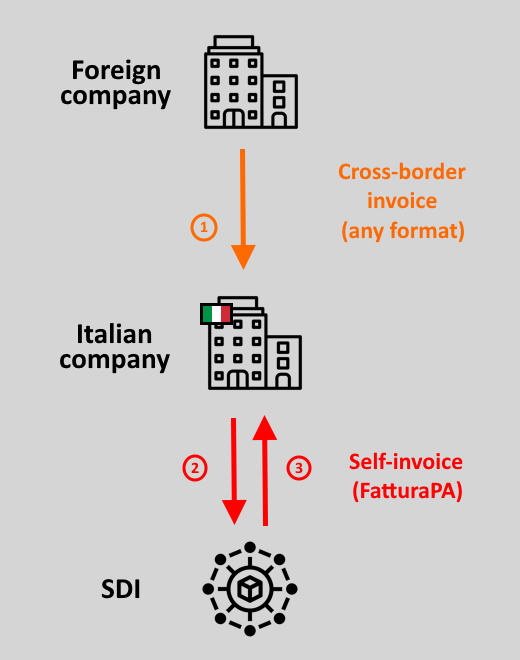
The Italian customer may receive commercial invoices from foreign suppliers through any mutually agreed method, such as EDI, PDF or paper.
It must then generally transmit a corresponding FatturaPA XML document to the SdI, using the relevant document type, such as TD17, TD18 or TD19.
The applicable document type and the information to be included in the XML depend on the nature of the purchase and on whether the supplier is established inside or outside the EU, as set out in the Agenzia delle Entrate’s official guidance [↗︎].
Cross-border invoice archiving
For Italian tax reporting purposes, the FatturaPA XML transmitted to the SdI is the document used to fulfil the Italian reporting requirement. The commercial invoice exchanged with the foreign trading partner remains a separate document and must also be archived.
Each of those documents must be archived. This rule applies for both inbound and outbound cross-border invoices.
"Fiscal archiving" of invoices
Invoice archiving is mandatory in Italy. Invoices must generally be retained for ten years, under a regulated digital-preservation framework.
Companies subject to these obligations must designate a Conservation Manager (Responsabile della conservazione) and maintain a Conservation Manual describing the archiving policy, the parties involved, the technical system, security measures and operating procedures.
The archiving process may be managed internally or outsourced to a solution provider. However, outsourcing the service does not remove the company’s responsibility for ensuring that its invoices are retained in compliance with the applicable requirements.
The Conservation Manual must follow the AgID guidance on the formation, management and preservation of electronic documents [↗︎].
In practice, invoices are placed in structured archival packages designed to preserve their integrity, authenticity, readability and availability over time. These packages are processed and, where required under the documented procedure, digitally signed or sealed by the responsible party or the external preservation provider.
Beyond E-Invoicing: E-Ordering (NSO)
Italy was already at the forefront of e-invoicing regulation, introducing mandatory B2G e-invoicing in 2015 and extending the obligation to domestic B2B and B2C invoices in 2019.
Italy then went a step further by introducing an e-ordering mandate for the National Health Service. Public entities within the Servizio Sanitario Nazionale (SSN), as well as entities purchasing on their behalf, must exchange purchase orders electronically with their suppliers through the Nodo Smistamento Ordini (NSO). The requirement has applied to orders for goods since February 1, 2020, and to orders for services since January 1, 2021.
NSO gives suppliers some flexibility in how they receive and process orders. They may connect through an accredited NSO channel or use the Peppol network, which is supported by NSO as an interoperability channel. The Peppol option can be particularly convenient for suppliers operating across several countries and already connected to the network.
The mandate currently focuses on SSN procurement. Its official technical rules [↗︎] also describe the use of NSO for order responses.
The Invoicing Hub Word
Italy
Italy has been one of the first countries to implement e-invoicing mandates as a tool to fight tax evasion, and chose a centralised approach for its mandate: all invoices in scope must pass through a single public platform, the SdI.
The first years of implementation proved challenging for Italian businesses, given the scale of the change, the need to adapt systems to the SdI and the complexity of Italy’s digital invoice archiving requirements.
Yet, more than two billion invoices now pass through the platform every year, making compliant electronic invoicing an established part of business operations across the country.
Overall, Italy has become one of the most advanced countries in the field of e-invoicing and remains a reference model for many countries around the world.
However, being an early adopter also has its drawbacks. Italy implemented its framework years before the ViDA directive was introduced, meaning that its current model is not fully aligned with the forthcoming European requirements. The system will therefore need to evolve, particularly for EU cross-border reporting, potentially creating significant impacts for Italian companies.
Get your Project Implemented
Gold Sponsor
The API ensures invoices are validated, transmitted, and reported in line with local regulations. Supporting both real-time and post-audit models, it adapts to evolving legal requirements without heavy internal development.
Secure, scalable, and easy to integrate with ERP and accounting systems, A-Cube automates workflows, reduces compliance risk with transparency.
Silver Sponsors
Official Resources [↗︎]
Public entity supervising the e-invoicing mandates in Italy
Public entity aiming to guarantee the achievement of the Italian digital agenda objectives
Agenzia Entrate mini-website about e-invoicing, and corresponding guidance & resources
Homepage of the Peppol Authority in Italy managed by AgID
Relevant legislation about e-invoicing in Italy
Guidelines to help economic operators use the SdI and submit FatturaPA invoices
Technical specifications about the FatturaPA format
Guidelines published by AgID about the e-ordering mandate
Get your Project Implemented
Gold Sponsor
The API ensures invoices are validated, transmitted, and reported in line with local regulations. Supporting both real-time and post-audit models, it adapts to evolving legal requirements without heavy internal development.
Secure, scalable, and easy to integrate with ERP and accounting systems, A-Cube automates workflows, reduces compliance risk with transparency.
Silver Sponsors
Advertisement
Latest News
Peppol & GENA e-invoicing conferences in Singapore – 17-19 November 2026
Spain’s B2B e-invoicing mandate will start in October 2027
Greece slightly postpones the next phases of its mandates
Slovakia proposes latest adjustments and an extended grace period
VeR expands the conversation around B2B e-invoicing
📩 Newsletter
Receive the latest e-invoicing news, directly in your mailbox, once a month.