E-Invoicing in Austria:
B2G rules, ebInterface & Peppol
Last update: 2026, September 15
Summary
Austria has required structured e-invoices for suppliers of the Federal Government since 2014. The framework relies on the e-Rechnung.gv.at platform and the Peppol network, using ebInterface or UBL invoice formats.
B2G Transactions
Mandatory e-invoicing for transactions with federal public administrations
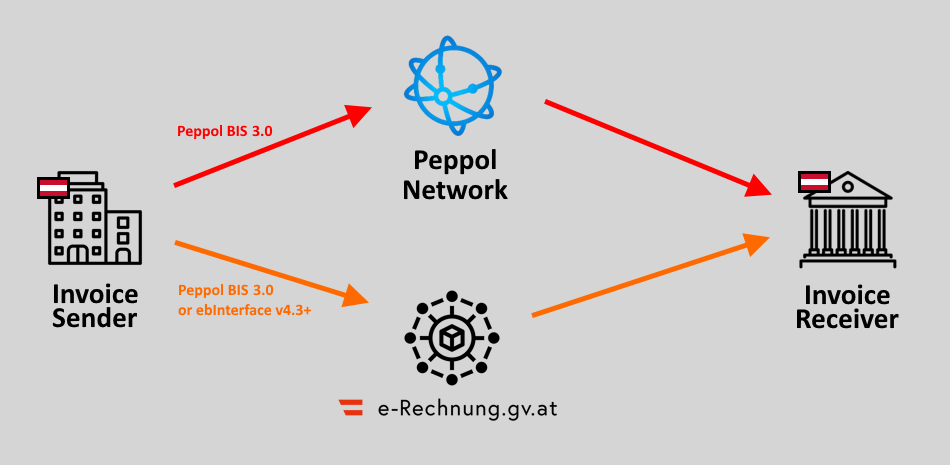
Suppliers of the Austria Federal Government must send electronic invoices through the Peppol network (Peppol BIS 3.0 format) or through the e-rechnung.gv.at central platform (ebInterface XML format or Peppol BIS 3.0).
E-invoicing is also possible with multiple local public administrations.
B2B Transactions
No e-invoicing obligation
B2C Transactions
No e-invoicing obligation
No e-invoicing or e-reporting obligation applies to business-to-consumer transactions in Austria.
Austria
Table of Contents
What the Law Says
B2G E-Invoicing
B2G e-invoicing has been mandatory for suppliers of Austrian Federal public administrations.
This obligation began on January 1, 2014, following the publication of Section 5 of the Austrian ICT Consolidation Act (IKTKonG) [↗︎]. Paper and PDF invoices are therefore not considered structured e-invoices and are not accepted as a standard submission method for federal B2G transactions.
Many other local public administrations (such as states, municipalities or cities) can also receive structured e-invoices. The government maintains a list of participating public invoice recipients [↗︎].
The Peppol network is allows suppliers to submit structured electronic invoices to Austrian public administrations, using the Peppol BIS Billing 3.0 specification in UBL syntax.
The e-Rechnung.gv.at central platform [↗︎] is another channel for suppliers to submit structured e-invoices to Austrian public administrations. The platform accepts the Austrian ebInterface XML invoice format (v4.3 and above), as well as the Peppol BIS Billing 3.0 format.
Depending on the targeted public administration, additional information, as highlighted in the e-Rechnungsverordnung, Section 4 [↗︎], may be needed such as the supplier number, purchase order reference, applicable order-position number, IBAN/BIC, payment terms and the supplier’s email address.
The B2G e-invoicing mandate applies to Austrian suppliers. Foreign suppliers to Federal Government departments are also covered where “technically feasible”, with no further official explanation of the term.
Invoices must generally be archived for seven years.
B2B E-Invoicing
B2B e-invoicing is voluntary in Austria.
Businesses may agree to exchange invoices in any format accepted by both parties, including:
- Paper invoices
- PDF invoices sent by email
- EDI, including established formats such as EDIFACT
- Structured electronic invoices sent through the Peppol network
No domestic B2B e-invoicing mandate has been announced. However, Austria will need to implement the EU’s VAT in the Digital Age (ViDA) reform. From July 1, 2030, intra-EU B2B transactions will be subject to e-reporting requirements based on structured electronic invoicing.
Like other European countries, Austria may take the implementation of ViDA as an opportunity to introduce mandatory B2B e-invoicing for domestic transactions, although no such measure has been announced yet.
Invoices must generally be archived for seven years.
B2C E-Invoicing
Austria does not have a B2C e-invoicing or e-reporting mandate.
Companies may continue to issue business-to-consumer invoices and receipts through their usual channels, including paper invoices, PDF invoices sent by email and printed receipts.
Timeline
Federal B2G e-invoicing mandatory
Suppliers to Austrian Federal Government departments must submit structured e-invoices
Legacy formats deprecated
Peppol BIS 3.0 as well as ebInterface v.4.3 & above remain the only accepted formats for B2G e-invoicing
ViDA intra-EU e-reporting begins
Intra-EU B2B transactions become subject to EU digital reporting requirements based on structured electronic invoicing.
Latest E-Invoicing News in Austria
EN 16931 update: the next step in e-invoicing is on its way
E-Invoicing Exchange Summit Vienna 2025: key insights and highlights
Technical Details (B2G)
The method for submitting a B2G invoice depends on the public administration receiving it. Federal public administrations require structured e-invoices, while other public administrations may or may not accept them. Suppliers should check the recipient’s specific requirements before sending an invoice.
Overview
Austria provides two official channels for exchanging B2G structured e-invoices:
- The Peppol network
- The e-rechnung.gv.at central platform
The government has published comprehensive B2G guidelines [↗︎] explaining both options in detail, as well as comprehensive lists of public administrations [↗︎] (federal and local) able to receive electronic invoices.
E-Invoicing via the Peppol network
For public administrations that can receive electronic invoices, the Peppol network is one of the channels through which suppliers can transmit their invoices.
Invoices sent to Austrian public administrations through Peppol must be addressed to the central participant ID 9915:b [↗︎]. The actual recipient is then determined from the purchase order reference included in the invoice.
Electronic invoices must be sent in Peppol BIS 3.0 format, in compliance with the official format specifications [↗︎]. Austria also maintains two national Core Invoice Usage Specifications (CIUS):
- CIUS AT NAT [↗︎] for B2B use
- CIUS AT GOV [↗︎] for additional B2G rules
Peppol BIS 3.0 is compliant with the European Norm 16931, and more details on EN 16931 compliance [↗︎] are also available in German.
E-Invoicing via the Central Platform
For public administrations that can receive electronic invoices, the e-rechnung.gv.at central platform [↗︎] is the other channel through which suppliers can transmit their invoices.
The platform is administered by the BMF (Ministry of Finance) and requires initial user authentication through the Unternehmensservice Portal (USP – Business Service Portal) [↗︎]. Alternatively, companies can avoid this authentication step by using service providers that are registered with the USP [↗︎].
Once authenticated, companies can choose from the following invoice delivery methods [↗︎] to the central platform:
- Manual input in an online form
- Manual upload of an e-invoice
- Automated transmission via web service
The formats accepted [↗︎] on the e-rechnung.gv.at central platform are:
- The local ebInterface format, developed and maintained by the AUSTRIAPRO association.
- Legacy versions (v4.2 and below) were deprecated in 2022.
- The currently accepted versions are v4.3, 5.0, 6.0 and the latest 6.1 version.
- Versions 5.0 and above are compatible with EN 16931 in the sense that they can be transformed into EN 16931-compliant invoices.
- The Peppol BIS 3.0 format.
Depending on the targeted public administration, some additional fields [↗︎] may need to be included in the e-invoice, such as the purchase order reference and supplier number, or other special fields [↗︎] tied to the BBG [↗︎] (Austria Public Procurement Agency).
Testing and validation
Before submitting an XML invoice, suppliers can use the e-Rechnung.gv.at Test Upload [↗︎] to check its technical validity. The tool supports all accepted invoice formats and does not submit the invoice for processing or payment.
Specific XML schemas are also available to help suppliers check certain Federal Government requirements before submitting an invoice.
The Invoicing Hub Word
Austria
With more than a decade having passed since B2G e-invoicing was made mandatory at the federal level, Austria has been an early adopter of e-invoicing in Europe.
The government provides comprehensive guidelines, responsive support and diverse options for companies to submit their e-invoices to public administrations, ranging from manual input to automated submission via web service or the Peppol network. In essence, B2G e-invoicing at the Austrian federal level operates smoothly.
However, despite this early implementation, Austria has not progressed beyond its initial B2G obligation, and no B2B e-invoicing mandate has been introduced. As a result, traditional invoicing in paper or PDF remains prevalent in Austria.
This may change in the coming years as Austria will inevitably implement the EU’s VAT in the Digital Age (ViDA) reform. The reform could indeed provide an opportunity for Austrian authorities to consider implementing broader domestic e-invoicing requirements.
Get your Project Implemented
Gold Sponsor
From setting up the initial connection, to monitoring messages and handling ongoing adjustments, ecosio’s experts take care of e-invoicing tasks for you, enabling you to experience reliable connections and full mandate compliance while freeing up internal teams to focus on what they do best.
Silver Sponsors
Official Resources [↗︎]
Public entity supervising e-invoicing in Austria
Association promoting e-invoicing and in charge of the ebInterface format
B2G central platform & official B2G e-invoicing guidelines
List of accepted B2G e-invoice formats & their specifications
B2G e-invoicing delivery methods specifications
Entire set of official Peppol BIS 3.0 specifications
Official directory of worldwide Peppol-ready businesses
Related Resources
Advertisement
Latest News
Slovakia proposes latest adjustments and an extended grace period
VeR expands the conversation around B2B e-invoicing
KSeF penalty grace period to be extended until end 2027
XRechnung 4.0 draft published: preparing for EN16931:2026 adoption
The Netherlands shares plans for mandatory B2B e-invoicing and e-reporting
📩 Newsletter
Receive the latest e-invoicing news, directly in your mailbox, once a month.