Skip to content

Advertisement

Become a gold sponsor - stacked
Contact us to learn about our sponsorship plans

E-Invoicing in Greece

Last update: 2026, May 21

Summary

B2G

Mandatory

B2G invoices must be cleared by the myDATA central platform, and then delivered through the Peppol network in Peppol BIS 3.0 (Greece CIUS) format.

B2B

Partially mandatory

Currently allowed using EDI, e-signature or guaranteeing a complete audit trail.
Will become gradually mandatory for domestic transactions over 2026 following a Clearance model through the myDATA central platform.

Greece

Table of Contents

What the Law Says

B2G E-Invoicing

B2G e-invoicing has been fully mandatory in Greece as directed by the Independent Authority for Public Revenue (AADE) since September 1, 2025, for all public contracts exceeding €2,500.

The rollout of the mandate took place in four phases starting in September 2023, progressively covering more public administrations.

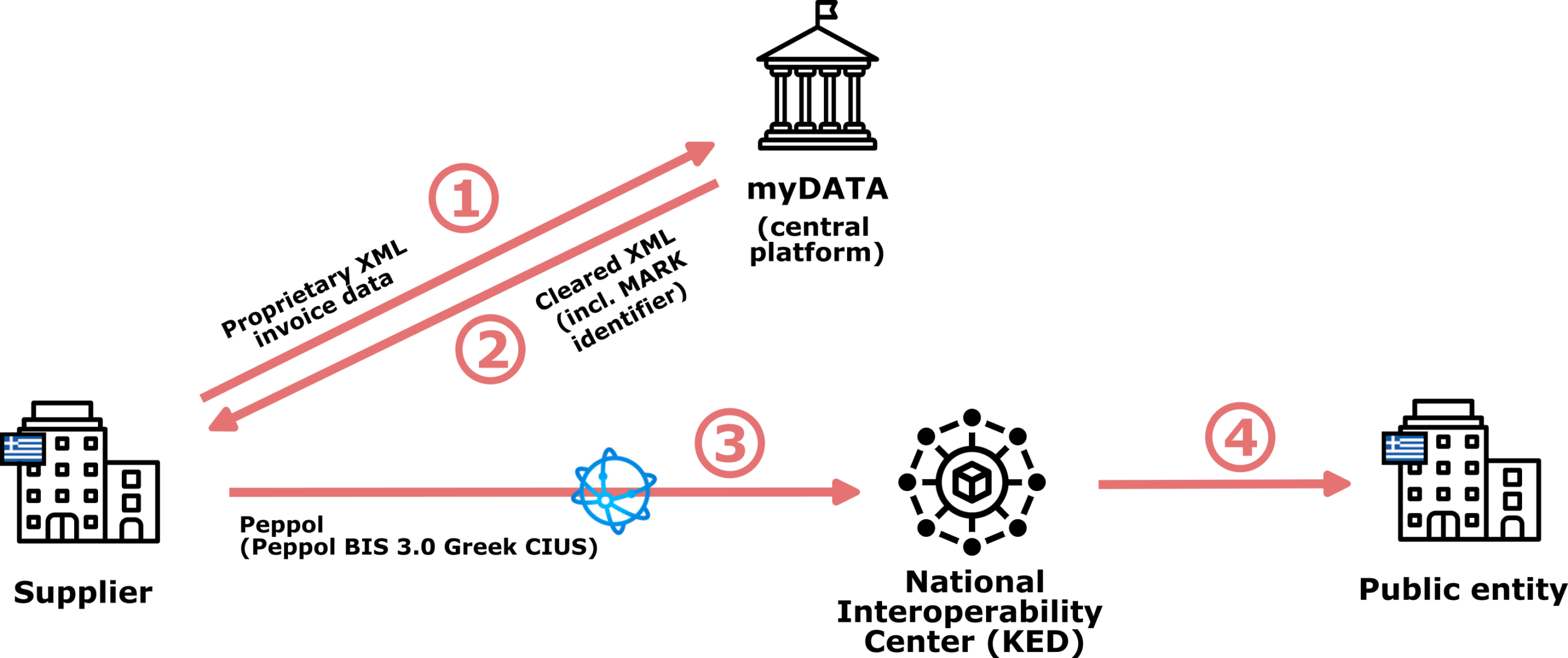
Under this requirement, all suppliers to Greek public entities must first submit their invoice data to the myDATA central platform for clearance. Once the data are successfully validated, the invoices are then transmitted electronically via the Peppol network to the National Interoperability Center (KED), which ensures their delivery to the appropriate public recipient.

The receiving public entity subsequently sends invoice statuses back to the supplier, confirming receipt and providing updates on the processing and payment (or rejection) status.

Invoices must be archived for 6 years.

B2B E-Invoicing

Greece’s B2B upcoming e-invoicing mandate was revealed in an official announcement [↗︎] made in September 2025 by the Independent Authority for Public Revenue (AADE), and will rely on a Clearance model with validation of invoices by the myDATA central platform before their delivery.

This B2B e-invoicing mandate will be rolled-out in 2 phases, depending on company size:

  • March 2, 2026: mandatory for large companies, with an annual turnover above 1 M€, with a transition period until May 3, 2026.
  • October 1, 2026: mandatory for all companies, with a transition period until December 31, 2026.

The transition periods are intended to allow companies to continue using other invoicing methods, provided they submit a form confirming their commitment to comply with the mandate within the required timeframe.

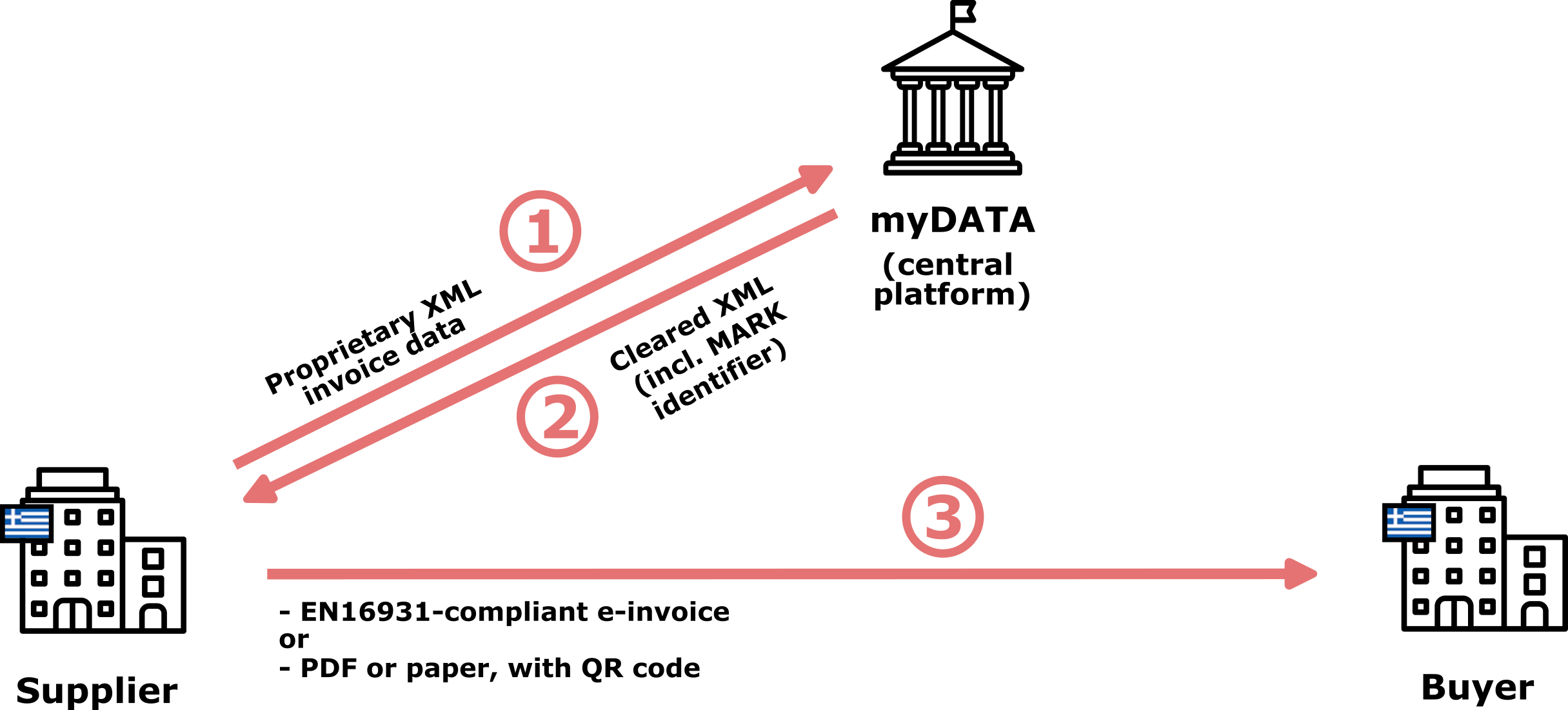
Businesses will be required to submit invoice tax data to the myDATA platform in a proprietary XML format. Once the invoice has been cleared, they will be responsible for delivering it to the recipient in their chosen format, including the corresponding proof of clearance, such as a unique identifier or QR code.

In the meantime, and until the mandate takes effect, companies may continue sending and receiving invoices through their usual methods, including electronic invoices (EDI), PDF, or paper formats.

Invoices must be archived for 6 years.

Timeline

Start of the B2G e-invoicing mandate

B2G e-invoicing becomes mandatory for suppliers of some central public administrations

B2G e-invoicing fully mandatory

4th phase of the B2G mandate, enforcing e-invoicing for all public contracts above 2,500 € countrywide

B2B e-invoicing for large companies

First phase of the B2B e-invoicing mandate, for large companies with an annual turnover above 1 M€

B2B e-invoicing mandatory for all companies

All companies countrywide must send and receive electronic B2B invoices

September 2023
September 1, 2025
March 2, 2026
October 1, 2026

Latest E-Invoicing News in Greece

Skyline with Monastiraki Square and the Acropolis hill at sunset, in Athens, capital of Greece.

A look at e-invoicing phase 1 & e-transportation in Greece

E-invoicing is now in effect in Greece for large companies, while e-transportation obligations are rolling out for all businesses.
Photo of the European Parliament, gathered within the European Commission in Brussels, capital of Belgium

European Commission calls for public input to shape the future of EU e-invoicing

A “Reality Check” event and a public consultation launched by the European Commission aim to shape EU e-invoicing by gathering feedback.
Photo of the scenic view, white walls and blue roofs of Santorini, an Island in Greece

Greece’s B2B mandate to start one month late, on March 2

In its first phase, the mandate wjll require large companies to implement e-invoicing, with a transition period until May 3, 2026.

Central Role of myDATA Platform

myDATA used for all Greek Obligations

Many of the tax compliance requirements for Greek businesses are centered around the myDATA central platform:

  • Accounting records: Reporting is mandatory, enabling the AADE to monitor companies’ accounting data and reconcile it with their tax returns.
  • B2G e-invoicing: B2G invoices must be cleared through myDATA before being delivered via Peppol.
  • B2B e-invoicing (being implemented): B2B invoices must also be cleared prior to their delivery.
  • E-transport (being implemented): Delivery notes must also be cleared prior to dispatch.

Comprehensive technical documentation [↗︎] is available on the myDATA website.

Invoice Clearance

B2G & B2B invoices must be cleared through the myDATA central platform.

The relevant data must be prepared in a proprietary XML format and submitted to the myDATA central platform for official validation.

If validation is successful, myDATA returns a unique identifier called MARK and an URL redirecting to myDATA (and attesting that the invoice was properly validated), that must be used to generate a QR code to be applied on PDF / paper invoices.

myDATA connectivity options

Companies are encouraged to use B2B certified providers [↗︎] or B2G certified providers [↗︎] to issue their invoices, validate them through myDATA, and transmit them to their final recipients.

Note: The lists of certified providers differ between B2G and B2B invoicing.

When using a certified provider, the invoice issuer is free to submit this invoice data in any format supported by the provider, as Greek law does not mandate a specific format for this transmission.

Alternatively, small businesses that lack e-invoicing capabilities or prefer not to work with certified providers can use the Timologio [↗︎] application, freely provided by the AADE. This tool allows them to create and manage their invoices manually.

Another option is for businesses with sufficient IT resources to handle the entire process independently, by connecting their ERP directly [↗︎] to the myDATA API and transmitting invoices through their own means.

Additional Details (B2G)

Overview of the Greece B2G e-invoicing obligation
The B2G invoice must first be cleared by the myDATA central platform, before being delivered to its final public recipient via the Peppol network through the National Interoperability Center (KED)

Invoice Content

B2G invoices in Greece are required to include specific fields as fully defined by the AADE [↗︎], and most of these fields are standard. However, the invoice must also include the Contracting Authority’s Electronic Invoicing Code (EAIC), which can be obtained from the official online register [↗︎].

Invoice Delivery

First, the invoice must be cleared by the myDATA central platform, which issues a unique identifier (MARK) that must be included in the invoice content.

Next, the invoice must be delivered to the recipient public entity via the Peppol network, using the Peppol BIS 3.0 format in accordance with the Greek CIUS specifications. To complete this process, the invoice is transmitted to the National Interoperability Center (KED), which ensures it is routed to the appropriate public recipient.

Invoice Status Feedback

Following invoice delivery, the invoice issuer will receive the following information:

  • receipt or rejection of the invoice by the KED,
  • successful receipt of the Electronic Invoice from the Contracting Authority’s system (determines the date of receipt of the HT)
  • rejection by the Contracting Authority
  • dispute by the Contracting Authority (with a possible request to send a credit note or other additional supporting documents)
  • Correction Request or rejection with the possibility of resubmission (soft reject)
  • acceptance
  • payment (partial or full)          

Additional Details (B2B)

Overview of the Greece B2G e-invoicing obligation
The B2B invoice must first be cleared by the myDATA central platform, before being delivered to the final recipient, in any format containing the proof of clearance

Invoice Delivery

The official B2B mandate announcement [↗︎] does not clearly define how invoices must be delivered. 

As is typically the case in a clearance model, invoice delivery itself appears to remain unregulated, which leaves room for several possible approaches:

  • Invoice delivery must occur electronically (including the MARK identifier), for instance via the Peppol network using the Peppol BIS 3.0 format and the Greek CIUS, similar to the B2G framework.

  • Invoice delivery is not regulated, allowing for flexibility in formats: either electronic (including the MARK identifier) or PDF/paper (featuring a QR code linking to the myDATA URL of the invoice).

Tax Deductions

To support all businesses in meeting the upcoming B2B e-invoicing mandate, the Greek government has introduced tax incentives: a 100% tax deduction covering the purchase and setup costs of the software, as well as the first 12 months of subscription or operating fees, provided the solution enables compliance with the new mandate.

To qualify for these tax deductions, companies must adopt an e-invoicing solution at least two months before the B2B mandate deadlines.

Sanctions

Failure to comply with the obligation to issue an electronic invoice is considered as non-issuance of that invoice and, therefore, the penalties are imposed, as applicable:

  • For failure to issue an electronic invoice for transactions subject to VAT, a fine of 50% of the VAT that would have resulted from the unissued invoice, or of the difference, respectively, is imposed.
  • For failure to issue an electronic invoice for transactions not subject to VAT, a fine of €500 per tax audit is imposed on entities keeping single-entry books and €1,000 per tax audit on entities keeping double-entry books.

The Invoicing Hub Word

Greece

Greece introduced the myDATA platform in the early 2020s to ensure accurate reporting of accounting records and proper calculation of VAT returns.

Over time, the platform’s scope has expanded to include B2G invoices, delivery notes, and, starting in 2026, B2B invoices.

In practice, Greece’s invoicing framework is based on a clearance model through a central platform. This approach presents two main challenges. First, it is not aligned with the ViDA directive, meaning that by 2030–2035, Greece will need to undertake major adjustments to transition toward more standardized four- or five-corner network models.

More importantly, the clearance model focuses on tax validation but does not enable businesses to fully benefit from digitalization. Invoice delivery remains unregulated, and in most cases, invoices are exchanged as PDFs or even paper documents, accompanied by a QR code confirming validation by the tax authority. As a result, companies still handle non-structured data, preventing full automation of their invoicing processes. This limits potential gains in data quality, efficiency, and cost savings.

Additional Resources [↗︎]

Tax authority supervising e-invoicing in Greece

Homepage of the myDATA central platform & resources used for clearance + B2B e-invoicing

Comprehensive technical resources: REST API documentation, XSD schema, XML examples, …

List of certified providers that must be used to issue B2B invoices electronically

Official guidance & resources for B2G e-invoicing in Greece

List of certified providers that must be used to issue B2G invoices electronically

Official application allowing for manual submission of B2G & B2B invoices for small companies

Get your Project Implemented

Gold Sponsor

Become a gold sponsor - stacked
Contact us to learn about our sponsorship plans

Silver Sponsors

Contact us to learn about our sponsorship plans

Advertisement

Become a gold sponsor - stacked
Contact us to learn about our sponsorship plans

Latest News

Skyline with Monastiraki Square and the Acropolis hill at sunset, in Athens, capital of Greece.

A look at e-invoicing phase 1 & e-transportation in Greece

E-invoicing is now in effect in Greece for large companies, while e-transportation obligations are rolling out for all businesses.

E-invoicing Compliance in Oman: The Complete Guide

Oman plans to introduce mandatory e-invoicing for B2B & B2G via a Peppol 5-corner model, and for B2C through a clearance model.

New technical specifications and ViDA impact in Italy

While Italy has been pioneer in Europe for B2B and B2G e-invoicing, the model keeps evolving over the years and now also faces ViDA impact.

France’s JFE 2026 and the latest official e-invoicing specifications

France’s e-invoicing reform enters final preparations with an update to its "External Specifications" and announcements from JFE 2026.

UAE extends ASP appointment deadline to October 2026

The UAE has postponed the first phase of its e-invoicing mandate to October 30, 2026, after businesses requested wider technical options.

📩 ‎ Newsletter

Receive the latest e-invoicing news, directly in your mailbox, once a month.