Skip to content

Advertisement

Become a gold sponsor - stacked
Contact us to learn about our sponsorship plans
↑ E-Invoicing in Saudi Arabia
What the Law Says
Timeline
Latest News
Technical Details
The Invoicing Hub Word
Additional Resources
Get your project implemented
↓ Bottom

E-Invoicing in Saudi Arabia

Last update: 2026, April 13

Summary

B2G & B2B

E-invoicing partially mandatory

Clearance required for all B2B & B2G transactions through a central platform (Fatoora) for businesses with an annual turnover exceeding 750K SAR (~170 K€)

B2C

E-reporting partially mandatory

E-reporting mandatory for all B2C transactions through a central platform (Fatoora) for businesses with an annual turnover exceeding 750K SAR (~170 K€)

What the Law Says

B2G & B2B E-Invoicing

Saudi Arabia is currently implementing e-invoicing obligations countrywide, driven by the Zakat, Tax, and Customs (ZATCA – Saudi Arabia tax authority).

Under this mandate, Saudi companies are required to comply with a clearance model, where they must submit their invoices first to ZATCA through the “Fatoora” central platform, either in UBL 2.1 format.

Then, ZATCA will validate (“clear”) the invoice automatically, apply a cryptographic stamp that proves the invoice validity, and make it available to the invoice issuer.

The invoice must then be sent by the invoice issuer to the buyer, in any format, as long as it contains the proof of validity: for a PDF or paper invoice, it must contain a QR code, and for an electronic invoice, it must contain a XML hash. 

The mandate is being deployed since end 2021 in a huge quantity of phases. We currently stand at wave 23 out of a total of XXX waves:

  • Wave 23, since March 31, 2026: clearance mandatory for B2G & B2B transactions for all companies with an annual turnover above 750K SAR (~170K €)
  • Wave 24, from June 30, 2026: clearance mandatory for B2G & B2B transactions for all companies with an annual turnover above 375K SAR (~85K €) 
Invoices must be archived 7 years.

B2C E-Reporting

The B2C obligations in Saudi Arabia are essentially similar to the B2G & B2B requirements, but the main change is a timeline / order of execution change.

B2C sales are more time-sensitive, and cannot suffer any delays due to invoice clearance by ZATCA, so in order to prevent this, the B2C mandate in Saudi Arabia is in fact a e-reporting mandate.

The invoice issuer must generate a B2C invoice or cash receipt that contains a QR code, and provide it immediately to the customer, without ZATCA verification.

The invoice issuer then has 24 hours to report the transaction and submit the relevant invoice data to the Fatoora central platform.

The B2C mandate is being rolled-out simultaneously with the B2G & B2B mandate, meaning that the same phases apply, and that we currently also stand at wave 23 out of a total of XXX waves:

  • Wave 23, since March 31, 2026: e-reporting mandatory for B2C transactions for all companies with an annual turnover above 750K SAR (~170K €)
  • Wave 24, from June 30, 2026: e-reporting mandatory for B2X transactions for all companies with an annual turnover above 375K SAR (~85K €) 
Invoices must be archived 7 years.

Timeline

E-invoicing mandate pilot phase

Pilot program starts with selected taxpayers, and voluntary implementation becomes possible

Large businesses - Accredited Service Provider appointment

Large businesses (annual revenue > 50M AED / ~11,5 M€) must have appointed an Aaccredited Service Provider and be able to start receiving e-invoices by this date

Large businesses - Mandatory e-invoicing

Sending e-invoices becomes mandatory for large businesses

Smaller businesses & Government entities - Accredited Service Provider appointment

Smaller businesses & public administrations must have appointed an Aaccredited Service Provider and be able to receive e-invoices by this date

Smaller businesses - Mandatory e-invoicing

Sending e-invoices becomes mandatory for other businesses

Government entities - Mandatory e-invoicing

Sending e-invoices becomes mandatory for all public administrations countrywide

July 1, 2026
July 31, 2026
January 1, 2027
March 31, 2027
July 1, 2027
October 1, 2027

Latest E-Invoicing News in Saudi Arabia

Technical Details

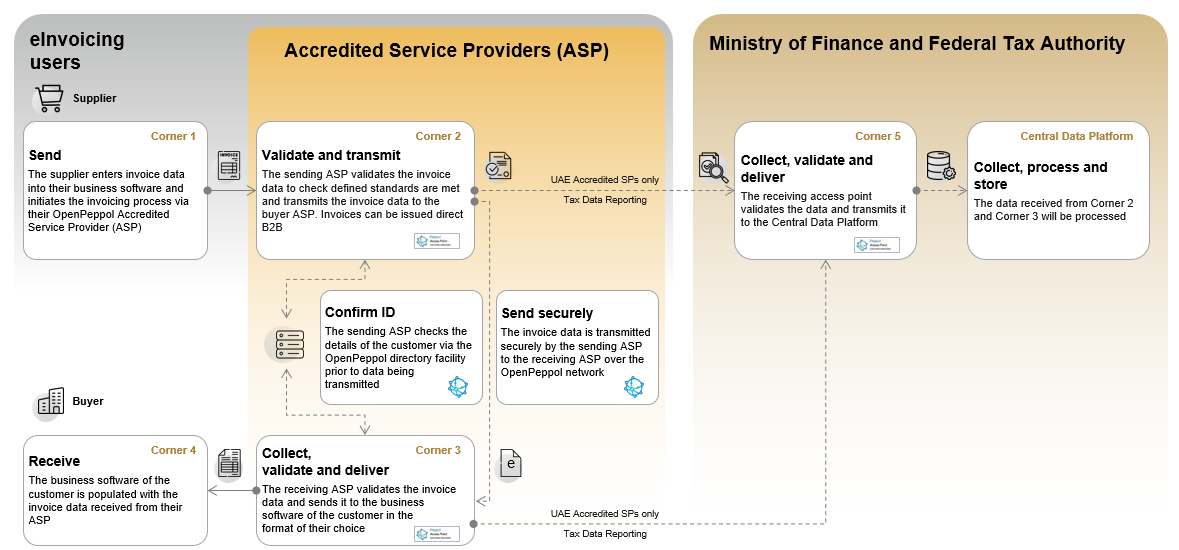
Overview of the 5-corner e-invoicing model (DCTCE) implemented in the UAE and relying on the Peppol network
The e-invoicing mandate in the UAE relies on a standard 5-corner model (DCTCE) via the Peppol network (official schema from the UAE MoF - click to enlarge)

Model and transmission method

UAE is implementing an e-invoicing Decentralized Continuous Transaction Control and Exchange (DCTCE) model, widely known as the “5-corner model”.

The model relies on the Peppol network, with the UAE Ministry of Finance acting as the 5th corner of the model.

Under this framework, suppliers and buyers exchange electronic invoices via Accredited Service Providers (ASP), which both extract tax-relevant data and transmit it to the tax authority in real-time, allowing it to gain a nationwide, consolidated view of transactions.

Invoice format & Company identifiers

E-invoices must be issued in the PINT-AE format (technical specifications [↗︎]), the UAE-specific implementation of the Peppol INTernational (PINT) standard.

The Ministry of Finance has also published detailed guidelines and invoice schemes [↗︎] corresponding to the UAE standard tax invoice, as well as 15 use cases that correspond to specific invoicing situations, such as exports or self-billing.

The national tax identifier in use in the UAE is the Tax Identification Number (TIN) which is the first 10 digits of the Tax registration number (TRN) issued to the business. It must be used to address e-invoices via the Peppol network using the 0235 UAE Peppol ID.

Formal acknowledgements

To ensure successful e-invoice transmission and cross-validation of the data submitted by each ASP to the tax authority, multiple acknowledgements (positive or negative) must be sent between participants, using the Peppol MLS (Message Level Status) standard:

  • The receiving ASP (corner 3) must send a MLS to the sending ASP (corner 2) upon validation of the invoice
  • The tax authority (corner 5) will send a MLS to each ASP following the submission of the reported tax data

Accredited Service Providers

Exchanging e-invoices on the Peppol network usually relies on Access Points: e-invoicing service providers that are members of and are connected to the Peppol network.

However, in UAE, as in multiple other countries, the local Peppol Authority (here: the UAE Ministry of Finance) requires those Peppol Access Points to be officially accredited.

The UAE Ministry of Finance has set several key requirements to certify service providers, such as the ISO 22301 and 27001 certifications, the use of Multi-Factor Authentication (MFA), data encryption.

The UAE makes available the full set of requirements to become accredited [↗︎], as well as the full list of Accredited Service Providers [↗︎] (regularly updated).

The Invoicing Hub Word

Saudi Arabia

The UAE, much like its iconic cities such as Dubai and Abu Dhabi, is leading the way in e-invoicing in the Middle East.

Adopting a pragmatic approach, the UAE has chosen to rely heavily on the Peppol standard, implementing a DCTCE e-invoicing mandate, also known as the 5-corner model.

However, the UAE has gone beyond merely adopting the standard. First, it requires mandatory accreditation for local Peppol Access Points, which are referred to locally as Accredited Service Providers (ASPs).

In addition, the UAE tax authority performs dual validation of tax-related data extracted from invoices. Both the sending ASP (corner 2) and the receiving ASP (corner 3) must independently extract the required data from the e-invoice and report it to the tax authority, which then cross-validates the information.

Finally, the system will also rely on the Peppol Message Level Status (MLS) standard to broadcast acknowledgements of successful or failed transactions, ensuring accurate information sharing among all participants.

Overall, the UAE’s choice to use the Peppol network and the PINT invoice format will significantly simplify implementation for companies operating internationally, by leveraging a widely proven and established standard.

Additional Resources [↗︎]

Tax authority supervising e-invoicing in the United Arab Emirates (UAE)

Official e-invoicing mandate homepage and resources

Guidelines, schemas and invoice mandatory fields

Official list of UAE pre-approved Accredited Service Providers

Technical specifications of the UAE implementation of the Peppol INTernational (PINT) invoice format

Get your Project Implemented

Gold Sponsor

Become a gold sponsor - stacked
Contact us to learn about our sponsorship plans

Silver Sponsors

Contact us to learn about our sponsorship plans

Advertisement

Become a gold sponsor - stacked
Contact us to learn about our sponsorship plans

Latest News

Aerial photo of Singapore's skyline including the Singapore Gardens and the Marina Bay Sands

Singapore e-reporting now applies to all new voluntary GST registrants

Singapore ties GST onboarding to InvoiceNow from April 1, 2026, shifting e-invoicing from voluntary use towards expected adoption.

E-Rechnungs-Gipfel Berlin – June 22-24, 2026

The Exchange Summit returns to Berlin for an all-German edition, focusing on local topics and the upcoming e-invoicing mandate.

GEBA: Electronic addresses for all German businesses

German Peppol Authority launches the German Electronic Business Address (GEBA), removing a significant practical limitation in Peppol adoption.

Poland’s KSeF phase 2 takes effect after solving initial hurdles

After early challenges and digital attacks, KSeF mandatory scope expended to most VAT-registered businesses as Phase 2 went live on April 1st

Join the DBNAlliance U.S. e-invoicing event in New York on April 22

Join industry leaders in New York on April 22 to explore recent e-invoicing interoperability breakthroughs shaping the U.S. market.

📩 ‎ Newsletter

Receive the latest e-invoicing news, directly in your mailbox, once a month.