Skip to content

Advertisement

Arratech delivers Access Points & SMP as-a-Service, giving businesses and service providers a modern, compliant platform to connect seamlessly to the Peppol Network and scale e-invoicing with ease.
Real-time tax reporting (CTC) and electronic invoicing are becoming global requirements, making compliance, security and scalability essential.

Arratech delivers Access Point-as-a-Service and SMP-as-a-Service, powering service providers, enterprises, software vendors and tax authorities to connect to the Peppol Network and emerging global e-invoicing infrastructures.

As ISO27001 and Peppol certified provider, we deliver a modern platform with a single unified API, secure onboarding, sandbox testing and effortless integration with ERPs and business systems.

We handle the behind the scenes compliance, updates and operations of your Peppol infrastructure so our customers can focus on their core business.

Our mission: to build the digital highways that make global e-invoicing reliable, scalable and truly effortless.
↑ A Brief History of Peppol
A European Commission Initiative
Exploring the Origins
Transition to a Non-Profit Association​
Peppol's Expansion and Evolving Role​
Peppol Timeline
The Invoicing Hub Word
Get your project implemented
↓ Bottom

A Brief History of Peppol

Summary

Peppol started as a European Commission initiative (2008-2012).

The initiative has since transformed into the global non-profit association OpenPeppol, and has also led to the development of the Peppol network, which enables seamless cross-border electronic document exchange.

Peppol has become a widely adopted framework by businesses and governments globally, serving as a cornerstone of international interoperability. Increasingly, national e-invoicing mandates involve the Peppol network to some extent or even rely on it entirely.

From a European Commission Initiative
to a global Non-Profit Association

Peppol’s history began over 15 years ago as a European Commission initiative and has since evolved into the global non-profit association, OpenPeppol. 

This article will explore the journey of Peppol from its inception to its current role in facilitating seamless cross-border electronic document exchange and its adoption by businesses and governments worldwide via the Peppol Network.

Peppol Logo - Color transparent

Exploring the Origins:
A European Commission Initiative

(2008-2012)

In the early 2000s, the need for a standardized electronic procurement system became evident as businesses sought efficient and secure means of exchanging procurement-related documents. This prompted the initiation of the Pan-European Public Procurement Online (PEPPOL) project in 2008, funded by the European Commission. This collaborative effort aimed to develop a framework for electronic procurement that would be universally accessible and interoperable across borders.

European Commission Logo

The Peppol project, with its consortium of European countries and private partners, focused on creating an open and secure network infrastructure. The goal was to enable businesses, particularly those engaged in public procurement, to seamlessly exchange electronic documents such as invoices, purchase orders, and catalogs. The project addressed the challenges posed by diverse procurement processes, languages, and systems across different European nations.

Over the course of four years, the Peppol project laid the groundwork for a standardized electronic document exchange network. Key components included the Peppol Transport Infrastructure (PTI), which facilitated the secure transmission of documents, and the Peppol Business Interoperability Specifications (BIS), defining the format and content of exchanged documents.

PEPPOL initial logo: Pan-European Public Procurement OnLine

By the project’s conclusion in 2012, Peppol had achieved significant milestones, creating a foundation for the digitization of public procurement processes across Europe. The success of the project prompted the need for a sustainable and independent entity to carry forward its achievements into the future and extend into the private sector.
Even today though, some of the early “public procurement” focus is still visible in terms like “Pre-Award” and “Post-Award” throughout the Peppol artifacts.

Transition to a Non-Profit Association

(2012 Onward)

Post-2012, the Peppol network underwent a transformative phase, transitioning from a publicly funded European Commission initiative to an independent and self-sustaining entity. Recognizing the network’s potential to revolutionize electronic procurement globally, stakeholders moved to establish the OpenPeppol Association, a non-profit organization dedicated to maintaining and further developing the Peppol specifications.

The formation of the OpenPeppol Association marked a significant shift from a project-driven approach to a community-driven model. This transition allowed for broader participation from governments, businesses, and technology providers, stimulating a collaborative ecosystem committed to advancing electronic procurement standards.

The OpenPeppol Association assumed responsibility for the ongoing development, maintenance, and promotion of the Peppol specifications. It provided a governance framework that encouraged transparency, inclusivity, and responsiveness to the evolving needs of its diverse user base. This transition ensured that the Peppol network could adapt to the changing landscape of digital commerce and continue to meet the demands of a globalized economy.

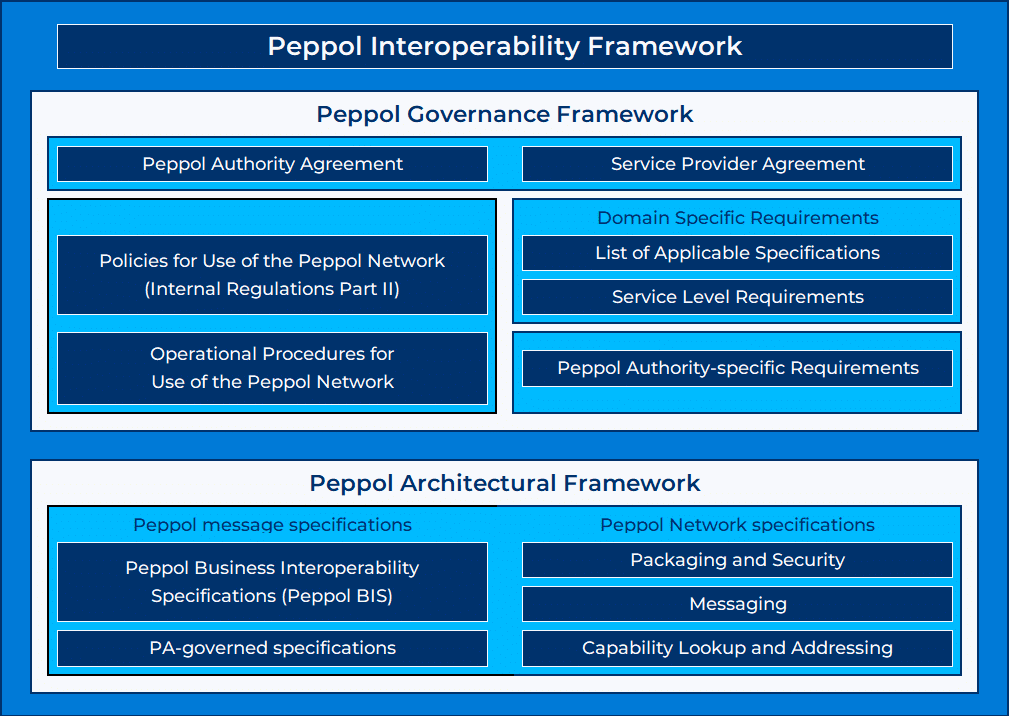
Peppol Interoperability Framework (PIF) - Click to enlarge

In 2019, OpenPeppol discontinued the use of the acronym PEPPOL (Pan-European Public Procurement OnLine) and opted for the simpler name “Peppol.” This change was made to better represent its broader scale, extending beyond Europe, and its expanded scope, encompassing more than just public procurement.

Peppol's Expansion and Evolving Role

As of 2023, the Peppol network has become a cornerstone of global electronic invoicing, supported by a growing number of users and stakeholders, as governments, businesses, and service providers worldwide are increasingly adopting Peppol standards.

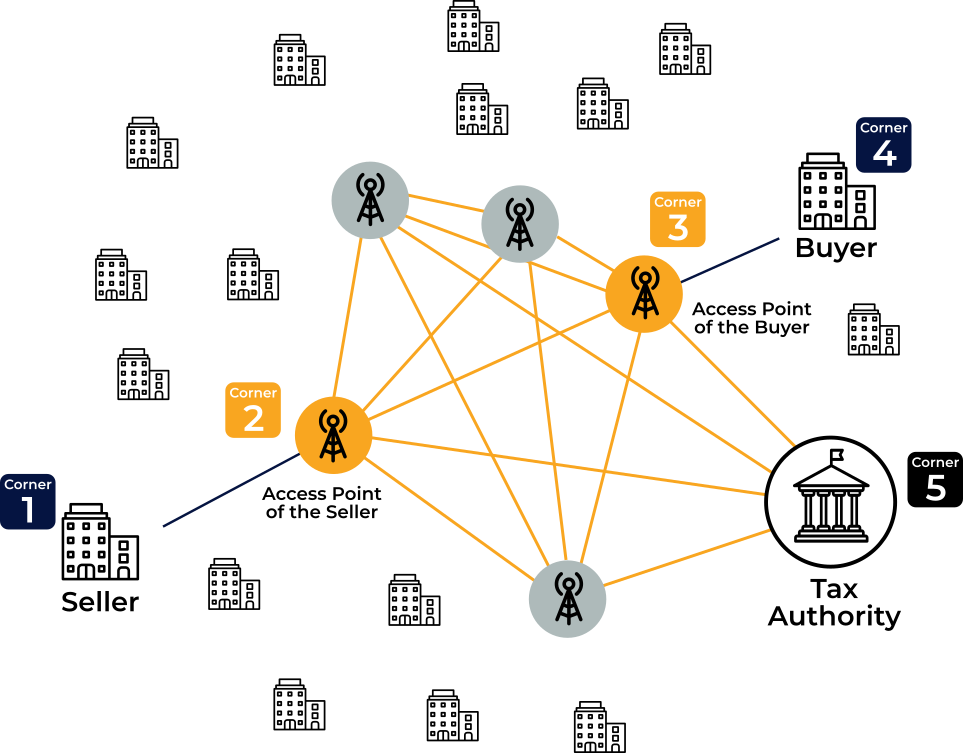
Additionally, the first implementations of 5-corner e-invoicing models (also called DCTCE – Decentralized Continuous Transaction Controls and Exchange) rely on Peppol. This model, which enables both the e-invoicing between companies and the e-reporting to the tax authority (the 5th corner) is gaining significant traction. It ensures that transactions comply with national regulations (such as specific invoice format & content or e-reporting obligations) while leveraging Peppol’s standardized protocols. 

In a 5-corner model, a Tax Authority acts as the 5th corner, receiving CTC (Continuous Transaction Controls) data from all Access Points. This data is used to facilitate tax reporting and prevent tax fraud.

However, the integration of various national e-invoicing mandates within the Peppol framework can add complexity, as businesses and service providers must manage diverse local requirements within a single system.

Looking ahead, the OpenPeppol Association remains dedicated to evolving the Peppol specifications to keep pace with emerging technologies and changing business needs. By promoting collaboration among governments, businesses, and technology providers, the association aims to ensure that Peppol continues to serve the global market effectively.

Peppol Timeline

Peppol Project Initiation
The Peppol initiative is launched by the European Commission
Creation of the OpenPeppol Association
OpenPeppol AISBL was established as a non-profit organization to govern the Peppol network
Norway Adopts Peppol
Norway is the first country to adopt Peppol, by mandating its use for B2G transactions
Peppol BIS 2.0 Format
Release of Peppol BIS (Business Interoperability Specifications) 2.0
Peppol BIS 3.0 Format
The use of Peppol BIS 3.0 becomes mandatory on the Peppol network
Singapore Adopts Peppol
Singapore becomes the first non-European country to adopt the Peppol network for its national e-invoicing initiative
PEPPOL Becomes Peppol
The PEPPOL acronym has been deprecated, as Peppol now extends beyond Europe and covers more than just public procurement
PINT Format
Introduction of the Peppol International (PINT) format, developed to accommodate local variations
2008
2012
2013
2013
2017
2019
2019
2022

The Invoicing Hub Word

Peppol: a crucial framework for interoperability and scalability.

Over its 15-year journey, the PEPPOL (Pan-European Public Procurement OnLine) initiative has evolved into the well-known “Peppol”, expanding far beyond its original scope to become a vital infrastructure for securestandardized document exchange between businesses and governments worldwide

The widespread adoption of Peppol standards and the growing prominence of the 5-corner e-invoicing model underscore its increasing influence. However, this expansion introduces new complexities, as integrating various national mandates within a unified framework requires careful coordination. 

Looking ahead, the OpenPeppol Association’s dedication to refining Peppol specifications ensures that this global network will continue to meet the demands of modern commerce. 

It must do so without compromising on securityscalability, or the standardized formats and protocols that have driven its global adoption, offering businesses a practical and scalable solution for both national and cross-border document exchange.

Get your Project Implemented

Gold Sponsor

EdiFactMx logo
We are an authorized e-invoicing provider (PAC) in Mexico, specializing in ERP integration and rapid CFDI 4.0 implementation via API, with expert support for companies invoicing in or to Mexico.
We are an authorized e-invoicing provider (PAC) in Mexico and the trusted gateway for issuing CFDI-compliant invoices within the country. Our solution enables fast, secure, and fully compliant e-invoicing tailored to Mexico’s tax regulations. We specialize in integrating with leading ERP systems like SAP, Oracle, MS Dynamics, and legacy platforms, offering rapid deployment through our robust CFDI 4.0 API.

With expert technical support and tailored consulting, we help global and local companies meet Mexico’s invoicing mandates with ease and efficiency. Whether you're operating in Mexico or need to invoice Mexican partners, we ensure full compliance and operational continuity.

Advertisement

Invopop logo - Color transparent
Invopop is the e-invoicing provider for global tech companies. Integrate once and unlock 25+ countries, including Peppol and local e-invoicing networks. Scale effortlessly with no-code workflows. Enterprise-grade security. ISO 27001.
Invopop is the e-invoicing provider for global tech companies. Through a single API, companies can issue compliant invoices in 25+ countries, including networks like Peppol, SDI, ChorusPro/PA, SII/VeriFactu, and KSeF. Invopop converts standard invoice data into each country’s required format and manages the whole invoice lifetime — from validation to submission and archiving.

Built for developers and product teams, it simplifies global compliance through our open-source standards (GOBL) and no-code workflow engine that adapts to any market. Trusted by leaders like Qonto, DeepL, and SumUp, Invopop helps companies scale internationally with speed and confidence. Enterprise-grade support & security. ISO 27001 certified.

Latest News

Main Market Square at summer dawn, aerial view of the historic central marketplace in Kraków, Poland

Poland’s KSeF phase 2 takes effect after solving initial hurdles

After early challenges and digital attacks, KSeF mandatory scope expended to most VAT-registered businesses as Phase 2 went live on April 1st

Join the DBNAlliance U.S. e-invoicing event in New York on April 22

Join industry leaders in New York on April 22 to explore recent e-invoicing interoperability breakthroughs shaping the U.S. market.

Spain formalizes a B2B e-invoicing mandate effective next year

Spain finally approved a Royal decree mandating the long awaited B2B e-invoicing obligations established under the "Crea y Crece".

The new billentis Market Report is coming in May 2026

The upcoming report has been redesigned to help companies navigate today’s rapidly evolving e-invoicing, CTC, and tax reporting landscape.

From the upcoming update of EN 16931 to XRechnung 4.0

Germany’s KoSIT confirms advanced progress and next steps for XRechnung 4.0, building on the upcoming EN16931-1:2026 release.

📩 ‎ Newsletter

Receive the latest e-invoicing news, directly in your mailbox, once a month.