Skip to content

Advertisement

Traffiqx logo - Color transparent
TRAFFIQX® is a network of independent providers that serve different core segments to make digitalization usable for every company. These providers are: Bundesdruckerei, DATEV, RICOH, SGH, Quadient, Asterion, BeCloud and b4value.net.
TRAFFIQX® is a network of independent providers that serve various core segments in order to make digitalization usable for every company. Experienced digitization specialists such as Bundesdruckerei, DATEV, RICOH, SGH, Quadient, Asterion, BeCloud and b4value.net have joined forces with a common technological basis to form a unique business network for the exchange of business documents.

The technological platform for Germany's leading provider network was developed by b4value.net back in 2004 and enables the fast, secure and error-free exchange of business documents, e-invoices and other transaction documents between senders and recipients - completely independent of their respective system environments. A redundant network architecture ensures process security and scalability.
↑ ISO 27001
Security & Reliability in E-Invoicing
Understanding ISO 27001​
Key Aspects Monitored Under ISO 27001
The Challenges of ISO 27001 Certification
Get Help from ISO 27001 Experts
A Global Trend
The Invoicing Hub Word
Get your project implemented
↓ Bottom

ISO 27001 - Improving Security in E-Invoicing

Summary

E-invoicing handles a significant amount of sensitive data, making data breaches and unauthorized access major concerns for all stakeholders in the field.

Adopting ISO 27001 standards helps organizations reduce these risks by focusing on key security areas such as data protection, regulatory requirements, and risk management.

This approach not only enhances trust but also ensures compliance with requirements like the upcoming French B2B e-invoicing mandate and Peppol network standards.

Security & Reliability in E-Invoicing

Electronic invoicing (e-invoicing) has revolutionized the way businesses exchange transactional data. By replacing traditional paper-based systems with digital processes, e-invoicing delivers significant benefits such as improved efficiency, cost savings, and enhanced accuracy in financial transactions for many businesses worldwide. 

However, the digital nature of e-invoicing introduces critical challenges related to data protection. Sensitive financial and business information is exchanged electronically, making it vulnerable to cyberattacks, unauthorized access, and fraud. 

Person typing on a laptop, with lock & password overlay, illustrating the concept of information security
E-Invoicing involves lots of sensitive data, which ISO 27001 help secure

In this context, ensuring the security & integrity of e-invoicing systems becomes a top priority. Frameworks like ISO 27001 provide a robust solution to these challenges, offering organizations a structured approach to safeguard their data.

Moreover, compliance with legal and regulatory requirements is a significant concern for e-invoicing providers. Many jurisdictions, including the European Union, have introduced strict data protection laws, such as the General Data Protection Regulation (GDPR). By aligning their operations with ISO 27001, organizations can demonstrate compliance with these regulations, minimizing legal risks and building credibility with clients and partners.

Understanding ISO 27001

ISO 27001 stands out as the most recognized standard internationally for managing information security. It offers organizations a comprehensive framework to identify, mitigate, and manage risks to their information assets. By implementing ISO 27001, businesses can establish a systematic approach to protecting sensitive data and meeting stakeholder expectations.

The standard focuses on three fundamental aspects of security:

  • Confidentiality: Ensuring that sensitive information is accessible only to authorized personnel, thereby preventing unauthorized access.

  • Integrity: Maintaining the accuracy and reliability of data by safeguarding it from unauthorized modifications or corruption.

  • Availability: Ensuring that information and systems are accessible when needed, minimizing disruptions to business operations.

ISO 27001 also emphasizes the importance of continuous improvement. Organizations are encouraged to regularly assess and update their security practices to address emerging threats and changes in their operational landscape. By adopting this standard, businesses not only enhance their security posture but also demonstrate a commitment to protecting their stakeholders’ trust.

Key Aspects Monitored Under ISO 27001

ISO 27001 Logo

ISO 27001 provides a structured approach to monitoring and managing critical aspects of information security within an organization. Key areas of focus include:

  • Access Control: In the context of e-invoicing, ensuring that only authorized individuals, such as employees of e-invoicing service providers, can access sensitive financial data and systems. Role-based access permissions and continuous activity monitoring prevent unauthorized access and help maintain data confidentiality.

  • Data Encryption: E-invoicing platforms handle a significant volume of sensitive transactional data. Encrypting this data, both during transmission between parties and at rest within servers, ensures that even if intercepted, the information remains unreadable to unauthorized entities.

  • Incident Response: For e-invoicing providers, responding swiftly to breaches or disruptions is crucial to maintaining client trust and regulatory compliance. ISO 27001 mandates clear incident response protocols, including identifying the root cause, mitigating impacts, and restoring normal operations, which helps minimize downtime and data loss.

  • Risk Assessment and Management: Regular risk assessments are essential for identifying vulnerabilities specific to e-invoicing platforms, such as risks associated with integration into client systems or exposure to external threats. ISO 27001 provides a framework for mitigating these risks effectively, ensuring that platforms remain secure and reliable.

  • Compliance Monitoring: E-invoicing is often subject to complex regulations, such as GDPR in the EU or mandates like the French B2B requirement. ISO 27001 ensures that organizations continuously audit their practices to meet these regulatory demands, reducing the risk of penalties and maintaining operational legitimacy.

The Challenges of ISO 27001 Certification

A Comprehensive Evaluation

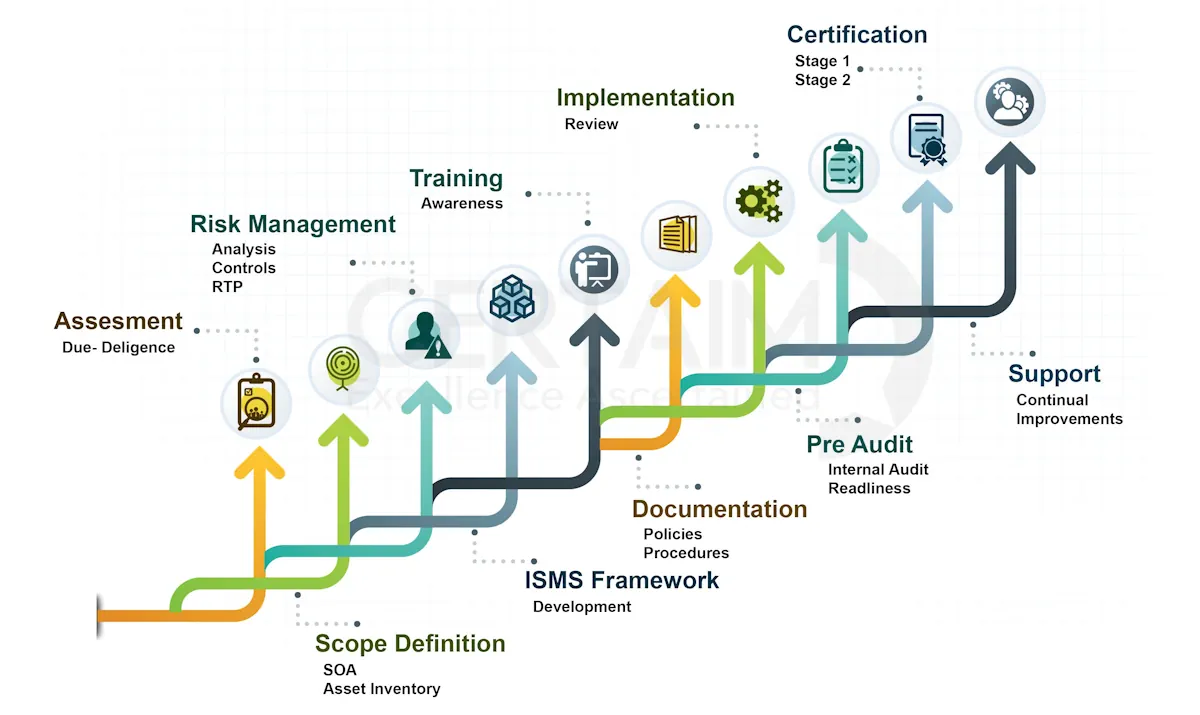
Achieving ISO 27001 certification is a complex and time-intensive process that involves multiple teams within an organization. 

It requires a comprehensive evaluation of existing practices, the implementation of new security measures, and ongoing audits to ensure compliance. Each department, from IT to legal and operations, plays a crucial role in meeting the standard’s requirements.

Diagram illustrating the many steps involved in the comprehensive evaluation needed to become ISO 27001 certified
ISO 27001 - Overview of the steps to become certified

Annual Renewal

One of the main challenges of ISO 27001 certification is that it’s not a one-time achievement, it requires annual renewal to maintain compliance. 

Staying certified means going through yearly audits where you need to show that your security processes are being followed correctly, risks are managed effectively, and improvements are made over time

Advertisement

Get Help from ISO 27001 Experts

For companies navigating this intricate process, getting help from ISO 27001 experts can be invaluable. Services like ouwba specialize in simplifying the path to ISO 27001 certification, providing expert guidance and tools to streamline the necessary steps.

By leveraging such services, organizations can achieve compliance more efficiently, saving time and resources while maintaining their focus on core business operations.

ouwba - ISO 27001 experts

A Global Trend

Upcoming B2B E-Invoicing Mandate in France

A practical illustration of ISO 27001’s importance in the e-invoicing industry is the upcoming B2B e-invoicing mandate in France. Scheduled to take effect in 2026, this regulation requires all platform operators, known as Plateformes de Dématérialisation Partenaires (PDPs), to be ISO 27001 certified.

With this obligation, the French government ensures that PDPs adhere to international best practices for information security. This not only safeguards data but also improves trust between businesses, service providers, and regulatory bodies, as PDPs will have to manipulate lots of sensitive data on behalf of the tax authority.

Photo of the Eiffel Tower in Paris, capital of France

Peppol Access Points

The Peppol network operates under the governance of national Peppol authorities, which establish specific regulations to ensure compliance, security, and interoperability within their jurisdictions.

Peppol Logo - Color transparent

In the Netherlands, the Peppol Authority requires all access points connected to the network to obtain ISO 27001 certification. This mandate, outlined in the “Peppol Authority Special Requirements” (PASR), ensures that service providers meet the highest standards of information security management.

Similarly, Peppol Authorities in Australia and New Zealand also mandate ISO 27001 certification for providers to officially become local Peppol Access Points and be authorized to operate within those countries.

The Invoicing Hub Word

ISO 27001: Ensuring Security and Compliance in E-Invoicing Operations

In the fast-evolving landscape of electronic invoicing, security is more important than ever. As digital transactions continue to grow, so do the risks related to data breaches and regulatory compliance. 

ISO 27001 is not just a requirement—it’s also an opportunity to build trust, improve operational efficiency, and strengthen information security

Preparing now gives e-invoicing service providers a head start, as ISO 27001 is already a mandatory requirement for becoming a certified PEPPOL Access Point.

With France’s 2026 e-invoicing mandate introducing strict requirements for service providers—and several countries expected to follow—alongside the increasing adoption of PEPPOL in Europe and APAC, ISO 27001 is quickly becoming a growing trend and a crucial standard for providers aiming to thrive in these evolving markets.

Get your Project Implemented

Gold Sponsor

Esker Logo
Esker is a global cloud platform built to unlock strategic value for Finance, Procurement and Customer Service professionals, and strengthen collaboration between companies by automating the cash conversion cycle.
By developing AI-driven technologies and automating the Source-to-Pay and Order-to-Cash cycles, Esker is a global cloud platform built to unlock strategic value for Finance, Procurement and Customer Service professionals, and strengthen collaboration between companies by automating the cash conversion cycle.

Founded in 1985, Esker operates in North America, Latin America, Europe and Asia Pacific.

Esker helps companies process e-invoices in compliance with the unique specifications of European countries. This includes processing any format (e.g., PDF, UBL, Facturae, Fattura-PA, etc.), communicating with PA platforms (including PEPPOL) to send e-invoices with status updates, and providing e-invoice archiving that’s compliant with regulatory frameworks.

Advertisement

EdiFactMx logo
We are an authorized e-invoicing provider (PAC) in Mexico, specializing in ERP integration and rapid CFDI 4.0 implementation via API, with expert support for companies invoicing in or to Mexico.
We are an authorized e-invoicing provider (PAC) in Mexico and the trusted gateway for issuing CFDI-compliant invoices within the country. Our solution enables fast, secure, and fully compliant e-invoicing tailored to Mexico’s tax regulations. We specialize in integrating with leading ERP systems like SAP, Oracle, MS Dynamics, and legacy platforms, offering rapid deployment through our robust CFDI 4.0 API.

With expert technical support and tailored consulting, we help global and local companies meet Mexico’s invoicing mandates with ease and efficiency. Whether you're operating in Mexico or need to invoice Mexican partners, we ensure full compliance and operational continuity.

Latest News

Main Market Square at summer dawn, aerial view of the historic central marketplace in Kraków, Poland

Poland’s KSeF phase 2 takes effect after solving initial hurdles

After early challenges and digital attacks, KSeF mandatory scope expended to most VAT-registered businesses as Phase 2 went live on April 1st

Join the DBNAlliance U.S. e-invoicing event in New York on April 22

Join industry leaders in New York on April 22 to explore recent e-invoicing interoperability breakthroughs shaping the U.S. market.

Spain formalizes a B2B e-invoicing mandate effective next year

Spain finally approved a Royal decree mandating the long awaited B2B e-invoicing obligations established under the "Crea y Crece".

The new billentis Market Report is coming in May 2026

The upcoming report has been redesigned to help companies navigate today’s rapidly evolving e-invoicing, CTC, and tax reporting landscape.

From the upcoming update of EN 16931 to XRechnung 4.0

Germany’s KoSIT confirms advanced progress and next steps for XRechnung 4.0, building on the upcoming EN16931-1:2026 release.

📩 ‎ Newsletter

Receive the latest e-invoicing news, directly in your mailbox, once a month.