Skip to content

Highlights of the European Commission webinar on the future of e-invoicing

/‎

/‎

/‎

10 years after the EU Directive 2014/55/EU publication, the European Commission evaluates its relative yet necessary impact.

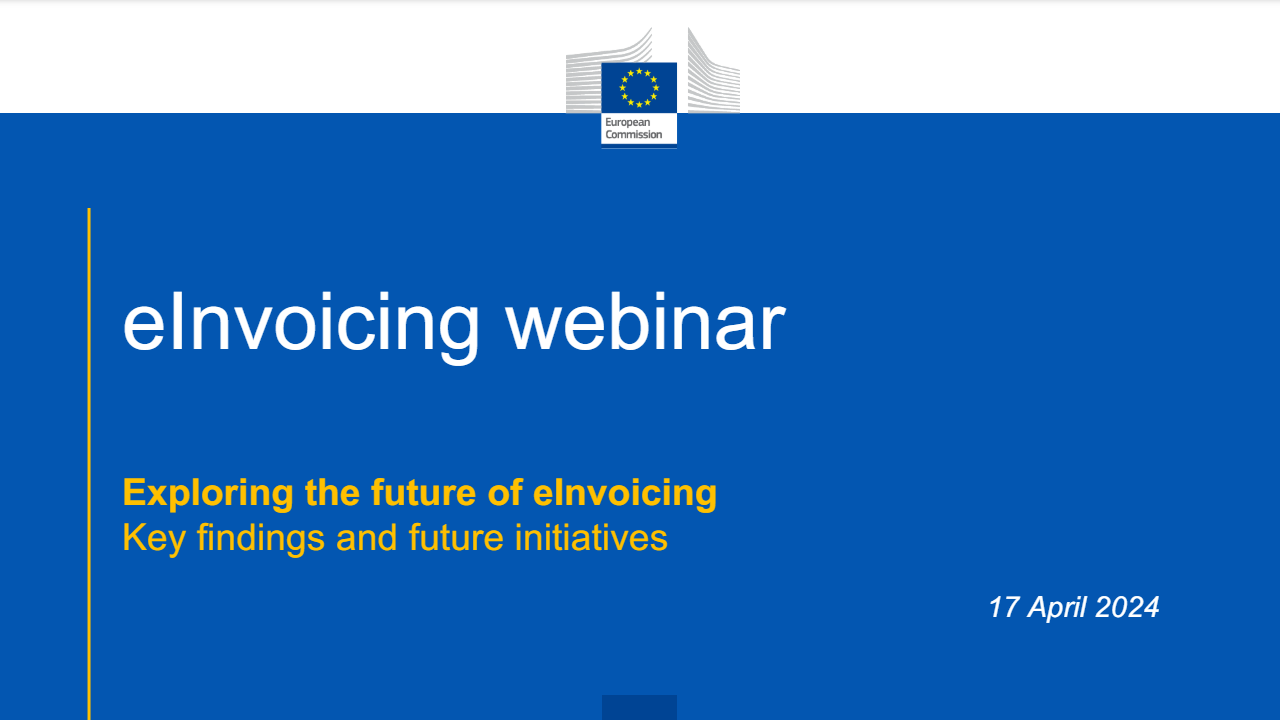
Last February, the European Commission published a comprehensive report detailing the impact of the E-Invoicing Directive 2014/55/EU, and then held a webinar exploring the “Future of e-invoicing” on April 17.

Some of the key findings shared by the European Commission:

  • The general uptake of e-invoicing has been relatively modest, as the percentage of entreprises in the EU sending or receiving e-invoices only rose from 10,3% in 2013 to 38,6% in 2023
  • The European Directive was however necessary as EU countries acting alone would have achieved lower results
  • The main barrier to wider adoption is the technical complexity for enterprises to implement e-invoicing due to the lack of interoperability and the many competing national standards

The European Commission also assesses that e-invoicing is now undergoing a rapid evolution moving from B2G to B2B in terms of market and policy, and requiring proactive measures. Additionally, it ackwnoledges the fact that there is an immense potential for regulatory reporting reduction.

Any e-invoicing stakeholder is invited to continue the discussion with the European Commission on their E-Invoicing User Community.
Download: European Commission April 17 webinar slides (PDF)

Get your Project Implemented

Gold Sponsor

Esker
By developing AI-driven technologies and automating the Source-to-Pay and Order-to-Cash cycles, Esker is a global cloud platform built to unlock strategic value for Finance, Procurement and Customer Service professionals, and strengthen collaboration between companies by automating the cash conversion cycle.

Founded in 1985, Esker operates in North America, Latin America, Europe and Asia Pacific.

Esker helps companies process e-invoices in compliance with the unique specifications of European countries. This includes processing any format (e.g., PDF, UBL, Facturae, Fattura-PA, etc.), communicating with PA platforms (including PEPPOL) to send e-invoices with status updates, and providing e-invoice archiving that’s compliant with regulatory frameworks.

Advertisement

Latest News

Photo of the Ministry of Finance near the Seine River in Paris, Capital of France

France’s DGFiP unveils the official list of Approved Platforms

France e-invoicing implementation made an important step forward with the official confirmation and publication of 100+ Approved Platforms.

Additional transactions covered by Israel’s e-invoicing mandate in 2026

Israel’s e-invoicing obligation is being implemented quicker than initially planed with two new phases on 2026, based on invoice amount.

Denmark’s Bookkeeping Act final stage and cancellation of OIOUBL 3.0

While uncertainty surrounds OIOUBL 3.0, the Bookkeeping Act is moving ahead and now enters its final rollout phase.

Webinar – What the 2029 UK mandate means for your business

Storecove's webinar will cover UK's e-invoicing requirements, how it will impact your organization, and how one API can simplify compliance.

A tense launch for Croatia’s e-invoicing mandate

Croatia made e-invoicing mandatory for B2G, B2B and B2C transactions just six months after the law passed, which is proving ambitious.

📩 ‎ Newsletter

Receive the latest e-invoicing news, directly in your mailbox, once a month.