Skip to content

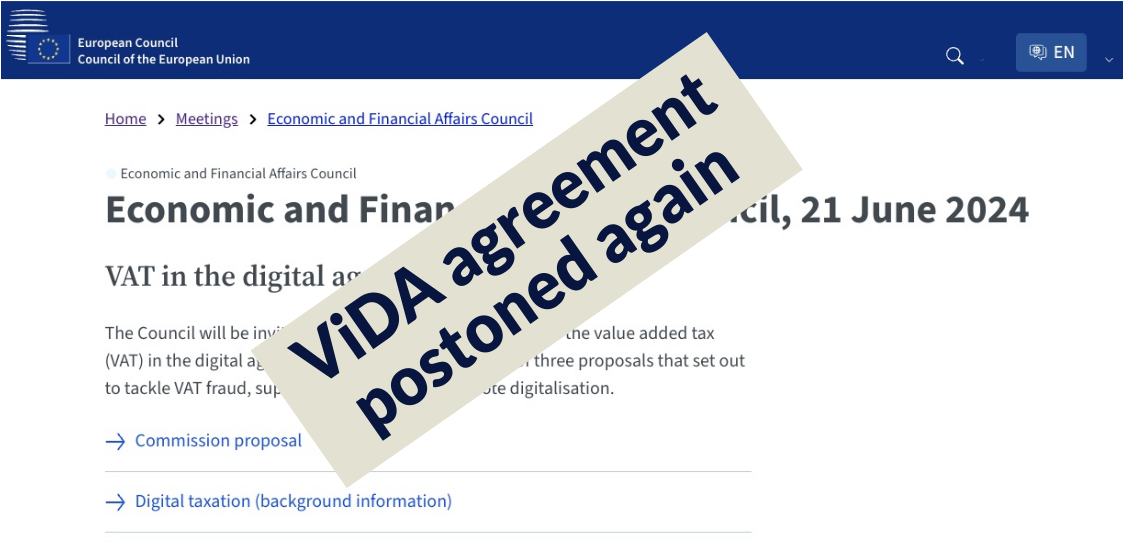
European Council not adopting ViDA (again)

/‎

/‎

/‎

In today’s ECOFIN session, the positions on passing the “VAT in the Digital Age” (ViDA) package have not materially changed.

Despite many efforts and compromise proposals, Estonia maintains their view to not be able to join the broad agreement on the VAT in the Digital Age (ViDA) package and refused support for the yet again updated text. As a result, the Belgian presidency of Vincent van Peteghem hands over the file to the Hungarian semester lead by Mihály Varga.

Reflecting the importance placed on the digitalization requirements in the VAT as well as the broader economic context of the single European Market, political agreement on the ViDA package was the top and only agenda item in the public session on 21.6.2024. In the public session, 17 member states explicitly voiced their support and the significant impact of the compromise on the table.
Still, Estonia maintains their position that the “deemed supplier” rules as proposed are not acceptable for the Estonian Small and Medium Businesses. Also the added option to “opt-out” does not satisfy their requirements to not implement the rules in Estonia.

Among those expressing support, Spain stressed the importance of keeping the integrity of the entire package to achieve its objectives. Germany urged considering the compromise for its very positive impact while voicing concerns that future deliberations may not lead to substantial changes in position.

Hungarian Minister of Finance Mihály Varga assured to keep the effort going on progressing on this important issue under their presidency starting on July 1st through the remainder of 2024. We’ll be sure to follow these discussions and hope for swift resolution and agreement.


Get your Project Implemented

Gold Sponsor

A-Cube API
A-Cube API is a global e-invoicing and tax compliance solution that helps businesses exchange electronic documents with governments, tax authorities, and trading partners worldwide. It offers seamless connectivity to Peppol networks and national clearance platforms, and is already active across many European countries, including France, Italy, Belgium, Spain, Poland, and Germany.

The API ensures invoices are validated, transmitted, and reported in line with local regulations. Supporting both real-time and post-audit models, it adapts to evolving legal requirements without heavy internal development.

Secure, scalable, and easy to integrate with ERP and accounting systems, A-Cube automates workflows, reduces compliance risk with transparency.

Advertisement

Latest News

Photo of the scenic view, white walls and blue roofs of Santorini, an Island in Greece

Greece’s B2B mandate to start one month late, on March 2

In its first phase, the mandate wjll require large companies to implement e-invoicing, with a transition period until May 3, 2026.

Peppol G2 to G3 certificate migration on April 1st 2026

The migration to G3 certificate is a critical change of Peppol network’s infrastructure which could paralyze e-Invoicing process.

E-Invoicing Compliance in the UAE: The Complete Guide

2 Ministerial Decisions published in 2025 have put the UAE on the road to mandatory e-invoicing, with rollout planned in 2026 & 2027.

Sweden to assess implementation of domestic e-invoicing 

Sweden will evaluate until December 2027 whether to adopt domestic e-invoicing or strictly adhere to intra-EU ViDA requirements.

Webinar – France’s digital leap: preparing for mandatory e‑invoicing in 2026

France’s mandatory e-invoicing is approaching, here’s what businesses need to know to prepare for the 2026 regulatory shift.

📩 ‎ Newsletter

Receive the latest e-invoicing news, directly in your mailbox, once a month.