E-Invoicing in the Philippines
Last update: 2026, March 6
Summary
E-Invoicing
Issuance soon mandatory, but not delivery
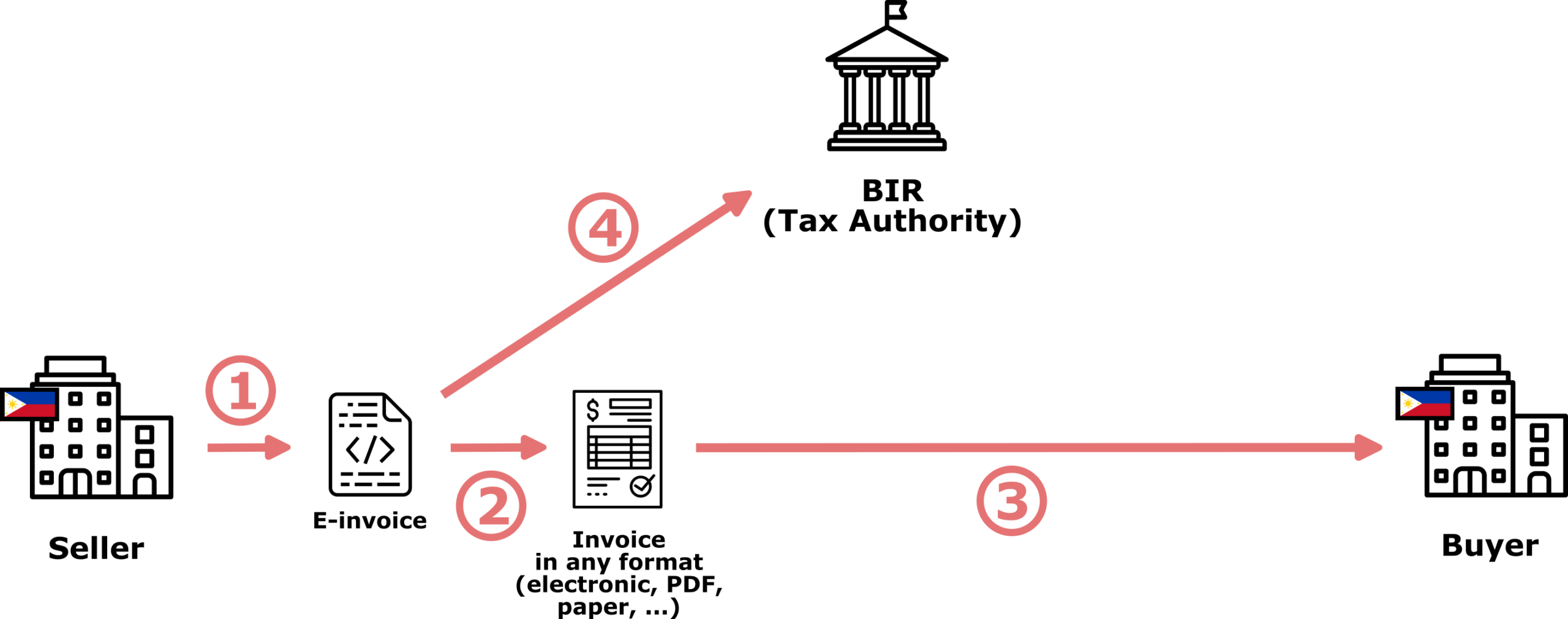
Starting from January 1, 2027, invoices will have to be generated in a structured way, though companies can still send them to the buyer in any format, including paper or PDF.
E-Reporting
Will become mandatory soon
Companies will have to transmit invoice data electronically (primarly in JSON or XML format) to the tax authority, beginning on a date yet to be determined.
What the Law Says
E-Invoicing
E-invoicing is currently not mandatory in the Philippines, meaning that companies are allowed to send and receive invoices using the method of their choice:
- Paper
- Any electronic format, as long as there’s a mutual agreement between parties
However, as part of an upcoming e-reporting mandate issued by the Bureau of Inland Revenue (BIR), the Philippines’ tax authority, companies will progressively have to generate their invoices primarily in an electronic format.
Although the initial Revenue Regulation No. 011-2025 [↗︎] set March 14, 2026 as the start date of the mandate, it was subsequently postponed.
The new implementation date is January 1, 2027, and it will primarily apply to:
- Taxpayers engaged in e-commerce or internet transactions
- Taxpayers under the jurisdiction of the Large Taxpayers Service (LTS)
- Large Taxpayers
Later a second phase of the mandate should be announced, involving taxpayers not in the scope of the first phase.
However, invoice transmission will remain unregulated, still leaving companies the choice of their preferred delivery method. Non-electronic invoices (such as PDF or paper) will, however, have to be derived from the original electronic invoice.
Additionally, the BIR is aiming to implement a cross-border e-invoicing obligation, called Customer Electronic Invoice (CEI). Enacted through the Joint Administrative Order 001-2025 [↗︎], this obligation will be rolled out in three phases following the publication of the Customs Administrative Order (respectively 30 / 60 / 90 days), which must occur before January 1, 2027.
But general uncertainty persists regarding those e-invoicing requirements, as detailed technical specifications have not yet been shared, making it unclear exactly what companies will be required to do.
E-Reporting
E-reporting is set to become progressively mandatory in the Philippines, following the Revenue Regulation No. 011-2025 published in February 2025.
Following the introduction of the e-invoicing mandate on January 1, 2027, the Bureau of Internal Revenue (BIR) will be required to establish an e-reporting system through which companies will submit their invoice data.
This system is a prerequisite for launching the next phase of the mandate, yet to be announced, which will expand the obligation to taxpayers not included in the initial phase.
Additional guidance is expected to be issued in a separate government issuance outlining the detailed rules and technical requirements.
Timeline
Pilot program start
E-invoicing & e-reporting pilot program started with 100 selected taxpayers
Pilot program end
Pilot program suspended without further notice due to technical challenges
New mandate deadline
First phase of the e-invoicing mandate, requiring some taxpayers to issue invoices electronically
Cross-border e-invoicing obligation
The Cross-border E-Invoicing system (CIE) will enter into force in 3 phases after the publication of the Customs Administrative Order (CAO)
Phase 2 of the mandate
This phase will apply to taxpayers not covered in the initial phase and will mark the beginning of the e-reporting obligation.
Latest E-Invoicing News in the Philippines
Additional Details
E-invoicing & e-reporting pilot phase (2022-2023)
The Philippines initially launched on July 2022 an e-invoicing and e-reporting pilot as a first step toward the implementation of full e-invoicing and e-reporting obligations. The pilot initially concerned 100 large taxpayers specifically identified and chosen by the Bureau of Internal Revenue (BIR).
For this purpose, the BIR established an Electronic lnvoicing/Receipting System (ElS) capable of storing and processing the data required to be transmitted by taxpayers.
Those selected taxpayers were to issue e-invoices under a structured JSON format, within 3 calendar days.
Facing technical difficulties, the BIR issued on November 2023 an advisory to all identified pilot participants informing them that “BIR is encountering technical challenges in the maintenance of Electronic Invoicing/Receipting and Sales Reporting System (EIS)” and that the BIR will be releasing another advisory once the system is back to its normal operations.
But up until 2025, no additional advisory has been published, effectively signaling the end of the pilot program.
New e-invoicing & e-reporting mandate (2027)
According to the 2027 mandate, e-invoices will need to be issued in a structured format, with the goal to allow data to be easily extracted electronically from the invoice, for transmission to the BIR platform (Electronic Invoicing/Receipting System – EIS) when the e-reporting obligation will be live.
Invoice data will have to be transmitted to the tax authority within 3 calendar days under a structured format (either JSON, XML format or any other format as may be prescribed by the BIR).
To comply with the obligation, Computerized Accounting System (CAS), Computerized Book of Accounts (CBA) with Accounting Records (with electronic invoicing), or other invoicing software shall be mandated to generate a system-generated compliant e-invoice.
The detailed technical requirements, including potential payment data obligations, are not yet available and are eagerly awaited from the BIR.
Cross-border e-invoicing
On January 2025, the Committee for Pre-border Technical Verification and Cross-border Electronic Invoicing enacted the Joint Administrative Order 001-2025 [↗︎], which contains the guidelines for implementing Administrative Order No. 23/2024.
The order notably aims at implementing a cross-border e-invoicing obligation, called Customs Electronic Invoice (CEI). The obligation, concerning most of the goods exported to the Philippines will be implemented as in 3 phases, following the publication of the Customs Administrative Order (CAO):
- Phase 1, 30 days after the publication of the CAO: Mandatory registration of exporters abroad
- Phase 2, 60 days after the publication of the CAO: Mandatory use of the CEI System for all imports covered by the BOC Bulk and Break-Bulk Cargo Clearance Enhancement Program
- Phase 3, 90 days after the publication of the CAO: Mandatory use of the CEI System for all other imports
To comply with the CEI obligation, all exporters of goods to the Philippines will be required to apply for registration in the CEI System annually in order to receive a digital certificate for the purpose of signing the e-invoices.
Signed e-invoices must include 20 mandatory fields, and will have to be generated prior to the exports of goods through the CEI System using an accredited Cross-border Electronic Invoicing System Provider.
Along with the CEI obligation, a pre-border technical verification system (PTV) will progressively be implemented, making mandatory to test and inspect all commodities by accredited Testing, Inspection, and Certification Companies prior to entering the Philippines.
It aims at ensuring that commodities imported to the Philippines match the declared specifications, description, weight, volume, and country of origin, and that they are safe and of good quality.
The Invoicing Hub Word
The Philippines
Mandatory structured e-invoicing is becoming a concrete compliance reality in Southeast Asia.
In the Philippines, regulatory plans have now translated into enforceable timelines, placing large taxpayers and e-commerce businesses on a defined path toward digital reporting under the Electronic Invoicing System (EIS).
The upcoming 2027 mandate functions primarily as a structured reporting system rather than a strict real-time clearance regime. Invoices are generated in digital format and transmitted electronically to the tax authority (BIR), increasing transparency and audit capability.
Within ASEAN, this positions the Philippines between more mature clearance-based systems such as Indonesia, and the phased structured reporting models currently being implemented in Malaysia and Vietnam. Singapore, by contrast, operates a Peppol-based exchange framework without a mandatory continuous transaction control model.
The Philippine approach suggests a phased compliance trajectory: structured reporting first, with potential tightening of controls in later stages.
However, the Philippines’ e-invoicing journey has been rocky, marked by an aborted 2022–2023 pilot, multiple postponements, including the latest delay moving the mandate from March 2026 to January 2027, and persistent uncertainty, as no technical specifications have yet been published, and no official online resources are available.
As a result, companies are left in the dark, unsure what they need to implement and unable to prepare, even as the deadline draws ever closer.
Additional Resources [↗︎]
Tax authority supervising e-invoicing in the Philippines
Central platform of pilot program, no longer in service, but providing insight into direction followed by tax authority
Get your Project Implemented
Gold Sponsor
Silver Sponsors
Latest News
E-invoicing in the Philippines from January 2027: The Complete Guide
EN 16931 update: the next step in e-invoicing is on its way
(Postponed to November) E-Invoicing Exchange Summit Middle East 2026
Singapore InvoiceNow to become mandatory for all GST-registered businesses by 2031
The French e-invoicing pilot begins, alongside updates to AFNOR standards
📩 Newsletter
Receive the latest e-invoicing news, directly in your mailbox, once a month.