Skip to content

Advertisement

Become a gold sponsor - stacked
Contact us to learn about our sponsorship plans
↑ E-Invoicing in Malaysia
What the Law Says
Timeline
Latest News
Technical Details
National E-Invoicing Initiative (via Peppol)
Cross-Border Invoices
Invoice Archiving
The Invoicing Hub Word
Additional Resources
Get your project implemented
↓ Bottom

E-Invoicing in Malaysia

Last update: 2026, January 7

Summary

B2G, B2B, B2C

Mandatory

E-Invoicing is currently mandatory all companies in Malaysia with a turnover above RM 1 million (~200 K€) through the central platform MyInvois following a Clearance model.

What the Law Says

Countrywide E-Invoicing Mandate

The government of Malaysia, by the intermediary of its tax authority, the IRBM (Inland Revenue Board of Malaysia) has gradually implemented an e-invoicing mandate that applies to all types of transactions (B2G, B2B and B2C). 

The mandate entered into effect depending on companies revenue, between August 1, 2024 and January 1, 2026, and now applies countrywide for all companies exceeding RM 1 million annual turnover (~200K€).

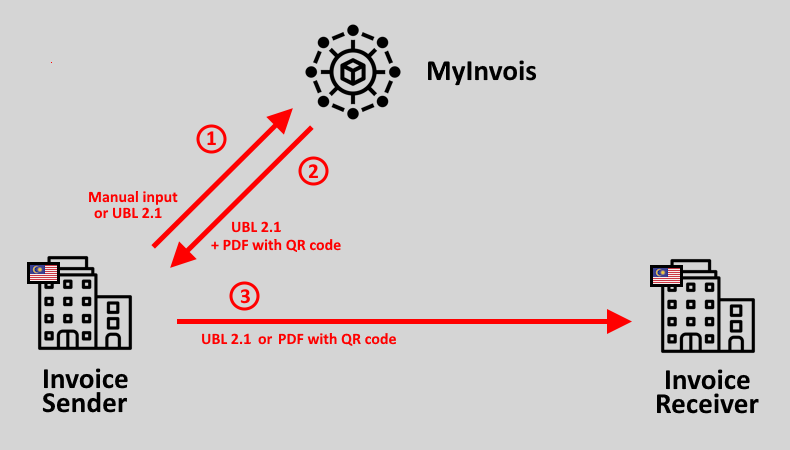
Under this mandate, suppliers must submit all invoices to the MyInvois central platform, either manually via a web interface or automatically through an API in UBL 2.1 format (XML or JSON).

Once the invoice content is verified, the MyInvois platform validates it and generates an e-invoice with a Unique Identifier Number (UIN) and a PDF version of the invoice with a QR code. The supplier is then responsible for delivering either (or both) to the buyer through their preferred channel.

Regarding the invoice delivery topic, the Malaysian government, through the Malaysia Digital Economy Corporation (MDEC), is driving a national e-invoicing initiative that primarily encourages the use of the Peppol network and the Malaysian Peppol International (MY PINT) invoice format.

All validated e-invoices will also be automatically archived by the IRBM and accessible through the MyInvois platform.

Grace Period & Exemptions

In the first six months of implementing the e-invoicing mandate, each taxpayer group in the rollout will be allowed a grace period and will be permitted to issue consolidated e-invoices on a monthly basis, rather than issuing a separate e-invoice for each transaction.

Additionally, as described in the official guidelines, the mandate only applies to private companies, as the public sector seems exempted from issuing e-invoices for the time being.

Finally, the mandate will not apply to very small companies (annual revenue below RM 1 million (~200K€), as announced by the government a few days before the start of the first phase of the mandate. It has been confirmed in version 3.2 of the guidelines, and in the official FAQ.

Other Methods

For small businesses not impacted by the e-invoicing mandate, e-invoicing via the MyInvois central platform is possible using the same rules, while traditional methods also remain allowed:

  • Paper-based invoices
  • PDF invoices with e-signature or complete audit trail
  • EDI

All invoices must be archived for 7 years.

Timeline

E-Invoicing Mandatory - Large Companies

Large companies (turnover > RM 100M) must send electronic invoices through the MyInvois central platform

E-Invoicing Mandatory - Mid-size Companies

The e-invoicing mandate starts applying to medium-sized companies (turnover > RM 25M)

E-Invoicing Mandatory - Small Companies

The e-invoicing mandate starts applying to small companies (turnover > RM 5M)

E-Invoicing Mandatory - All Companies

All invoicing transactions must be performed in an electronic way through the MyInvois central platform, except for very small companies (turnover < RM 1M) for which the mandate does not apply.

Aug 1, 2024
Jan 1, 2025
July 1, 2025
January 1, 2026

Latest E-Invoicing News in Malaysia

Night photo of the skyline of Kuala Lumpur, capital of Malaysia

New exemption threshold and grace period for Malaysian small enterprises

In response to multiple concerns raised, the Malaysian Government has announced two key measures to ease the transition for small enterprises.

Skyline of Kuala Lumpur, capital of Malaysia

Malaysia extends e-invoicing deadline for small businesses

Small businesses with a revenue below RM 500K get more time to transition to digital invoicing and adapt to the new requirements.
Malaysian Flag with the Petronas Towers and various buildings in the background in Kuala Lumpur, capital of Malaysia

Malaysia’s E-Invoicing mandate will apply to more businesses in 2025

From January 1, 2025, Malaysia’s e-invoicing mandate will cover mid-sized businesses, with full implementation for all companies by July 2025.

Technical Details

The following technical details focus on the countrywide e-invoicing mandate. Comprehensive guidelines and a SDK (Software Development Kit) are also maintained by the IRBM, providing more ample information.

Schema of the Malaysia e-invoicing landscape using the MyInvois central platform for validation and delivery of the invoice by the supplier
E-Invoicing in Malaysia: invoice validation by the MyInvois central platform & invoice delivery by the supplier

E-Invoice Validation

(Steps 1 & 2 as illustrated in the schema above)

In Malaysia, all e-invoices must undergo validation by the tax authority through the MyInvois central platform before reaching their final recipient.

To submit an e-invoice to MyInvois, suppliers have two options:

  • Manual data input via a web interface: this method is suitable for small volumes and companies without automated e-invoicing solutions (web interface guidelines are available)
  • Automated submission via a REST API: e-invoices submitted this way must adhere to the UBL 2.1 standard, be formatted in either XML or JSON, and digitally signed.
All invoices must include a Tax Identification Number (TIN), an official identifier for all Malaysian taxpayers introduced in 2022 and used to properly identify all parties during the invoicing process.
 

Once validated by MyInvois, the supplier will receive an e-invoice containing a Unique Identifier Number (UIN) and a PDF version of the invoice containing a QR code.

Both the supplier and the buyer also get notified by MyInvois alerting them about the e-invoice.

E-Invoice Delivery

(Step 3 as illustrated in the schema above)

Upon validation by MyInvois, it becomes the supplier’s responsibility to ensure the invoice is delivered to the buyer. Both the supplier and the buyer are free to agree on their preferred delivery method

Typically, most companies will opt to share the PDF invoice (with the QR code) via email. But the IRBM also strongly encourages sharing the e-invoice (in XML/JSON UBL 2.1 format) containing the UIN through the Peppol network, in order to maximize the benefits of e-invoicing, such as streamlining operations and reducing manual processing through automation.

The UIN and/or the QR code then enable the buyer to verify the validity of the e-invoice on MyInvois.

Furthermore, there is a 72-hour window after the invoice validation for the supplier to cancel the invoice or for the buyer to reject it. As the buyer received a notification from MyInvois upon validation of the e-invoice, they are aware that they should expect to receive an e-invoice from their supplier very soon.

National E-Invoicing Initiative (via Peppol)

In addition to the e-invoicing mandate primarily aimed at tax reporting, the Malaysian government is promoting a (non-mandatory!) national e-invoicing initiative through the Malaysia Digital Economy Corporation (MDEC), which has published official guidelines. This voluntary program encourages companies to adopt e-invoicing to leverage the numerous benefits of automation, such as faster processes and fewer manual errors.

Relying on the Peppol network, service providers wanting to offer Peppol services in Malaysia must be certified by the MDEC, which maintains lists of certified Peppol Service Providers and certified Peppol-Ready Service Providers are maintained. All Peppol requirements are also detailed in the Peppol Authority Specific Requirements for Malaysia.

Using the Malaysian version of the Peppol International (MY PINT) format, this initiative also allows compatibility with the e-invoicing mandate. The Peppol service provider of the invoice sender can indeed ensure compliance by sending the required data (in UBL 2.1 format) to the MyInvois portal, retrieving the UIN, and sending a MY PINT e-invoice via Peppol to the recipient.

Cross-Border Invoices

Foreign companies do not have to comply with the mandate. Rather, this responsibility falls upon the Malaysian company.

Sending Cross-Border Invoices

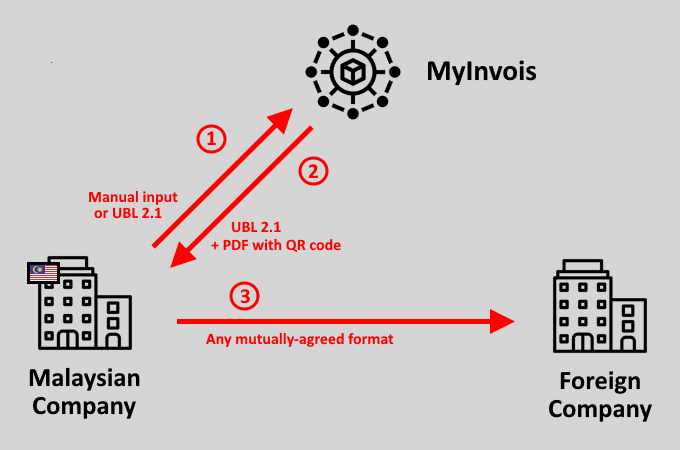
Sending cross-border invoices will not differ significantly from sending domestic invoices for a Malaysian company.

When a Malaysian seller invoices a foreign buyer, they must follow the mandated process by validating their e-invoice through MyInvois (steps 1 & 2) and must then send a copy of the invoice to the foreign buyer in a mutually agreed format (step 3).

The only difference stands in the fact that Malaysian businesses are not required to use the e-invoice or the PDF with QR code generated by MyInvois for foreign transactions. They can rather use the mutually agreed-upon format & channel with their foreign buyer.

Receiving Cross-Border Invoices

Receiving cross-border invoices introduces a bit more complexity for the Malaysian company.

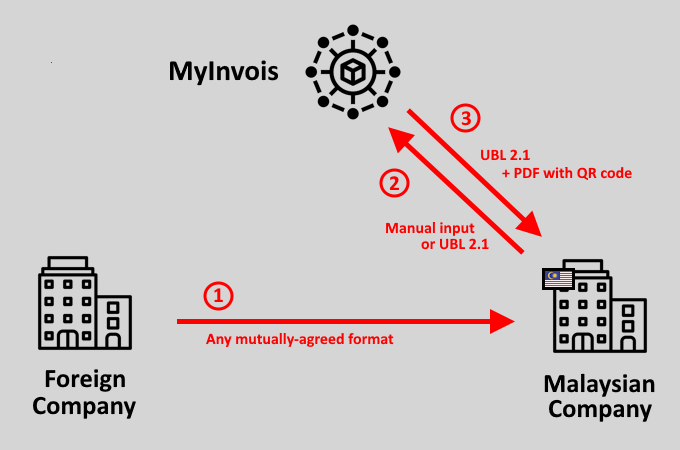
When a foreign seller invoices a Malaysian buyer, the foreign seller is free to issue the invoice as they see fit (step 1).

Then, the Malaysian buyer must subsequently issue a corresponding self-invoice and submit this self-invoice to MyInvois for validation (steps 2 & 3).

Invoice Archiving

All e-invoices validated by the MyInvois platform are automatically archived by the IRBM.

Suppliers and buyers then have the ability to retrieve those invoices in various formats, either using MyInvois web interface or via its API:

  • E-invoice (XML or JSON format)
  • Metadata
  • PDF invoice (via web interface only)
  • Grid (via web interface only)

The Invoicing Hub Word

Malaysia

Malaysia is adopting a pre-clearance e-invoicing mandate akin to those in effect in Latin America

Under this approach, suppliers must initially validate their invoices through the MyInvois central platform, which then generates e-invoice and PDFs containing validation proofs. Suppliers are then free to send those verified invoices through their usual channels. 

While this type of mandate reduces project scale as the actual delivery of the invoice is not in scope, it falls short in harnessing the full potential of e-invoicing, likely offering minimal automation benefits.

Nevertheless, Malaysia emerges as a pioneering nation in the Asia-Pacific region to enact a comprehensive e-invoicing mandate, setting a precedent for others to follow suit. 

Moreover, the Malaysia tax authority offers clear guidelines, detailed use cases, and comprehensive technical documentation, thus easing the burden for companies falling under the mandate’s scope.

Additional Resources

Public entity in charge of e-invoicing in Malaysia

Guidelines & technical specifications maintained by the IRBM

MyInvois is part of the MyTax portal

Comprehensive set of technical resources to interact with the MyInvois platform

Peppol Authority in Malaysia

Guidelines, certified providers & technical specifications for the use of Peppol in Malaysia

Get your Project Implemented

Gold Sponsor

Become a gold sponsor - stacked
Contact us to learn about our sponsorship plans

Silver Sponsors

Contact us to learn about our sponsorship plans

Advertisement

Become a gold sponsor - stacked
Contact us to learn about our sponsorship plans

Latest News

Photo of the seafront in Copenhagen, capital of The Netherlands

Denmark’s Bookkeeping Act final stage and cancellation of OIOUBL 3.0

While uncertainty surrounds OIOUBL 3.0, the Bookkeeping Act is moving ahead and now enters its final rollout phase.

Webinar – What the 2029 UK mandate means for your business

Storecove's webinar will cover UK's e-invoicing requirements, how it will impact your organization, and how one API can simplify compliance.

A tense launch for Croatia’s e-invoicing mandate

Croatia made e-invoicing mandatory for B2G, B2B and B2C transactions just six months after the law passed, which is proving ambitious.

New exemption threshold and grace period for Malaysian small enterprises

In response to multiple concerns raised, the Malaysian Government has announced two key measures to ease the transition for small enterprises.

Mandatory e-invoicing takes effect in Belgium

Since January 1, 2026, all Belgium companies are obliged to exchange invoices electronically, primarily through the Peppol network.

📩 ‎ Newsletter

Receive the latest e-invoicing news, directly in your mailbox, once a month.