
Skip to content

ECOFIN meeting on 14.5.2024 does not adopt ViDA (yet)

/‎

/‎

/‎

ECOFIN on ViDA (14.5.2024)
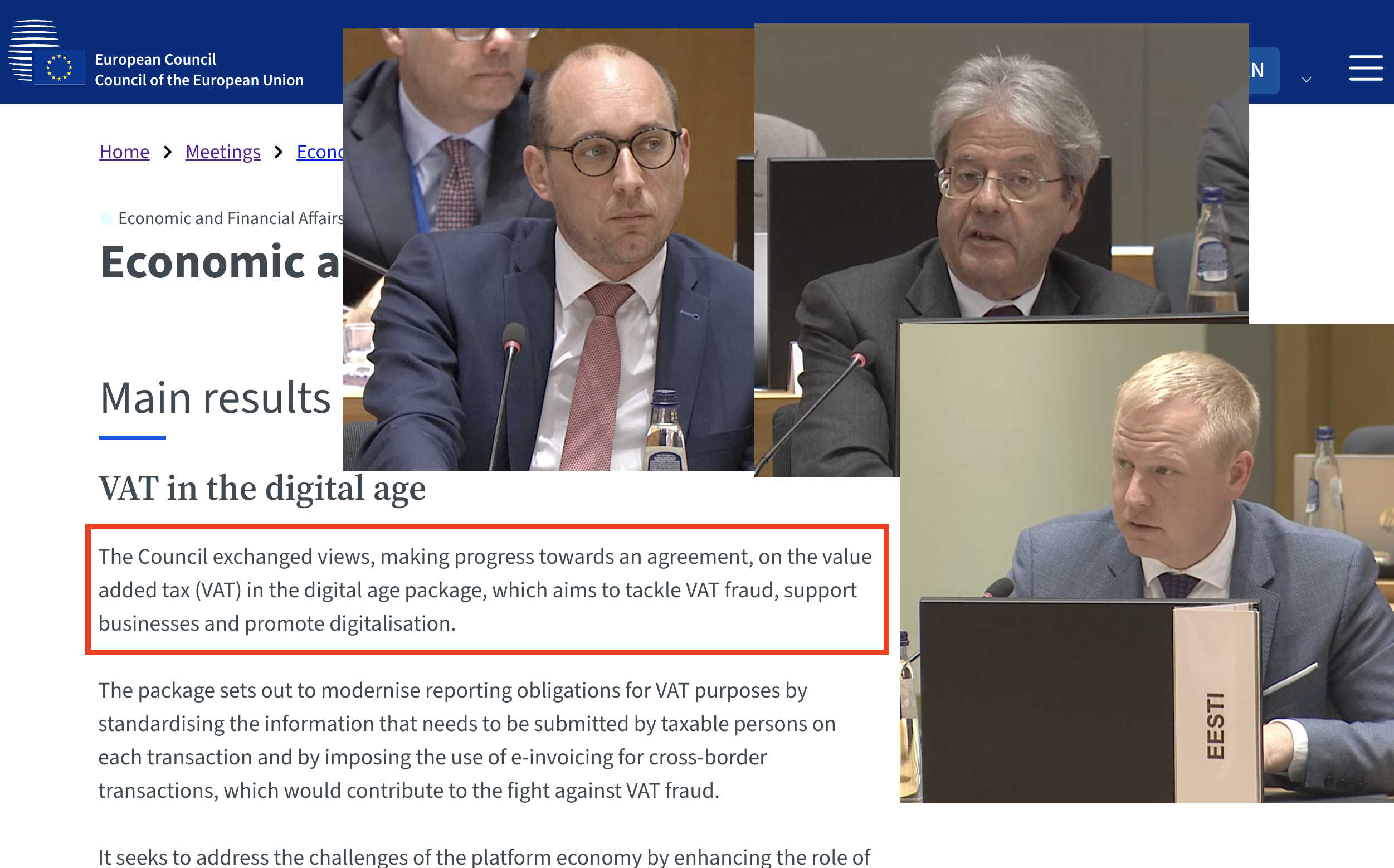
ECOFIN with ministers van Petheghem, Gentiloni, Võrklaev on ViDA (14.5.2024)
The “VAT in the Digital Age” (ViDA) package achieved unanimous agreement on Digital Reporting (DRR) and Single VAT registration but failed to be adopted due to Estonia’s concerns on tax rules for “deemed suppliers” in digital platforms.

As announced recently, the ECOFIN meeting on 14.5.2024 considered the three pillars of the VAT in the Digital Age (ViDA) for adoption as a whole. Participating ministers of finances exchanged views on each of the pillars, achieving overall progress towards agreement. In particular, the views on the pillars were

  • Digital Reporting Requirements (DRR) are agreed in the compromise text including a revised timeline as published before the meeting
  • Single VAT Registration is also agreed in the update compromise form
  • VAT Treatment of the Platform Economy contains a “Deemed Supplier regime” agreed by all members states except one and needs more work before unanimous agreement

From an e-Invoicing point of view, this means that the updates outlined in the published material are expected to remain largely unchanged and may serve as a preliminary basis for planning further activities. See European Council considering ViDA on 14.5.2024 for a quick overview and further pointers.

“Further work” needed

Estonian Finance Minister Mart Võrklaev stated the view that “further work” is needed to achieve an agreement on the “Deemed Suppliers regime” in the tax rules for the platform economy. European Commissioner Paolo Gentiloni emphasized the spirit of compromise and value of agreement to no immediate avail.

Belgian Finance Minister Vincent van Pethegem expressed confidence that with continued work on the remaining topic an agreeable compromise can still be reached for the entire ViDA package within the Belgian presidency in the first half of 2024. The opportunity arises on the next ECOFIN meeting, scheduled for 21.6.2024 (planned meeting agenda)

The so adopted then, the outlined texts solidify into a more reliable and concrete frame to current and related future activities in e-Invoicing. Until then, the suspense continues – although the target picture has quite clarified in the last week!


Get your Project Implemented

Gold Sponsor

Storecove
Our e-invoicing products enable customers to send and receive e-invoices globally, always in the correct format. Additionally, customers can achieve compliance with tax regulations in multiple countries, including Italy, Malaysia, Singapore, Romania, Poland, Portugal, Spain, India, and more.

With connections to 31 countries and growing, we are continuously adding more countries to enhance our e-invoicing solutions, striving for full global coverage and compliance with each country's tax regulations.

Advertisement

Latest News

Aerial view of Jerusalem, capital of Israel

Additional transactions covered by Israel’s e-invoicing mandate in 2026

Israel’s e-invoicing obligation is being implemented quicker than initially planed with two new phases on 2026, based on invoice amount.

Denmark’s Bookkeeping Act final stage and cancellation of OIOUBL 3.0

While uncertainty surrounds OIOUBL 3.0, the Bookkeeping Act is moving ahead and now enters its final rollout phase.

Webinar – What the 2029 UK mandate means for your business

Storecove's webinar will cover UK's e-invoicing requirements, how it will impact your organization, and how one API can simplify compliance.

A tense launch for Croatia’s e-invoicing mandate

Croatia made e-invoicing mandatory for B2G, B2B and B2C transactions just six months after the law passed, which is proving ambitious.

New exemption threshold and grace period for Malaysian small enterprises

In response to multiple concerns raised, the Malaysian Government has announced two key measures to ease the transition for small enterprises.

📩 ‎ Newsletter

Receive the latest e-invoicing news, directly in your mailbox, once a month.